
One Day in Zagreb: A Walking Itinerary
A self-guided one-day Zagreb walk: Ban Jelačić Square, Dolac market, the cathedral, the Upper Town, a Lower Town museum, and Tkalčićeva at dusk.
Updated · 8 min read
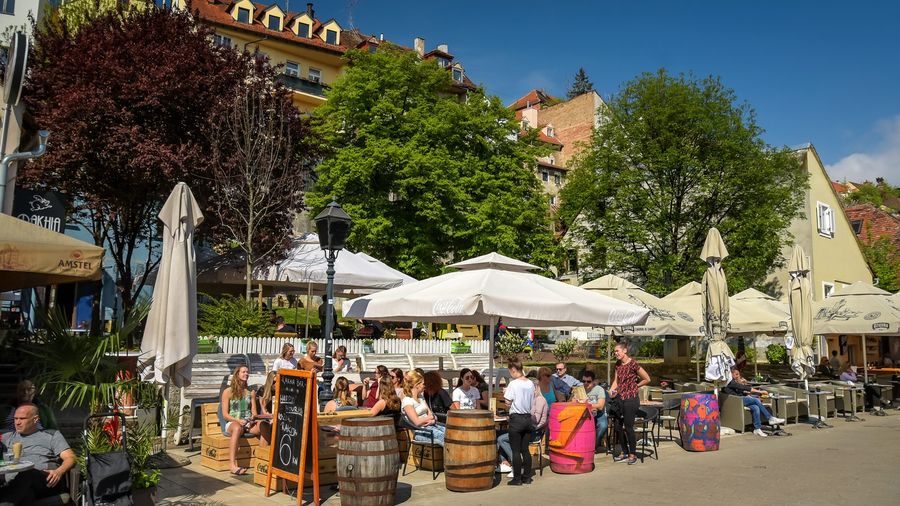
One day is enough to read the shape of Zagreb if you keep to the compact core: start on Ban Jelačić Square, climb through Dolac market to the cathedral, cross into the medieval Upper Town for St Mark's Church and the funicular, drop to one Lower Town museum in the afternoon, and end over coffee and dinner on Tkalčićeva. Nothing on this route is more than a ten-minute walk from the last stop.
Most travellers give Zagreb a single day on the way to Split or Dubrovnik, and a single day is genuinely workable here in a way it is not in bigger capitals. Croatia's inland capital packs its sights into two low hills and the boulevards below them, so a well-ordered day on foot takes in the medieval Upper Town, the earthquake-scarred cathedral, and the country's best-loved market.
This itinerary walks you through it hour by hour, with the café culture that is the real point of the place woven through. For the longer questions of when to come and how much to budget, pair it with our Zagreb trip planner.
How should you plan one day in Zagreb?
Walk a single loop that climbs from Ban Jelačić Square through Dolac and the cathedral into the Upper Town, then descends to the Lower Town museums and finishes on Tkalčićeva. Doing it clockwise keeps the uphill in the cool morning and leaves the café terraces for the golden end of the day.
The logic is geography. Zagreb's old core sits on two medieval hills — Kaptol, crowned by the cathedral, and Gradec, the Upper Town proper — with the main square and the museum-lined Lower Town spread on the flat below. Tackle the hills while you are fresh and the light is soft, then let gravity carry you down to the galleries and the coffee.
| Time | Stop |
|---|---|
| 9:00 | Ban Jelačić Square and morning coffee |
| 9:30 | Dolac market under the red parasols |
| 10:30 | Zagreb Cathedral on Kaptol |
| 11:30 | Funicular up to the Upper Town, St Mark's Church, Lotrščak Tower |
| 13:00 | Lunch on or near Tkalčićeva street |
| 14:30 | One Lower Town museum — the Museum of Broken Relationships or the Mimara |
| 17:00 | Zrinjevac and the Lower Town "green horseshoe" |
| 19:00 | Dinner and drinks back on Tkalčićeva |
Where should you begin the morning?
Start on Ban Jelačić Square, the city's central plaza and tram hub, with a coffee at one of its terraces before the day warms up. From there it is a two-minute climb to Dolac, the open-air farmers' market locals call the belly of Zagreb, at its freshest between seven and eleven.
Ban Jelačić Square is where every tram line and every local rendezvous converges, anchored by the equestrian statue of the 19th-century governor it is named for. Order a coffee and watch the morning commute — the unhurried café ritual is as much a Zagreb sight as any monument.
Then climb the short flight of steps to Dolac market. Trading daily since 1930, its upper terrace is a grid of raised stone tables under hundreds of matching red parasols, with a covered hall of cheese, meat, and fish below. Buy a handful of cherries or a wedge of škripavac cheese for later, and photograph the parasols with the cathedral spires rising behind.
How do you spend the late morning?
Continue uphill from Dolac to Zagreb Cathedral on Kaptol, Croatia's tallest building at about 108 metres, free to enter even mid-restoration. Give it half an hour inside before crossing to the neighbouring Gradec hill and the medieval Upper Town.
The cathedral is a two-minute walk above the market, so the market and the mother church of Croatian Catholicism fold into one stretch. A magnitude-5.5 earthquake sheared the top off the south spire in 2020, so you will likely see the towers wrapped in scaffolding — but the interior stays open, with the tomb of Cardinal Stepinac behind the high altar and a rare glagolitic inscription on the north wall. It anchors the morning of this itinerary; linger only as long as the light and your interest hold.
From Kaptol, cross the old boundary onto Gradec, the second of Zagreb's founding hills, where the lanes narrow and the traffic falls away into a quiet medieval quarter.
What makes the Upper Town worth the climb?
The Upper Town (Gornji Grad) is Zagreb's postcard: the tile-roofed St Mark's Church, the Lotrščak Tower with its noon cannon and view terrace, and the 66-second Uspinjača funicular, one of the world's shortest. Ride the funicular up and walk back down to save your legs for the afternoon.
Catch the Uspinjača funicular from Tomićeva street off Ilica — a 66-second, under-a-euro ride that locals still use daily. At the top, the Lotrščak Tower fires its Grič cannon at noon, a tradition kept since the 1870s, and its terrace looks out over the Lower Town rooftops toward the cathedral.
A short walk inland brings you to St Mark's Square, flanked by the Croatian Parliament (Sabor) and the Banski dvori government palace. Between them stands the small medieval St Mark's Church, its 1880 glazed roof displaying the coats of arms of Croatia, Dalmatia, and Slavonia beside the city emblem — the image most often mistaken for the cathedral on postcards.
Which single museum should you choose?
With one afternoon you have time for one collection, so choose by mood: the Museum of Broken Relationships for something unlike any museum anywhere, or the eclectic Mimara for Old Masters and Asian art. Both sit a short walk from the Upper Town stairs.
Zagreb crams more than thirty museums into its centre, which is exactly why a single day forces a decision. The Museum of Broken Relationships, founded here in 2006 and awarded the Kenneth Hudson Prize for Europe's most daring museum in 2011, fills a Baroque Upper Town palace with donated objects from ended love affairs, each carrying an anonymous story — oddly moving and genuinely original.
If your taste runs to fine art instead, the Mimara Museum on the Lower Town's Roosevelt Square holds a sprawling private collection of Old Masters, glass, and Asian art. Either way, resist the urge to squeeze in a second; the pleasure of a short museum visit is leaving with energy to spare.
How should the day wind down?
End where Zagreb is happiest: stroll the Lower Town's leafy "green horseshoe" of parks, then settle onto Tkalčićeva street for dinner and a drink as the terraces fill. This café-lined lane running between the two hills is the social heart of the capital from morning to midnight.
Drop down into the Lower Town (Donji Grad) and its Lenuci horseshoe of garden squares — Zrinjevac, with its music pavilion and plane trees, is the loveliest, especially under early-evening light. The Art Nouveau facades along the way are Zagreb's quiet counterpoint to the medieval hills above.
Then make for Tkalčićeva, the pedestrian strip in the valley between Gradec and Kaptol, lined end to end with cafés, rakija bars, and casual restaurants. Try štrukli — Zagreb's baked cheese pastry — and watch the street fill. It is the fitting last image of a city whose appeal is less a single monument than the way its people live in public.
What if you have only half a day?
Compress the route to its spine: Ban Jelačić Square, Dolac, the cathedral, and the funicular up to St Mark's and the Lotrščak terrace, finishing with a coffee on Tkalčićeva. That covers the essential Zagreb in three to four hours and skips only the museums.
A cruise stopover, a long layover, or a train connection still leaves time for the city's shape. Keep to the uphill loop from the main square through the market to the cathedral and the Upper Town, and you will have seen the two hills, the market, and the café street — the things that make Zagreb itself. Save the museums and the Plitvice Lakes day trip for a return visit, which, as our trip planner argues, the capital tends to earn.
A few logistics make the day smoother. Everything here is walkable, so you will barely need the trams; Dolac is liveliest before 11 AM and winds down by early afternoon, so do it first; and the cathedral reserves Sunday mornings for mass, so a Sunday plan is better started in the Upper Town and looped back to Kaptol after one.
Save One Day in Zagreb: A Walking Itinerary
Save One Day in Zagreb: A Walking Itinerary to your free account
Sign in or create a free account to keep this place in Saved places and add it to your trips.
Frequently Asked Questions
Can you see Zagreb in one day?
Yes, comfortably, because the historic core is small and walkable. One unhurried day covers Ban Jelačić Square, Dolac market, the cathedral, the Upper Town with St Mark's Church, and one Lower Town museum, with coffee on Tkalčićeva to finish. You will skip the second and third museums and any day trip, but you will understand the shape of the city.
Is one day in Zagreb enough?
It is enough for the capital's highlights but not for its depth. A single day works well as a stopover between the coast and Central Europe, or as the city portion of a longer Croatian trip. If museums are your reason to come — Zagreb has more than thirty — give it two days so you are not forced to choose only one collection.
What is the best area to stay for one day in Zagreb?
Base yourself around Ban Jelačić Square or the Lower Town (Donji Grad) within a few minutes' walk of it. Everything on a one-day plan radiates from that central square, so you can start on foot without a tram, drop bags between the morning and evening, and reach the main train and bus connections easily when you leave.
Do you need to book anything in advance for one day in Zagreb?
Almost nothing. The cathedral and Dolac are free and need no ticket, and museum entries are inexpensive and rarely sell out. The one thing worth reserving is a late-morning free walking tour from Ban Jelačić Square if you want the history narrated, and a dinner table on Tkalčićeva in summer or during the December Advent market.