
Spiritual Significance
Zagreb Cathedral is the mother church of the Archdiocese of Zagreb and the spiritual centre of Croatian Catholicism, a faith woven deeply into the country's national identity. For more than nine centuries it has been the seat of the city's bishops and archbishops, hosting coronation-era ceremonies, royal and state funerals, and the great feasts of the liturgical year. Its most powerful focus of devotion is the tomb of Cardinal Alojzije Stepinac, beatified by Pope John Paul II in 1998; the faithful leave flowers and candles there year-round, and his cause for sainthood keeps the cathedral at the heart of Croatian religious life. The Assumption of Mary on 15 August is the cathedral's patronal feast and one of its most significant celebrations.
Visitor Etiquette
Treat the cathedral as a living house of worship. Enter quietly, keep conversation to a murmur, and silence your phone. Modest dress is required: cover shoulders and avoid very short skirts or shorts. Photography is generally permitted without flash, but never during mass and never pointed at people in prayer; tripods are not allowed. If a service is underway, either join respectfully from the back or wait until it ends rather than wandering the aisles. Refrain from eating, drinking, or entering the sanctuary and altar areas. Donations for the restoration are appreciated, and lighting a candle is welcome — follow the posted instructions and use the trays provided.
Zagreb Cathedral timeline
-
Diocese founded
King Ladislaus establishes the Zagreb bishopric on Kaptol hill, and the first cathedral is begun beside the new bishop's seat.
-
First cathedral consecrated
The original Romanesque cathedral is dedicated in the presence of King Andrew II before he departs on the Fifth Crusade.
-
Mongol invasion
A Tatar raid wrecks the early cathedral, forcing a Gothic rebuilding that stretches across the following centuries.
-
Renaissance walls raised
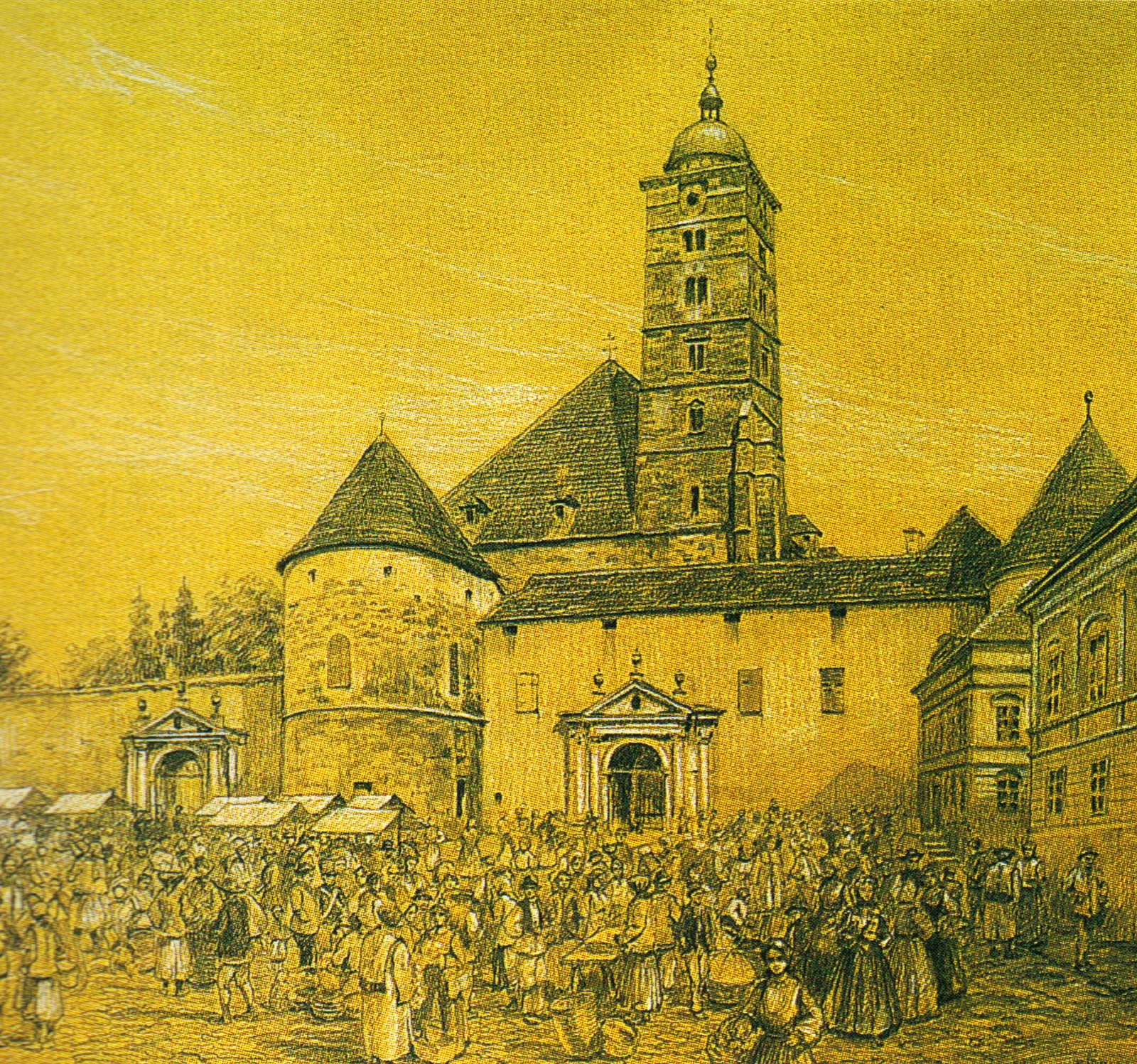
Ramparts and round towers are thrown up around the cathedral to guard Kaptol against the advancing Ottoman threat; their remnants still flank the approach.
-
Great earthquake
A violent earthquake devastates the medieval cathedral and topples its bell tower, prompting a complete reimagining of the building.
-
Neo-Gothic spires completed
Hermann Bollé crowns the west front with the twin openwork spires, rising about 108 metres and making the cathedral the tallest building in Croatia.
-
South spire falls again
A magnitude-5.5 earthquake shears the top off the south spire; a stone-by-stone restoration of both towers continues today.
Zagreb Cathedral in Pictures
When to Visit
The cathedral is generally open to visitors Monday to Saturday, roughly 10 AM to 5 PM, and on Sundays from about 1 PM (mornings are reserved for mass). Hours shift with the liturgical calendar and with the ongoing restoration, so check the noticeboard at the entrance. Mass times typically include early morning and evening services on weekdays and several on Sundays — attending one is the most atmospheric way to experience the space. Avoid arriving during a service if you only want to sightsee, as movement is restricted. A focused interior visit takes 30–45 minutes; mornings offer the best light through the eastern windows and the quietest atmosphere before tour groups arrive.
Admission and Costs
Entry to Zagreb Cathedral is free, as it remains an active place of worship rather than a ticketed monument. There is no charge to view the interior, attend mass, or photograph the building from the square. Donations toward the earthquake restoration fund are welcomed and can be left in boxes near the entrance — even a few euros is appreciated given the scale of the rebuilding. If you join a guided Kaptol or Upper Town walking tour that includes the cathedral, expect to pay roughly €15–25 (about $16–27) per person for a small group, or €90–150 (about $97–162) for a private half-day guide covering the wider old town.
The Case for a Guide
The cathedral can be appreciated on your own, but a knowledgeable Zagreb guide turns a quick look into a layered story of the city's religious and political history.
- Decoding the layers: A guide separates the medieval Gothic core from Bollé's 19th-century neo-Gothic reconstruction and the fragments of Renaissance fortification — distinctions most visitors never notice
- The Stepinac story: The tomb of Cardinal Stepinac carries enormous and divisive meaning in Croatian history; a guide can explain his beatification, his wartime role, and why pilgrims still come
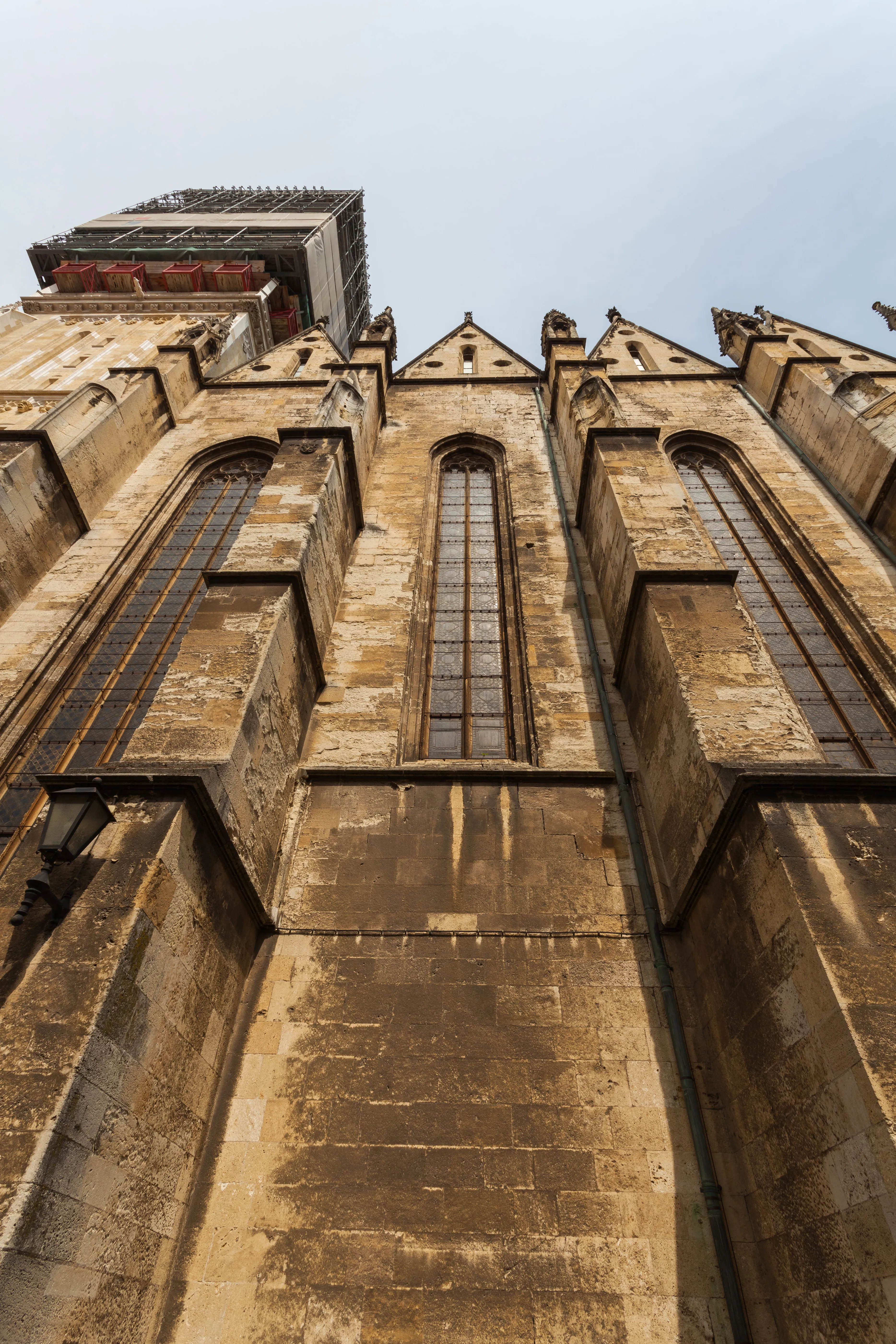
- The 2020 earthquake: Standing before the scaffolded spires, a guide can describe what fell, how the restoration works, and what the rebuilt towers will look like
- Reading the glagolitic inscription: The ancient Croatian script on the north wall is easy to miss and impossible to interpret without context
- Connecting Kaptol and Gradec: A guide places the cathedral within the rivalry of Zagreb's two founding hills and the streets that still mark the old boundary
Tips for Visitors
Dress respectfully: As an active cathedral, shoulders and knees should be covered; quiet voices and switched-off phones are expected inside. Go early: Arriving close to opening means cooler light, fewer groups, and a calmer interior. Combine with the market: Dolac is a two-minute walk downhill, busiest before noon, so do the market first and the cathedral after. Look up and around the square: The golden Marian column and the surviving fortification towers are easy to overlook in the rush to enter. Pick your viewpoint: Scaffolding limits some exterior angles, so choose where to shoot from. The classic clean frames are from Dolac's upper terrace and the Kaptol forecourt directly beneath the spires. For the towers rising above the rooftops, try the Strossmayer Promenade or the Lotrščak Tower terrace across the valley in the Upper Town, while the Zagreb 360° deck on Ilica looks straight over Ban Jelačić Square toward Kaptol.
Frequently Asked Questions
Is Zagreb Cathedral open during the restoration, and why are its spires covered in scaffolding?
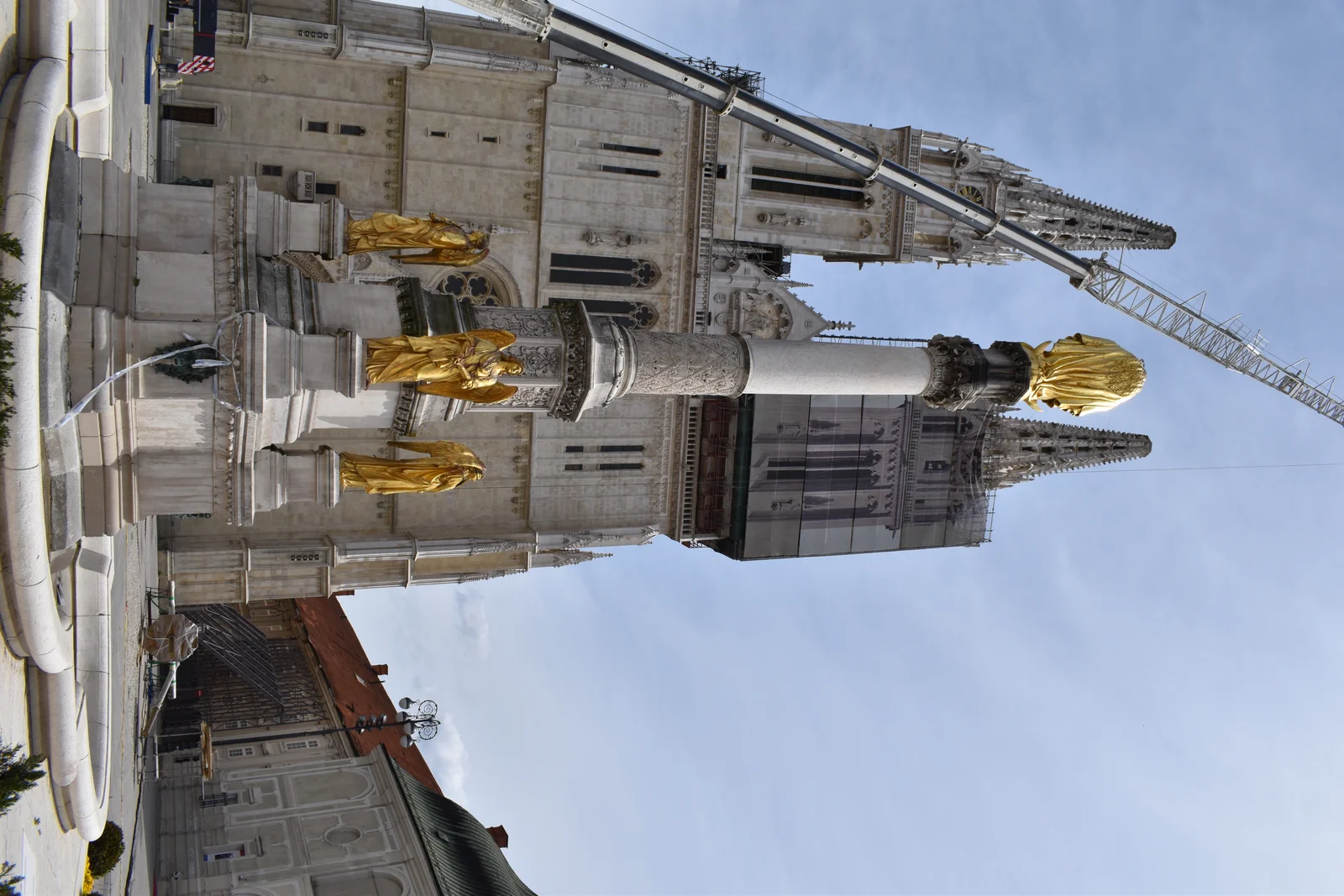
A powerful 5.5-magnitude earthquake struck Zagreb on 22 March 2020 and snapped the top of the south spire, which crashed onto the cathedral roof. Both towers were declared unstable, and a long restoration began that includes dismantling and rebuilding the upper sections stone by stone. For much of the 2020s the cathedral has stood wrapped in scaffolding and cranes — an unusual but historically significant sight. Crucially, though, the cathedral stays open to visitors throughout the works: the interior was repaired and reopened for worship while the exterior remained a building site, so you can still walk the nave, see the tomb of Cardinal Stepinac, and attend mass free of charge. What the restoration limits is the detail — the treasury is closed, the odd chapel is screened off, and a brief closure can fall during a structural phase, so check the noticeboard on Kaptol square. There is no fixed date for the spires to reopen scaffolding-free; the stone-by-stone rebuilding is expected to run well into the second half of the 2020s, so plan to see the towers wrapped rather than bare on most visits.
How tall is Zagreb Cathedral, and can you climb the spires?
At roughly 108 metres, Zagreb Cathedral is the tallest building in Croatia — its twin neo-Gothic spires stand higher than anything else in the country and are visible from across the city and even from the slopes of Medvednica mountain. That height is comparatively young: Hermann Bollé's openwork spires reached about 108 metres when they were completed in 1906, and the 22 March 2020 earthquake sheared the top off the south tower, which the ongoing restoration is rebuilding to its original profile. Inside, the nave climbs around 46 metres to the vaulting and runs some 77 metres to the apse. Despite that monumental scale it sits on the compact Kaptol hill rather than a vast open plaza, so it feels intimate as you approach on foot through the narrow streets of the old ecclesiastical quarter. The spires themselves cannot be climbed — they were built as ornament rather than viewing galleries, and the earthquake restoration would rule out any ascent regardless — so visitors take in the height from the Kaptol forecourt below, or gain a viewpoint instead at the nearby Lotrščak Tower in the Upper Town, whose public terrace looks out over the rooftops of the historic centre.
How old is Zagreb Cathedral, and when was it built?
Christian worship has crowned Kaptol since the Zagreb bishopric was founded in 1094, but the cathedral you see today is far younger than that millennium of history suggests. The first Romanesque cathedral was consecrated in 1217 and then wrecked by a Mongol raid in 1242; the Gothic church that replaced it was reworked over the following centuries and ringed with Renaissance walls against the Ottoman threat. The building's defining feature — its twin neo-Gothic spires — is barely a century old: after a catastrophic earthquake in 1880 the architect Hermann Bollé rebuilt the west front, completing the roughly 108-metre towers in 1906. So while the site's religious life spans more than nine centuries, the silhouette that symbolises Zagreb today dates only to the turn of the twentieth century.
What is Zagreb Cathedral called, and who is it dedicated to?
The great cathedral of Zagreb carries a formal name most visitors never hear: the Cathedral of the Assumption of the Blessed Virgin Mary, dedicated jointly to the Virgin Mary and the sainted kings Stephen and Ladislaus. In Croatian it is the Zagrebačka katedrala, and because it crowns the Kaptol hill it is sometimes simply called the cathedral on Kaptol. What makes it a cathedral rather than an ordinary parish church is its role as the seat (cathedra) of the Archbishop of Zagreb, and its Marian dedication is why the building's patronal feast falls on the Assumption, 15 August.
Is Zagreb Cathedral the same as St Mark's Church with the colourful tiled roof?
No — these are two different churches on two different hills, and the mix-up is one of the most common in the city. Zagreb Cathedral is the tall, twin-spired neo-Gothic building on the Kaptol hill, its roughly 108-metre towers making it the tallest structure in Croatia and the seat of the archbishop. The church with the famous glazed, multicoloured tiled roof — the one whose photograph is so often mistaken for the cathedral on postcards — is St Mark's Church (crkva svetog Marka), a small medieval parish church on St Mark's Square in the Upper Town (Gornji Grad), a short walk uphill across the old boundary onto the neighbouring Gradec hill. That roof, laid in 1880, displays the coats of arms of the Triune Kingdom of Croatia, Dalmatia, and Slavonia beside the emblem of the city of Zagreb. If you have come for the towering cathedral, head for Kaptol just above Dolac Market; if you want the tiled roof, continue up into Gornji Grad. Most visitors happily see both in a single morning.
What should I look for inside the cathedral besides the architecture?
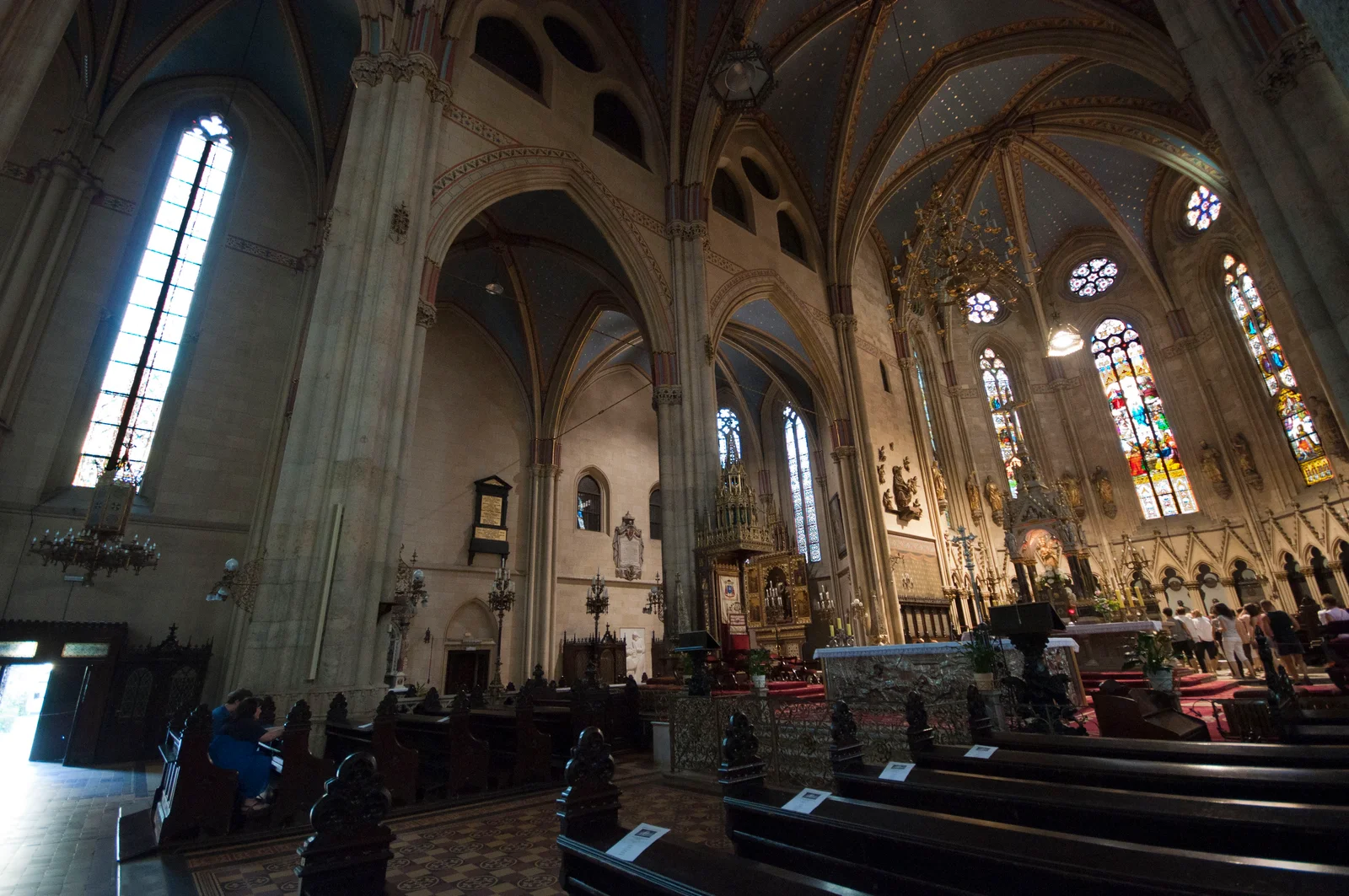
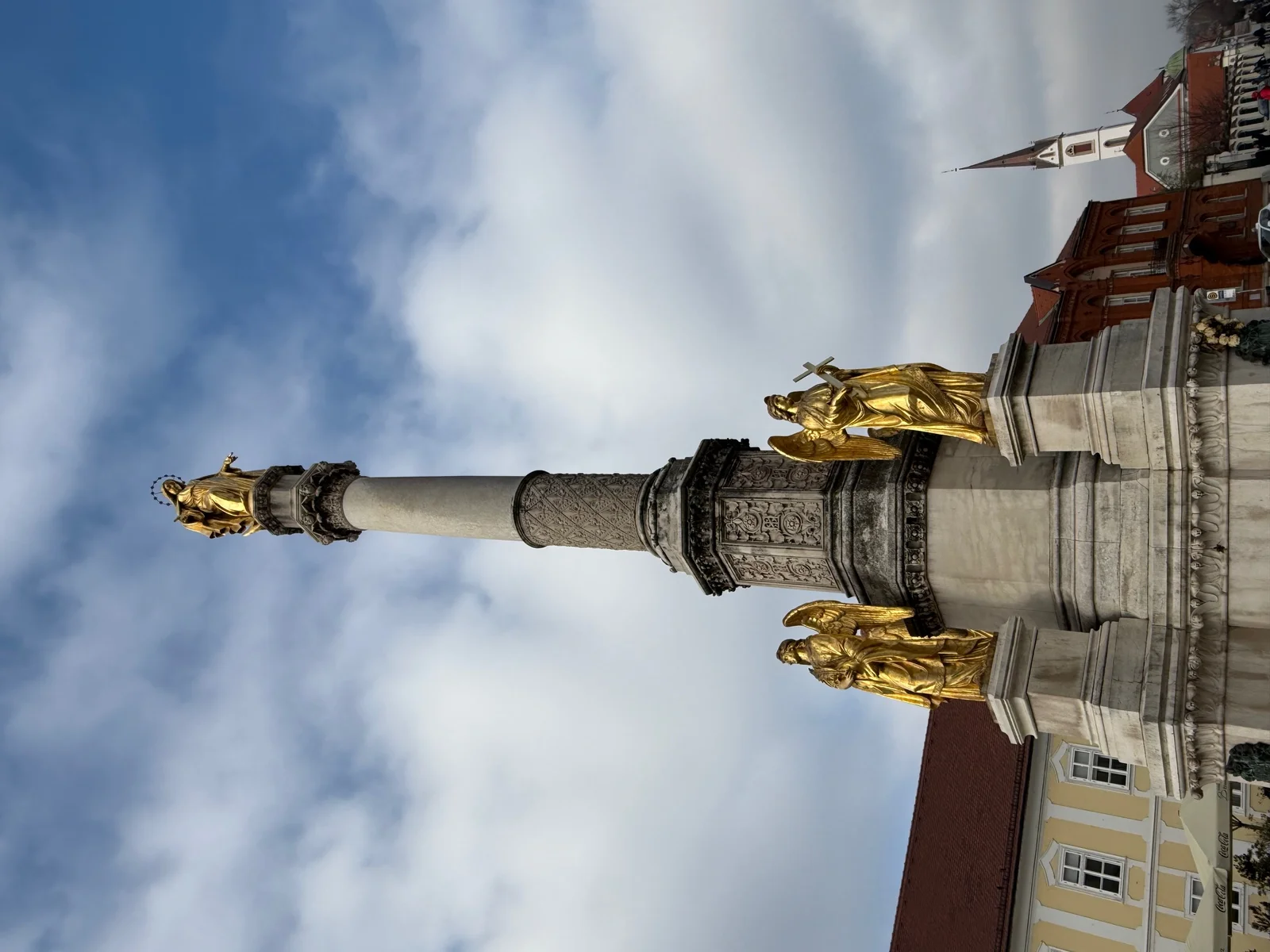
Several treasures reward a slow look. The glagolitic inscription on the north wall, written in the ancient Croatian script, is one of the oldest of its kind. The tomb of Cardinal Alojzije Stepinac, a deeply venerated and controversial 20th-century figure, lies behind the main altar and draws steady streams of the faithful. There is a neo-Gothic high altar, Renaissance pews, and a Baroque marble pulpit. Outside, the gilded column of the Virgin Mary with four angels stands in front of the main entrance. Kaptol also guards one of the richest church treasuries (riznica) in this part of Europe — gold and silver chalices, jewelled reliquaries, embroidered vestments, and illuminated manuscripts, some reaching back to the eleventh century — though this is a separate collection whose public access has always been limited and is tighter still during the earthquake restoration, so ask at the cathedral whether it can be seen.
Who is buried inside Zagreb Cathedral?
The one grave that draws visitors deep into the cathedral is the tomb of Cardinal Alojzije Stepinac (1898–1960), the wartime Archbishop of Zagreb, whose sarcophagus lies behind the high altar beneath a relief carved by Ivan Meštrović, Croatia's most celebrated modern sculptor, who made it from his exile in the United States. Stepinac is among the most venerated — and most fiercely debated — figures in the country's twentieth century: jailed by the communist authorities after the Second World War and beatified by Pope John Paul II in 1998, he still draws a quiet stream of pilgrims who leave candles and flowers at the tomb, and his open cause for canonisation keeps this the emotional heart of the building. He is not the only churchman laid to rest on Kaptol, where generations of Zagreb's bishops and canons were interred in and around the medieval cathedral over the centuries, but most later archbishops lie instead in the arcaded Mirogoj cemetery that Hermann Bollé laid out on the city's northern edge — which is why Stepinac's is the grave nearly everyone comes to find. Approach it as the faithful do, quietly, and look up at the Meštrović relief above it before moving on.
What are Zagreb Cathedral's opening hours and mass times?
Outside of services the cathedral is generally open to visitors Monday to Saturday from about 10 AM to 5 PM, and on Sundays only from around 1 PM, since Sunday mornings are reserved for mass. Entry is free. As the seat of the Archdiocese of Zagreb it also holds daily mass — typically an early-morning and an evening service on weekdays, with several masses on Sundays and holy days, including the main late-morning capitular (chapter) mass. Both the visiting hours and the mass times flex with the liturgical calendar and with the ongoing earthquake restoration, so the noticeboard just inside the main door on Kaptol square always carries the current schedule. Attending a service is free and by far the most atmospheric way to experience the nave, but if you have come only to sightsee, avoid arriving mid-mass: movement through the aisles is restricted while worship is under way. Aim instead for a weekday mid-morning for the calmest interior and the best light through the eastern windows, before the day's tour groups arrive.
Is Zagreb Cathedral worth visiting?
For most visitors it is an easy yes, and it costs nothing to enter. Even mid-restoration, with one spire still wrapped in scaffolding, the roughly 108-metre neo-Gothic west front is the tallest structure in Croatia and the defining image of the Zagreb skyline, while the interior rewards the short climb up Kaptol with the tomb of Cardinal Stepinac, a rare glagolitic inscription, and Renaissance choir stalls. Skip it only if a scaffolding-free facade is essential to your photographs or your time in the city is very tight — otherwise a 30–45-minute stop, ideally paired with the neighbouring Dolac Market, is one of the simplest highlights in the capital.
How do you get to Zagreb Cathedral?
The cathedral stands at Kaptol 31, 10000 Zagreb, crowning the Kaptol hill a two-minute walk uphill from Ban Jelačić Square, the city's central tram hub, so most visitors simply arrive on foot after climbing past Dolac Market. ZET trams 6, 11, and 12 all stop at or beside Ban Jelačić Square. There is no dedicated visitor car park on Kaptol and the surrounding streets are tightly restricted, so driving is discouraged — the compact old town is built to be explored on foot.