
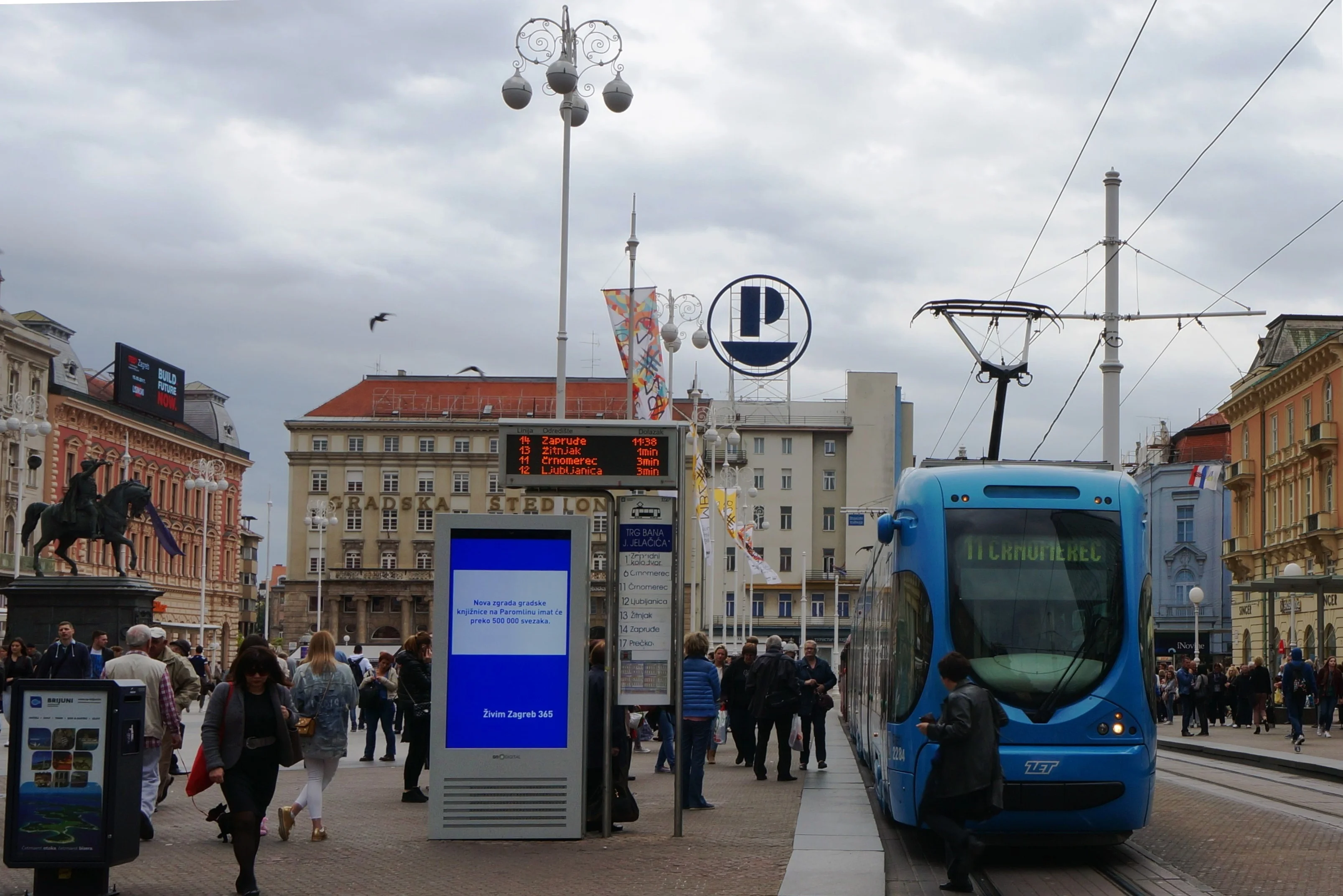
Landmarks Along the Route
The square is a compass for central Zagreb. At its centre is Fernkorn's equestrian statue of Ban Jelačić; at the eastern end, the Manduševac fountain. The north side carries the well-known public clock that serves as the city's meeting point, set among a parade of historicist and Secessionist facades.
From the square's corners, short walks fan out to the capital's highlights: two minutes uphill to Dolac Market and, just above it, Zagreb Cathedral on Kaptol; a few steps west to the foot of the Uspinjača funicular for the Upper Town, St Mark's Church, and the Lotrščak Tower; and south into the shopping streets and the green Lower Town promenade.
Photo Spots
The classic shot frames the equestrian statue against the façade wall with a blue ZET tram crossing the foreground — the image that says "Zagreb" at a glance. Stand on the southern side in late afternoon for warm light on the statue and the buildings behind.
For a sense of scale, shoot from the raised steps toward Dolac Market looking back down over the square and its trams. The Manduševac fountain makes a quieter detail shot, especially lit at dusk. In December, the Advent lights and stalls turn the whole square into the city's best night-time photograph, with the statue rising out of the festive crowd.
When to Visit
The square is an open public space, free and accessible at all hours, and there is no "visit" to time — but the mood changes through the day. Mornings bring commuters and the bustle of trams; late afternoon and early evening fill the café terraces along the edges with the locals' špica ritual of coffee and people-watching.
Allow 15–20 minutes to take in the statue, the Manduševac, and the facades, more if you pause for coffee. The square is loveliest under December's Advent lights, when stalls, music, and crowds transform it, and during the warm months when the terraces spill outdoors. It works equally as a first orientation stop or a last coffee before the train.
Admission and Costs
There is no cost to enjoy Ban Jelačić Square; it is the free, open heart of the city. The only money you are likely to spend is a ZET tram fare (a single ride is a couple of euros) to reach it, or the price of a coffee on one of the surrounding terraces, where an espresso runs about €1.50–2.50 (around $2–3).
Most free walking tours of Zagreb assemble here before heading up to the Upper Town, tip-based with €10–12 conventional. A private half-day guide covering the square and the old town runs the usual €90–150 (about $97–162) for a small group.
The Case for a Guide
You can take in the square alone, but a Zagreb guide unpacks the history packed into it.
- The Jelačić story: A guide explains the 1848 revolutions, why the statue was removed in 1947, and what its 1990 return meant for independent Croatia
- The naming legend: Standing at the Manduševac, a guide tells the Manda story and separates the folk etymology from the documented history
- Reading the facades: The buildings ringing the square span historicist, Secessionist, and modern styles; a guide points out the best
- Orientation: A guide uses the square to map the whole city — Upper Town, Lower Town, Dolac, the cathedral — before you set off
- Living traditions: From the špica coffee ritual to the Advent market, a guide explains how the square still works as the city's social stage
Tips for Visitors
Use it as your base: Nearly every tram passes through, so plan your days to start and end here. Meet "under the clock": The clock on the square's north side is the city's classic rendezvous point — locals also say "under the tail", meaning the statue's horse. Climb to Dolac first thing: The market is two minutes uphill and best before 11 AM.
Come back for the terraces: Late-afternoon coffee on the square is a genuine local ritual, not a tourist trap. Visit in December: The Advent market makes the square magical, but expect crowds. Toss a coin in the Manduševac: It is the small, time-honoured Zagreb thing to do before you leave.
Frequently Asked Questions
Who is the man on the horse in Ban Jelačić Square?
The equestrian statue is Ban Josip Jelačić (1801–1859), the 19th-century viceroy (ban) of Croatia and a national hero who led Croatian forces during the revolutions of 1848. The bronze, by the Viennese sculptor Anton Dominik Fernkorn, was unveiled in 1866 and gives the square its name.
It has a turbulent story. Under socialist Yugoslavia the statue was seen as a nationalist symbol and removed in 1947; the square was renamed Republic Square. With Croatian independence it was restored to the square in 1990, repositioned so the sabre now points south. For many Zagrebčani its return is bound up with the story of the country's independence.
What is the Manduševac fountain, and how is it linked to Zagreb's name?
At the eastern end of the square bubbles the Manduševac, a restored spring and fountain marking the old water source around which the settlement grew. Legend says a girl named Manda was asked by a thirsty knight to scoop him water — "Mando dušo, zagrabi!" ("Manda, dear, scoop!") — and from that zagrabi came the name Zagreb.
It is a folk etymology rather than hard history, but the fountain is where locals tell it, and tossing a coin into the Manduševac is a small Zagreb tradition. The spring was covered over for a century and restored to the square in 1987.