
Getting Around Hong Kong: A Practical Transport Guide
How to navigate Hong Kong — the MTR and Octopus card, double-decker trams, the Star Ferry, buses and taxis, the Airport Express, plus timing and budget tips.
Read the full guideUpdated · 14 min read
Getting around Hong Kong comes down to one rechargeable Octopus card and a transport network that packs the MTR metro, double-decker trams, the harbour-crossing Star Ferry, buses, and ferries to outlying islands into a compact, vertical city. The MTR reaches almost every sight quickly and cheaply, the ferries and trams turn transit itself into sightseeing, and taxis fill the late-night gaps. Buy an Octopus card on arrival and the whole territory opens up for a few dollars a ride.
Hong Kong is one of the easiest major Asian cities to navigate, and it is a place where the journey is often part of the attraction. This Special Administrative Region of China crams roughly 7.5 million people onto a sliver of the mainland and a scatter of steep islands, and to knit that dense, mountainous geography together it has built a transport system that is fast, spotlessly clean, and unusually legible to visitors. English is widely used on signage and by staff, fares are low, and a single tap-and-go card handles nearly everything. This guide walks through the MTR, the Octopus card, the trams and ferries, buses and taxis, airport transfers, and the day-planning quirks that separate a smooth trip from a frustrating one.
How does the Hong Kong MTR work?
The MTR is the backbone of getting around Hong Kong — a fast, air-conditioned metro of roughly a dozen colour-coded lines and around 100 stations that reaches Hong Kong Island, Kowloon, the New Territories, and Lantau. Trains run from about 6 AM to past midnight, arrive every few minutes, and are among the most punctual in the world. Fares are distance-based and start around HK$5, and every station is bilingual with lettered exits.
The Mass Transit Railway opened in 1979 and has grown into the tool you will lean on most. Its lines are known by colour and name rather than number — the Island Line runs east–west along the north shore of Hong Kong Island through Central and Causeway Bay; the Tsuen Wan Line dives under Victoria Harbour to link Central with the Kowloon districts of Tsim Sha Tsui and Mong Kok; and the Tung Chung Line and Airport Express strike out toward Lantau Island. Where two lines meet, the cross-platform interchanges are designed so that a connecting train often waits on the opposite side of the same platform.
A few practical points make the MTR painless:
- Fares are distance-based, typically HK$5–15 (about US$0.65–2) for the trips a visitor makes, and you save a little on every journey by paying with an Octopus card rather than a single-ride ticket.
- Signage is fully bilingual, lines are colour-coded, and station exits are lettered (A, B, C…) and posted with a list of the streets and landmarks each one surfaces beside — check the exit board before you climb the stairs.
- Trains are frequent and punctual, arriving every two to four minutes at peak times, so there is no need to consult a timetable.
- Eating and drinking are prohibited in the paid area and on trains, and the rule is enforced with fines; finish your bubble tea before you tap in.
What is the Octopus card and do you need one?
The Octopus card is Hong Kong's rechargeable tap-to-pay card, and it is the single most useful thing you can carry. Introduced in 1997, it works on the MTR, buses, trams, ferries, and minibuses, and at convenience stores, bakeries, and vending machines. A tourist On-Loan Octopus costs HK$150 — HK$50 as a refundable deposit and HK$100 of usable value — from any MTR station or the airport.
For decades the Octopus card has been the thing every Hong Kong resident taps dozens of times a day, and it remains the simplest option for a visitor. Buy one the moment you land: the On-Loan Octopus for adults sells for HK$150, of which HK$100 is immediately spendable and HK$50 is a deposit you get back (minus a small handling fee if you return it within three months) when you hand the card in at a station service desk. Top it up in cash at any MTR add-value machine or convenience-store counter.
You are not locked into the physical card. Contactless Visa and Mastercard now work at MTR gates and on many buses, and the mobile Octopus app lets you add a card to an iPhone or Android wallet and reload it from an overseas bank card. Whichever route you pick, the goal is the same — avoid single-ride paper tickets, which cost more and mean queuing at a machine before every trip. Keep a little credit in reserve so a top-up line never strands you at a turnstile.
Should you ride the trams and the Star Ferry?
Absolutely — on Hong Kong Island the double-decker trams and the harbour-crossing Star Ferry are transport and sightseeing in one, and both are astonishingly cheap. The trams have trundled along the island's north shore since 1904 for a flat fare of about HK$3, while the Star Ferry has crossed Victoria Harbour since 1888 for under HK$6. Grab an open upper-deck seat on either and the city unspools past you.
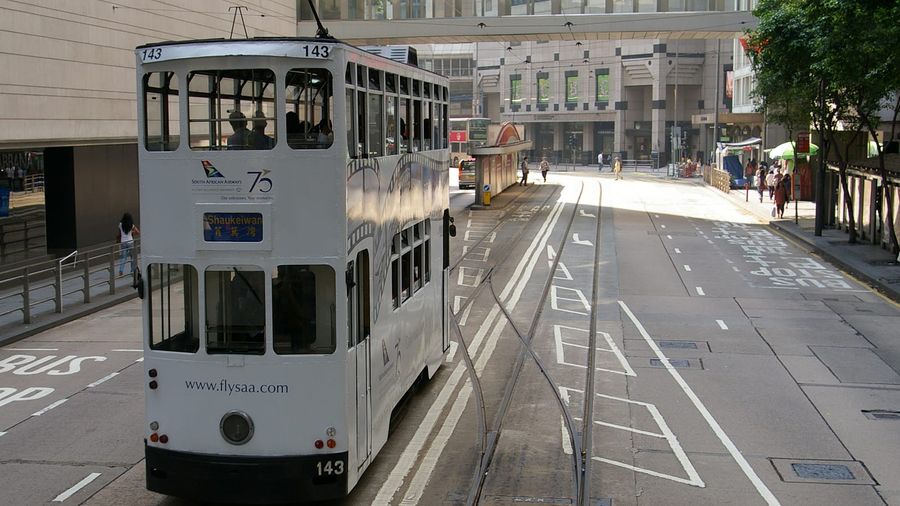
The trams — universally nicknamed "ding ding" for their bell — are the narrow, top-heavy double-deckers you see threading through Central, Wan Chai, and Causeway Bay, the same ones pictured above at a Des Voeux Road stop. You board at the rear, ride as far as you like, and tap your Octopus at the front as you step off, paying the same flat HK$3 whether you go one stop or the length of the line. Climb to the front of the upper deck for a slow, cinematic street-level tour of the island for less than the price of a coffee.
The Star Ferry is the other unmissable ride: a seven-minute crossing between Central (or Wan Chai) and Tsim Sha Tsui that National Geographic Traveler once named one of the world's most rewarding journeys. The green-and-white boats have run continuously since 1888, and the upper-deck fare of a few Hong Kong dollars buys the finest cheap view in the city — the wall of skyscrapers rising straight from the water. Ferries also fan out from the Central piers to the outlying islands of Lamma, Cheung Chau, and Lantau, turning a half-day beach or hiking escape into a scenic voyage of its own.
How do you use Hong Kong's buses and minibuses?
Buses reach the hilltops, the south side of the island, and the outlying corners the MTR misses, and the front seats of an air-conditioned double-decker offer a grandstand view. Fares run roughly HK$4–12, paid by Octopus as you board, and you must press the bell for your stop. The green and red minibuses are faster and more local, but their routes and stop announcements assume some familiarity, so lean on a mapping app.
Franchised double-decker buses cover the whole territory, and they come into their own for journeys the rail network handles poorly — up to Victoria Peak via the winding Peak Road, over to the beaches of Repulse Bay and Stanley on the island's south side, or out along the Kowloon waterfront. Tap your Octopus against the reader beside the driver as you board (there is no tap-off), and watch the on-board screen or your phone for the stop before yours, then press the bell.
The minibuses (or "public light buses") are the 19-seat vans that dart through the city. Green minibuses run fixed routes at fixed fares and accept Octopus; red minibuses are more freewheeling, negotiate their own routes, and often want cash — best left until you have found your feet. For any bus journey, apps such as Citymapper, Google Maps, or the official MTR Mobile and KMB apps tell you exactly which number to board and count down the stops, which removes almost all of the guesswork.
When should you take a taxi?
Hong Kong's metered taxis are plentiful, honest, and cheaper than in most world cities, so they are the natural choice late at night, in the rain, or with luggage. The catch is that they are colour-coded by territory — red taxis serve the urban areas, green ones the New Territories, and blue ones Lantau — and many drivers read limited English, so have your destination written in Chinese characters ready to show.
Flag-fall for a red urban taxi starts around HK$29 for the first two kilometres, with modest increments after, so a typical cross-town hop runs HK$40–80 (US$5–10) and even a longer ride rarely feels expensive by international standards. Taxis are metered and drivers are generally scrupulous, but a few quirks are worth knowing: there are surcharges for the harbour tunnels and for luggage placed in the boot, not every cab takes Octopus or cards (carry some cash), and the three colours cannot freely cross into one another's zones.
Because addresses can be hard to convey, the reliable move is to show the driver your destination in Chinese — a mapping app will display it, or your hotel can write it on a card. Ride-hailing through Uber operates in Hong Kong but sits in a legal grey area and can cost more than a street taxi; for most visitors, the abundant metered cabs are the simpler default.
How do you get to and from the airport?
Hong Kong International Airport sits on reclaimed land off Lantau Island, and the fastest way in is the Airport Express, which reaches Hong Kong Station in Central in about 24 minutes for HK$115. Cheaper options are the A-series Cityflyer buses that stop at major hotels for HK$33–48, or a taxi for roughly HK$300–400 to the island. Free shuttle buses link the Airport Express stations to nearby hotels.
The Airport Express is a dedicated high-speed line, not the ordinary metro: trains leave every ten minutes or so and glide to Kowloon in about 21 minutes and Hong Kong Station in Central in about 24, with luggage racks and in-town check-in for some airlines. A single adult fare to Central is HK$115, and groups save with the discounted two- and three-person tickets. On arrival, the free Airport Express shuttle buses run circuits past the main hotel clusters in Kowloon and on Hong Kong Island, so you rarely need a taxi for the last leg.
If you would rather save money than minutes, the A-series "Cityflyer" airport buses are comfortable double-deckers that call at hotels and housing estates across the territory for HK$33–48, taking roughly an hour to Central. A red taxi to the island runs about HK$300–400 including the tunnel toll — worth it late at night or with a group and heavy bags. Whichever you choose, an Octopus card covers the bus and the Airport Express alike.
How should you time your days and budget?
Two rhythms shape a Hong Kong transport day. The MTR is tightest from about 8 to 9:30 AM and 6 to 7:30 PM, so slot rail-heavy sightseeing into the calmer midday hours. And because June through September brings typhoon season, keep an eye on the storm-signal warnings — a hoisted Signal 8 shuts down almost all public transport within hours.
Plan around the peaks. The trains and buses fill on weekday mornings from roughly 8:00 to 9:30 and again in the evening from about 6:00 to 7:30, with the harbour-crossing lines the tightest squeeze. Aim your MTR-dependent hops at the middle of the day, and save the walkable, tram-served heart of the island — where sights cluster within a few stops of one another — for the rush-hour windows.
The bigger seasonal variable is the weather. Hong Kong's typhoon season runs June to September, and when the Observatory hoists a Signal 8 the ferries stop, buses are withdrawn, and even the MTR pares back, so build slack into any itinerary in those months and check the daily forecast. On budget, few world cities are cheaper to move around: an Octopus loaded with HK$100–150 comfortably covers a day or two of metro, tram, and ferry hopping, and the China country guide is a useful reminder that Hong Kong keeps its own currency, pegged near 7.8 to the US dollar, rather than the mainland yuan.
Why does a local guide still help?
None of Hong Kong's transport is hard once you have tapped through the gates for a day, but a local guide erases the learning curve and adds the context a map cannot. A good walking-tour guide sets you up with an Octopus card, picks the fastest mix of MTR, tram, and ferry, and knows which lettered station exit drops you at the door you actually want rather than a block and a hill away.
Hong Kong is one of the more self-navigable big cities in Asia, and after a day of tapping on and off you will feel at home on the network. Where a guide earns their fee is in the layering — steering you onto the upper deck of the right tram past the wet markets of Sheung Wan, timing a Star Ferry crossing for the golden hour before the nightly harbour light show, or combining the MTR, the Ngong Ping cable car, and a bus to reach the Tian Tan Buddha on Lantau without backtracking. The Hong Kong city guide lists typical walking- and food-tour prices — group walking tours run about HK$200–400 (US$25–50) per person — and pairing a half-day guided orientation with an Octopus card already loaded is the fastest way to make the city feel like your own. It is also how many visitors first find the Temple Street Night Market, reached in minutes on the MTR to Jordan or Yau Ma Tei.
Related Guides
- Getting Around Tokyo: A Practical Transport Guide — how another great Asian rail city handles tap cards, rush hour, and airport transfers
- Getting Around Chengdu: A Practical Transport Guide — navigating a mainland Chinese metropolis where mobile payment replaces the tap card
- Beijing Guided Tours — planning a guided visit to China's imperial capital, a common onward leg by high-speed rail
Buy an Octopus card on your first morning, download a mapping app, and the rest of Hong Kong unfolds for a few dollars a ride. The MTR carries you under the harbour and across the islands, the trams and the Star Ferry turn ordinary journeys into sightseeing, buses climb to the Peak and the southern beaches, and taxis close the late-night gap — leaving you free to do what Hong Kong does best, which is to reveal a different city around every corner.
Hero photograph of a Hong Kong double-decker tram on Des Voeux Road, Central, by Jakub Hałun, licensed CC BY-SA 4.0 via Wikimedia Commons.
Frequently Asked Questions
Do I need an Octopus card to get around Hong Kong?
Not strictly, but it makes everything simpler. The Octopus card taps you onto the MTR, buses, trams, ferries, and minibuses at the standard fare, and buys drinks and snacks at convenience stores. A tourist On-Loan card costs HK$150 (HK$50 refundable deposit plus HK$100 of stored value) at the airport or any MTR station. Contactless bank cards and the mobile Octopus app also work on most services now.
How much does public transport cost in Hong Kong?
It is one of Hong Kong's genuine bargains. Most MTR trips run HK$5–15 (about US$0.65–2), a Star Ferry crossing of Victoria Harbour is under HK$6, and a ride on the century-old tram is a flat HK$3 regardless of distance. A full day of MTR-and-ferry sightseeing rarely tops HK$60–80 (US$8–10).
How do I get from Hong Kong airport into the city?
The Airport Express is the fastest option — it reaches Hong Kong Station in Central in about 24 minutes for HK$115. Cheaper alternatives are the A-series Cityflyer airport buses (HK$33–48) that stop at major hotels, or a red taxi (roughly HK$300–400 to Central). Free shuttle buses connect the Airport Express stations to nearby hotels.
Is the Hong Kong MTR easy to use for non-Chinese speakers?
Yes. The MTR is bilingual throughout — signs, maps, and announcements are in English and Chinese — and lines are colour-coded with numbered exits. It is clean, air-conditioned, and famously punctual. Tap in with an Octopus card, follow the coloured line to your interchange, and use the lettered exits to surface next to your destination.