
Spiritual Significance
Belfast Cathedral belongs to the Church of Ireland, the Anglican church of the island, and holds an unusual constitutional position: it is the cathedral of the Diocese of Connor while also serving as the cathedral of the neighbouring Diocese of Down and Dromore, making it one of the few Church of Ireland cathedrals to answer to two dioceses at once. A cathedral in the strict sense is defined not by size but by the presence of a cathedra, the bishop's throne; St Anne's has been the mother church of Anglican Belfast since its consecration in 1904, hosting ordinations, episcopal enthronements, and the civic services that mark moments of city and national life.
The building is also, uniquely, a political shrine. The baptistery holds the grave of Edward Carson (1854–1935), the Dublin-born barrister and Ulster Unionist leader whose campaign against Irish Home Rule and whose signing of the Ulster Covenant in 1912 — followed by more than 200,000 further signatures — helped shape the partition that created Northern Ireland in 1921. Carson was given a state funeral and interred here in 1935, the only burial the cathedral has ever permitted, his grave marked simply with the single word Carson. That a working Anglican cathedral should also be the resting place of the figurehead of unionism gives the interior a charged dual character that a visitor unaware of the history can easily miss.
Modern Belfast has added its own gloss. The Spire of Hope, installed in 2007 as the post-1998 peace process took root, was conceived as a deliberate symbol of reconciliation rising above a long-divided city, and the cathedral now presents itself as shared civic ground. Its annual Black Santa sit-out — in which the Dean of Belfast stands on the west steps through the days before Christmas to collect for local charities, a tradition running since the mid-1970s — has become one of the city's best-loved rituals.
Visitor Etiquette
Belfast Cathedral is a living place of worship as much as a monument, and a few courtesies make a visit smoother for everyone:
- Time your arrival around services. Sightseeing pauses during worship. If you arrive while a service, a choir rehearsal, or the daily prayers are under way, wait quietly at the back or return afterward — weekday mornings are the most reliable window.
- Dress and behave as you would in any church. There is no strict dress code, but covered shoulders, lowered voices, and silenced phones are appreciated.
- Photography is welcome but discreet. Hand-held photos for personal use are normally fine; avoid flash near the baptistery mosaic and the older stained glass, and never photograph people at prayer.
- Treat the memorials with restraint. The Carson grave and the many regimental and civic memorials are sensitive to some visitors; a quiet moment at the baptistery is the respectful default.
- Give generously. Admission is free, but the cathedral depends on donations and the small charge for its guidebook to maintain a building that is, in a sense, still being finished.
Because the memorials reach directly into Northern Ireland's contested history, a local guide can explain who and what they commemorate with the balance the subject deserves — see the case for a guide below.
Belfast Cathedral timeline
-
Georgian parish church built
A parish church dedicated to Saint Anne stood on Donegall Street, giving the future cathedral both its name and its site.
-
Foundation stone laid
Sir Thomas Drew's Hiberno-Romanesque cathedral began to rise around the older parish church, which stayed in use during the early construction.
-
Consecrated as a cathedral
The Cathedral Church of Saint Anne was consecrated for the Church of Ireland, though building work would continue for another century.
-
Edward Carson interred
The Ulster Unionist leader was given a state funeral and buried in the baptistery — the only burial the Cathedral has ever permitted.
-
Survives the Belfast Blitz
The German air raids devastated much of the city, but the Cathedral came through the bombing largely intact.
-
Spire of Hope installed
A 40-metre stainless-steel spire was raised above the crossing, completing the exterior and standing as a symbol of the peace process.
When to Visit
Monday–Saturday 9 AM–5 PM; Sunday 1–3 PM (and for services). Free admission; donations welcomed. Opening hours flex with the liturgical calendar and special events, so confirm on the cathedral website before a special trip. The building closes to sightseers during worship — principally the Sunday 11 AM Choral Eucharist and weekday said services — so mid-morning to early afternoon on a weekday is the most reliable time for an unhurried look.
Allow 45 minutes to 1 hour for a thorough self-guided visit, or 1 to 1.5 hours with a guide who can decode the carvings and memorials. The surrounding Cathedral Quarter — Union Street, Commercial Court, and Hill Street, with their restored Victorian warehouses, cobbles, and small bars — rewards a wander before or after the visit. In December, the candlelit carol services and the Black Santa charity sit-out on the west steps give the cathedral its most atmospheric moment of the year.
Admission and Costs
Free admission to the Cathedral, with donations welcome and a modest charge for the illustrated guidebook that repays the outlay for anyone interested in the carvings and windows. Guided tours are arranged by appointment through the Cathedral office rather than run to a fixed daily timetable — contact them directly. As a guide to independent operators: a private guide for the Cathedral and Cathedral Quarter runs about £60–120 ($75–150) for up to 6 people over 1.5 hours, while general Belfast walking tours that take in the Cathedral cost £12–20 ($15–25) per person for a two-hour circuit. Cathedral Quarter pub-heritage and history walks can fold in a cathedral stop for a fuller half-day.
The Case for a Guide
Belfast Cathedral rewards guide interpretation more than most churches, because its meaning is bound up in history that its signage only partly explains:
- The construction history — Understanding which parts of the building went up in which decade, and what was happening in Belfast during each phase, connects the architecture directly to the city's story from Victorian boom through the Troubles to the peace process
- The Carson memorial — Explaining who Edward Carson was, and what he still represents to different traditions in Northern Ireland, is genuinely complex and sensitive; a good guide provides balanced context rather than a one-sided narrative
- The carvings, mosaics, and windows — The ten carved nave capitals, the Creation mosaic over the baptistery, and the twentieth-century windows are significant works of art that the existing labels barely interpret; a guide fills the gaps
- Cathedral Quarter context — The streets around the cathedral hold some of Belfast's finest Victorian commercial architecture, and pairing the interior with a walk of the Quarter is far richer with someone who knows the history of both
Tips for Visitors
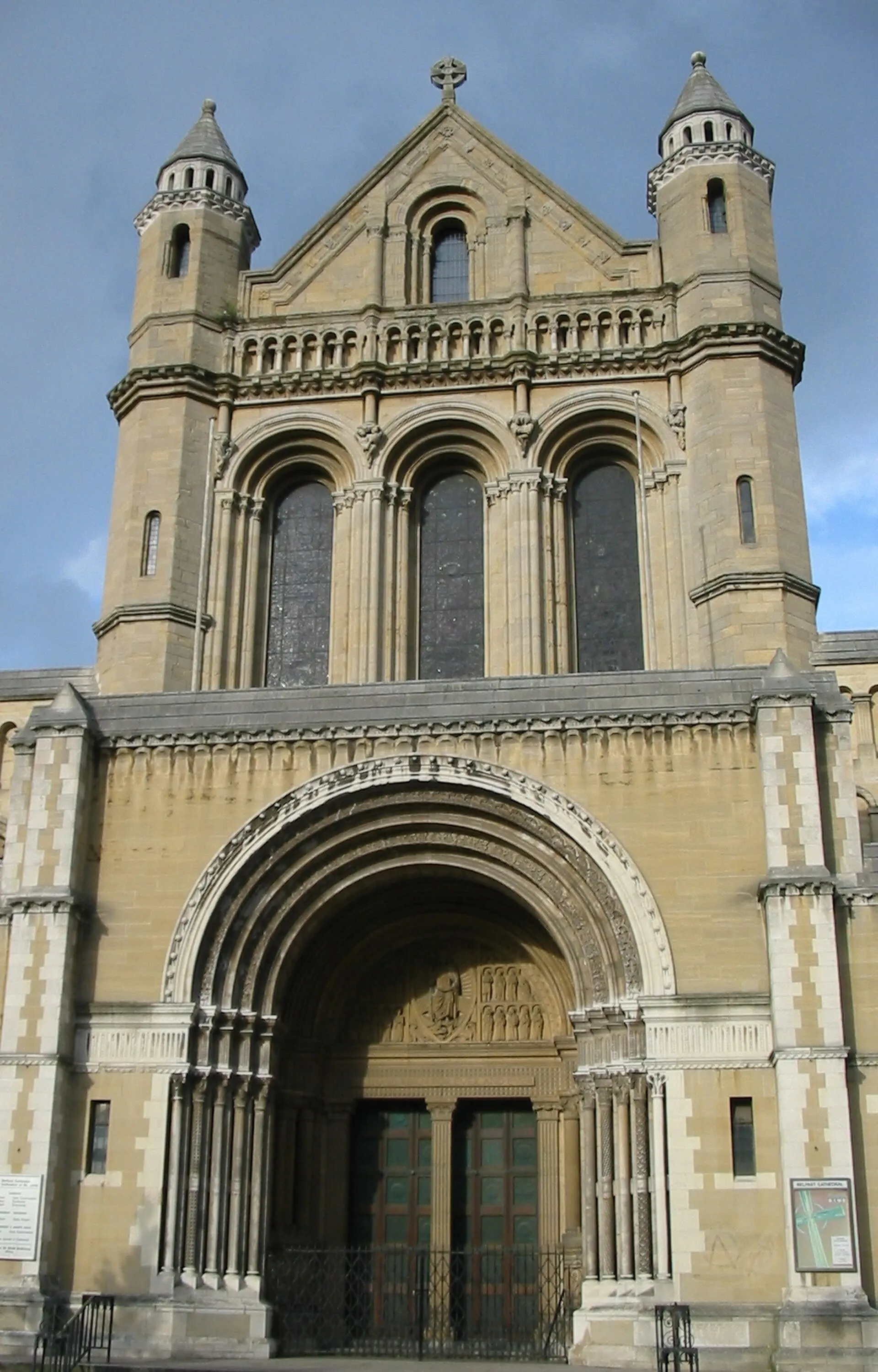
The Spire of Hope is best framed looking north along Donegall Street in morning light, when the steel catches the sun above the round-arched west front; after dark it glows from within and is visible across the Cathedral Quarter. Inside, the baptistery mosaic and the play of light through the clerestory windows are the standout interior shots — photograph them without flash.
Combine the cathedral with the Victorian Crown Liquor Saloon, a 20-minute walk south along Great Victoria Street, for a complete picture of confident Victorian Belfast; the Palm House and Ulster Museum at the Botanic Gardens make a natural second half-day, and the waterfront Titanic Belfast sits about a 15-minute walk east across the Lagan. The Cathedral Quarter bars immediately behind the building — White's Tavern and the Duke of York among them — are excellent for lunch or an early evening drink. If your schedule allows, arrive for the Sunday 11 AM Choral Eucharist: the music is of a high standard and the service is an experience in itself.
Frequently Asked Questions
Why is Belfast Cathedral called the Cathedral of Saint Anne?
The Cathedral Church of Saint Anne was built on the site of a late-eighteenth-century Georgian parish church also dedicated to Saint Anne, the mother of the Virgin Mary. The parish church was demolished to make way for the present building, which was consecrated as a cathedral of the Church of Ireland in 1904 — though construction of the building continued for over a century and the Spire of Hope was added only in 2007. It serves as the cathedral of the Church of Ireland Diocese of Connor and is unusual in also acting as the cathedral for the neighbouring Diocese of Down and Dromore.
What is the Spire of Hope?
The Spire of Hope is a stainless steel spire, 40 metres tall, added to the Cathedral in 2007 after a design competition. It rises above the central crossing of the Cathedral on a square base and is lit internally at night, making it visible across much of the city. It marks the completion of the Cathedral's external form after over a century of construction and is one of Belfast's most distinctive modern architectural additions.
Can visitors go up the Spire of Hope?
No — the Spire of Hope is not an observation tower and has no public access. The 40-metre stainless-steel spire rises from the central crossing on a slender base and is a structural and symbolic feature rather than a viewing platform; it is lit internally at night and is best appreciated from the street outside, particularly looking north along Donegall Street. Visitors explore the Cathedral at ground level, where the nave, baptistery, and chancel hold the building's principal treasures.
Who is buried in Belfast Cathedral?
The most significant burial is that of Edward Carson (Lord Carson of Duncairn), the barrister and politician who led Ulster Unionist resistance to Irish Home Rule and whose signature on the Ulster Covenant in 1912 was followed by over 200,000 others. Carson was given a state funeral in 1935 and interred in the baptistery — the only burial the Cathedral has ever permitted — his grave marked simply with the single word "Carson". His baptistry memorial is one of the most important political memorials in Northern Ireland.