
Crown Liquor Saloon timeline
-
Great Victoria Street station opens
The Ulster Railway terminus brought crowds to the street, creating the passing trade the pub would later be built to serve.
-
Patrick Flanagan's ornate remodelling
The gin-palace interior seen today — tiling, glass, and carved snugs — was created under Flanagan's patronage, reputedly by Italian craftsmen decorating churches in Ireland who worked here in their off-hours.
-
Survives the Belfast Blitz
The German air raids that devastated much of the city left the Crown and its glass largely intact.
-
National Trust takes ownership
The Trust bought the building to save it from redevelopment and leased it back for continued use as a pub.
- 1990s
Bomb damage and repair
Repeated attacks on the neighbouring Europa Hotel blew in the Crown's windows more than once; each time the etched and stained glass was painstakingly restored.
-
Major conservation restoration
The National Trust undertook a thorough restoration of the tiling, glass, and woodwork, returning the saloon to its full Victorian richness.
Architecture
The Crown is best read as a single, coordinated decorative scheme rather than a collection of ornaments, and a slow circuit of the room reveals how tightly the crafts interlock:
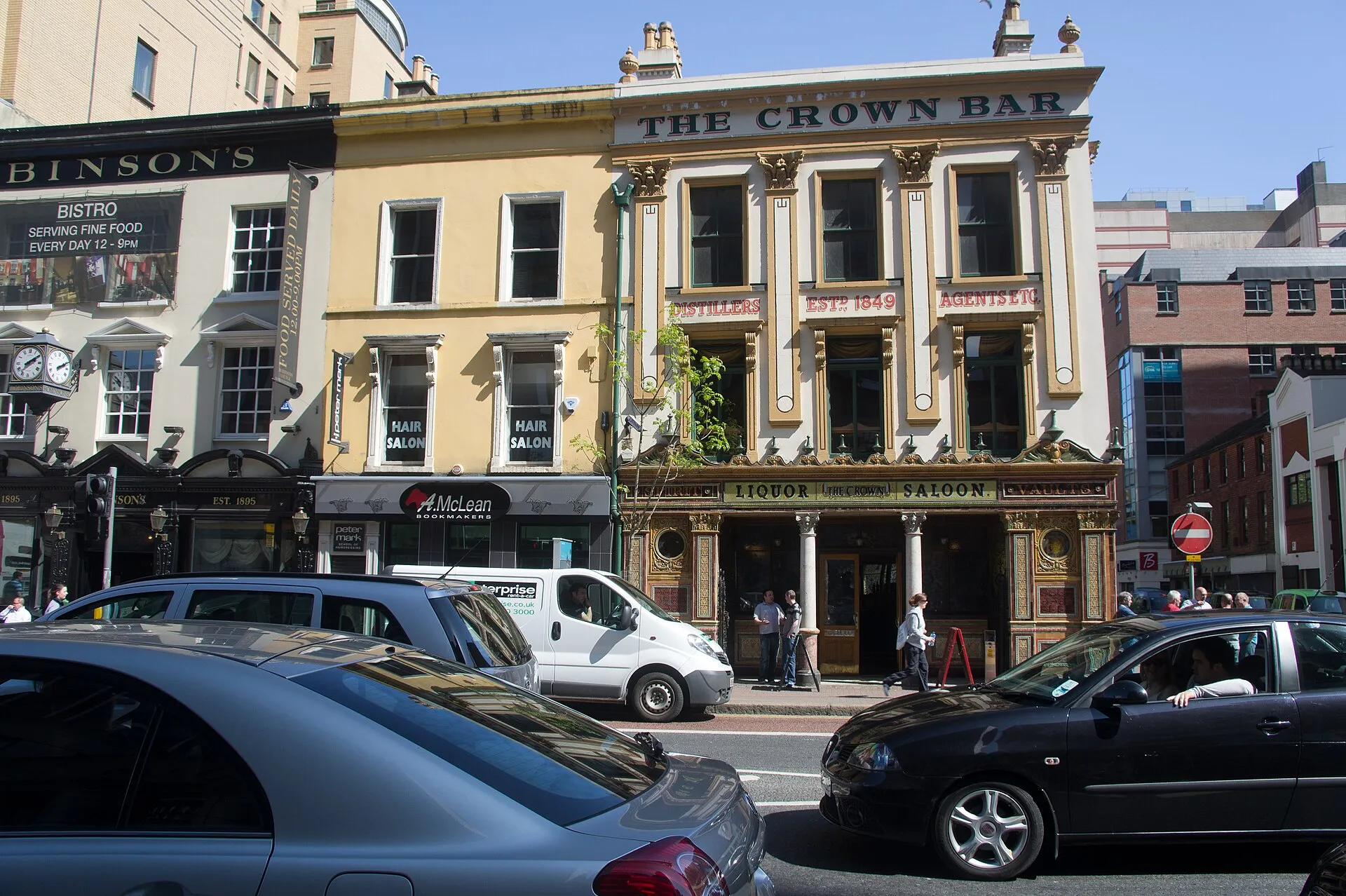
- The facade — A frontage of polychrome Italian majolica and encaustic tiles, with the pub's name in gilded and painted glass and a mosaic-tiled entrance; it is the most photographed shopfront in Belfast and reads best in flat daylight, when the glaze colours are most saturated.
- The snugs — Ten carved boxes, traditionally lettered A to J, run down one side of the room. Each is panelled in dark wood, topped with a carved animal or heraldic beast, and fitted with a coloured-glass screen, a bell-push for service, and a striker plate — a complete piece of Victorian social engineering built for privacy.
- The long bar — A continuous counter faces the snugs, backed by a mahogany and mirror gantry; the floor at your feet is laid in a geometric mosaic of ceramic tiles that has survived more than a century of boots.
- Glass and ceiling — Etched, painted, and stained glass in fleurs-de-lis, shells, and fairies filters the light, while the ceiling carries moulded and painted plasterwork above the gas brackets.
The rarity is the completeness of the ensemble: many Victorian pubs kept a fine bar-back or a single etched window, but very few preserve the facade, floor, glass, snugs, ceiling, and lighting together in their original places. That intactness is exactly why the National Trust treats the whole interior as a listed artefact and why restoration work — most recently a thorough conservation in 2007 — aims to repair rather than replace.
Historical Significance
The Crown Liquor Saloon is significant both as a physical artefact of Victorian decorative craft and as a document of Belfast's social history. Great Victoria Street in the late nineteenth century was the heart of the city's commercial and theatrical district: the Ulster Railway terminus had drawn crowds to the street since 1839, and the Grand Opera House directly opposite pulled audiences from across Belfast and beyond. The Crown was built to serve this affluent entertainment district, and its decorative ambition reflects the commercial confidence of a city then at the height of its linen-and-shipbuilding power — the same confidence that raised the Botanic Gardens Palm House, Belfast Cathedral, and the yards that would build the Titanic.
Its survival is remarkable. The saloon came through the Belfast Blitz of 1941 with its glass intact, resisted the redevelopment pressures of the 1960s and 1970s, and endured the Troubles at close quarters: the adjoining Europa Hotel became one of the most-bombed hotels in Europe, and blasts aimed at it repeatedly shattered the Crown's windows, each pane afterward restored to the original pattern. The Poet Laureate and architectural conservationist Sir John Betjeman was among those who campaigned for the pub's preservation, and his advocacy helped persuade the National Trust to take it on in 1978. The interior has since served as a ready-made set for period films and television dramas needing an authentic Victorian bar.
When to Visit
The Crown Liquor Saloon is open daily as a working pub: typically Monday–Saturday from late morning until late evening and Sunday afternoon into the evening (hours flex with the season and events at the Grand Opera House opposite, so confirm on the day). The kitchen serves food from opening until mid-evening. The pub is busiest on Friday and Saturday evenings and around Sunday lunchtime, and it fills quickly before and after Opera House performances.
Midweek afternoons are the best window for a quieter visit, when the tiling, glass, and snugs can be studied without competing for space. Come after dark to see the room as it was designed to be seen: the gas mantles are lit in the evening and throw a soft, flickering light across the glass that no photograph quite captures. The tiled facade can be viewed and photographed at any hour and glows against the night when the frontage is illuminated.
Admission and Costs
Free to enter — it is a working pub, not a ticketed attraction. A pint of Guinness costs the standard Belfast pub price (roughly £5–6 / $6–8), and food is served at ordinary Belfast prices; a snug and a plate of oysters or Irish stew make the classic order. There is no admission charge and no compulsory tour, and the National Trust provides interpretation on site explaining the building's significance.
Guided architectural visits are not run to a fixed daily timetable, but the Crown features on many walking tours of Victorian Belfast — some take in only the exterior, while others arrange a short interior visit. A private, guide-led architectural walk of the Great Victoria Street precinct including the Crown runs about £80–150 ($100–190) for up to six people, and evening pub-heritage tours of the Cathedral Quarter and city centre often fold the Crown in for £15–25 ($19–32) per person.
The Case for a Guide
The Crown is an ideal subject for a guided architectural walk of Victorian Belfast's Great Victoria Street precinct, because its meaning is carried in details a casual drinker walks straight past:
- Decorative craft identification — The different tilework (encaustic, majolica, mosaic), the plasterwork techniques, and the woodcarving are distinct crafts whose origins and production methods a specialist can pick apart element by element
- The snug system — Understanding how the snugs functioned socially in Victorian Ulster — who used them, why, and how the etiquette of the lettered booths reflected social hierarchy — turns a pretty booth into a lesson in social history
- The Flanagan story — The family who built and ran the Crown for generations is a Belfast story of Irish Catholic entrepreneurship in a city dominated by Protestant commerce, and the mosaic-crown anecdote is best told in full by someone who knows the context
- Great Victoria Street context — The Crown sits opposite the Grand Opera House and beside the Europa Hotel; together they tell the theatrical, commercial, and Troubles-era history of the street, a thread that pairs naturally with a walk up to Belfast Cathedral
Tips for Visitors
Secure a snug if at all possible — sitting in an original Victorian carved booth with a proper pint is one of the distinctive experiences of a Belfast visit and cannot be replicated anywhere else. Arrive before the Friday and Saturday evening rush, and steer clear of the hour before Grand Opera House curtain-up, for the best chance of one.
For photographs, work the building in three passes: the tiled facade in daylight, when the majolica colours are most intense and the gilded lettering is legible; the mosaic crown at the entrance floor, the single most-photographed detail; and the interior under gaslight after dark, framing a snug's carved screen against the etched glass and the glow of the mantles. Hold the camera steady in the low light rather than using flash, which flattens the glass.
The Grand Opera House directly opposite is architecturally significant in its own right and can be combined with the Crown for a Victorian Great Victoria Street hour, and Belfast Cathedral is a 20-minute walk north through the Cathedral Quarter — a natural pairing for a morning of Victorian Belfast architecture, with the Botanic Gardens Palm House and the waterfront Titanic Belfast filling out the day.
Frequently Asked Questions
Is the Crown Liquor Saloon still a working pub?
Yes — despite being owned by the National Trust and listed in the highest architectural category, the Crown Liquor Saloon operates as a fully functioning pub every day, serving Guinness, Ulster whiskey, and traditional bar food. The National Trust acquired it in 1978 to prevent demolition and leases it to operators who keep it in active use, which is what allows a visitor to experience it as a pub rather than a roped-off museum. It is one of only a small number of pubs owned by the National Trust anywhere in the UK.
What makes the Crown Liquor Saloon architecturally significant?
The interior is a masterpiece of Victorian decorative craft, remodelled around 1885 under the patronage of Patrick Flanagan for what was then the Crown Bar. The decorative programme includes Italian majolica and encaustic tiling on the facade and floor, etched and stained glass, ten carved wooden snugs (private drinking booths) with their original locking mechanisms and bell-pushes, a decorated ceiling, ornate plasterwork, and gas lamps that still light the room by mantle rather than bulb. The rarity is not any single element but the survival of the whole ensemble in its original location and near-original condition — something almost unmatched anywhere in the British Isles.
What is a snug in an Irish pub context?
The snugs in the Crown are carved wooden compartments along the pub's length, each seating four to six people and originally fitted with a door that could be closed against the rest of the room. Each snug has a bell-push once wired to a board behind the bar for summoning service without leaving the booth, and a gunmetal plate for striking matches. In the Victorian era, snugs let women, clergy, police, and people of higher social standing drink without mingling with the general bar, and they remain a distinctive feature of traditional Irish and Ulster pub design.
Why is there a crown mosaic on the floor at the entrance?
A mosaic crown is set into the tiled floor at the doorway, giving the pub its name. A well-worn local story holds that the original proprietor, a nationalist, placed the royal emblem at the threshold specifically so that every customer would tread on the Crown on their way in — a small political joke rendered permanent in ceramic. Whatever the truth of the anecdote, the mosaic is one of the most photographed details in the building and a reliable point of interest a guide will pause over.