
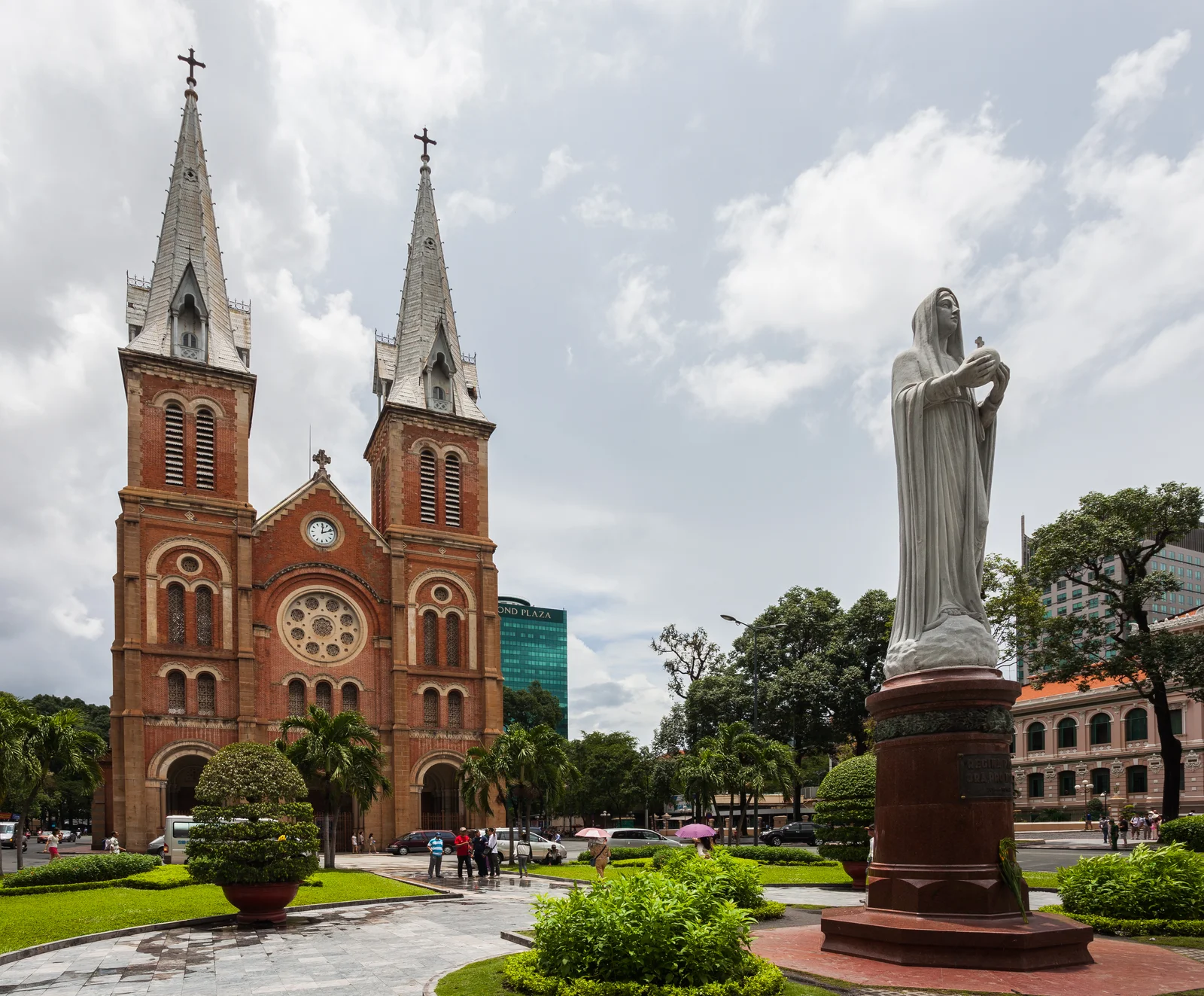
Spiritual Significance
The cathedral is a working Roman Catholic church, the seat of the Archdiocese of Ho Chi Minh City, and it serves one of the largest Catholic communities in Southeast Asia — a legacy of French missionary activity and colonial rule that left Vietnam with a sizeable Catholic minority.
It was raised to the rank of a minor basilica by the Vatican in 1962, which is why its full name carries the word Basilica. Beyond its tourist fame it remains a genuine place of devotion, busiest at Christmas and Easter when the square fills with worshippers, and its statue of Our Lady of Peace draws a steady stream of local pilgrims.
Visitor Etiquette
Even from outside, treat the cathedral as an active religious site rather than a photo backdrop. Dress modestly — covered shoulders and knees — if there is any chance of entering for a service, and keep your voice down near the doors where worshippers come and go.
Do not try to enter during the restoration or interrupt a Mass to look around; if you attend a service, sit or stand quietly at the back, switch your phone to silent, and avoid flash photography of the congregation. The best-behaved visitors are the ones you would never notice were there as tourists at all.
When to Visit
The square and exterior are accessible at any time and are best photographed in the early morning or late afternoon, when the low sun lights the red brick and the traffic around the square eases a little. Expect to spend 15 to 30 minutes here, longer if you fold in the post office opposite.
During the restoration there are no public visiting hours for the interior. When the cathedral is open for worship, Mass times (typically several on Sunday and daily morning services) are the only way inside; confirm the current schedule locally, dress modestly, and remember these are services, not tours.
Admission and Costs
Visiting the cathedral is free — there is no entry charge for the exterior, the square, or attendance at Mass. This is one of the easiest landmarks in Ho Chi Minh City to see on a self-guided walk at no cost.
The only money most people spend here is on a cyclo or private walking guide of the colonial quarter, which typically bundles the cathedral with the Central Post Office and Reunification Palace: reckon US$8–15 for a short cyclo loop or US$40–80 for a half-day private city guide covering several colonial sites.
Tips for Visitors
Come as part of the colonial-quarter walk rather than a special trip: the cathedral, the Central Post Office directly opposite, and the book street beside it form a tight, shady cluster you can cover in under an hour on foot.
Photograph the facade from the post-office side of the square for the cleanest angle, and go early to avoid both the heat and the wedding-photo crowds that colonise the steps on weekends. If the scaffolding disappoints, the richer interior experience nearby is the restored lobby of the post office — step across and see that instead.
Frequently Asked Questions
Can you go inside Saigon Notre-Dame Cathedral right now?
For most of the period since 2017 the cathedral has been closed for a major restoration, with scaffolding on the towers and the interior off-limits to casual visitors. Completion has been pushed back repeatedly, so assume you are seeing the exterior only unless you confirm otherwise locally.
That still makes it worth the five-minute walk from the Central Post Office across the square: the red-brick facade and twin spires are the set-piece image of colonial Saigon. When Mass resumes for worshippers, services are the one reliable way inside — tourists should stand at the back and stay quiet.
Did Gustave Eiffel design the Saigon cathedral or post office?
No — this is one of Saigon's most repeated myths. Neither the cathedral nor the neighbouring Central Post Office was designed by Gustave Eiffel, though the claim is attached to both by guides and signage.
The cathedral was designed by the French architect Jules Bourard and built between 1877 and 1880. The confusion is understandable given the era and the iron used in the post office, but the attribution is not supported by the record. A good local guide will tell you the real story rather than repeat the postcard version.
Why is the cathedral built from French bricks?
The French colonial administration wanted a church that looked unmistakably European, so it imported the materials rather than using local ones. The distinctive red bricks came from Marseille, the stained glass from Chartres, and the iron and fittings from France.
The Marseille brick is the reason the facade has kept its deep colour for nearly 150 years without being painted or rendered. It is also why the building reads as a transplanted piece of France dropped into the tropics — part of the deliberate image-making that earned old Saigon the nickname Pearl of the Orient.