
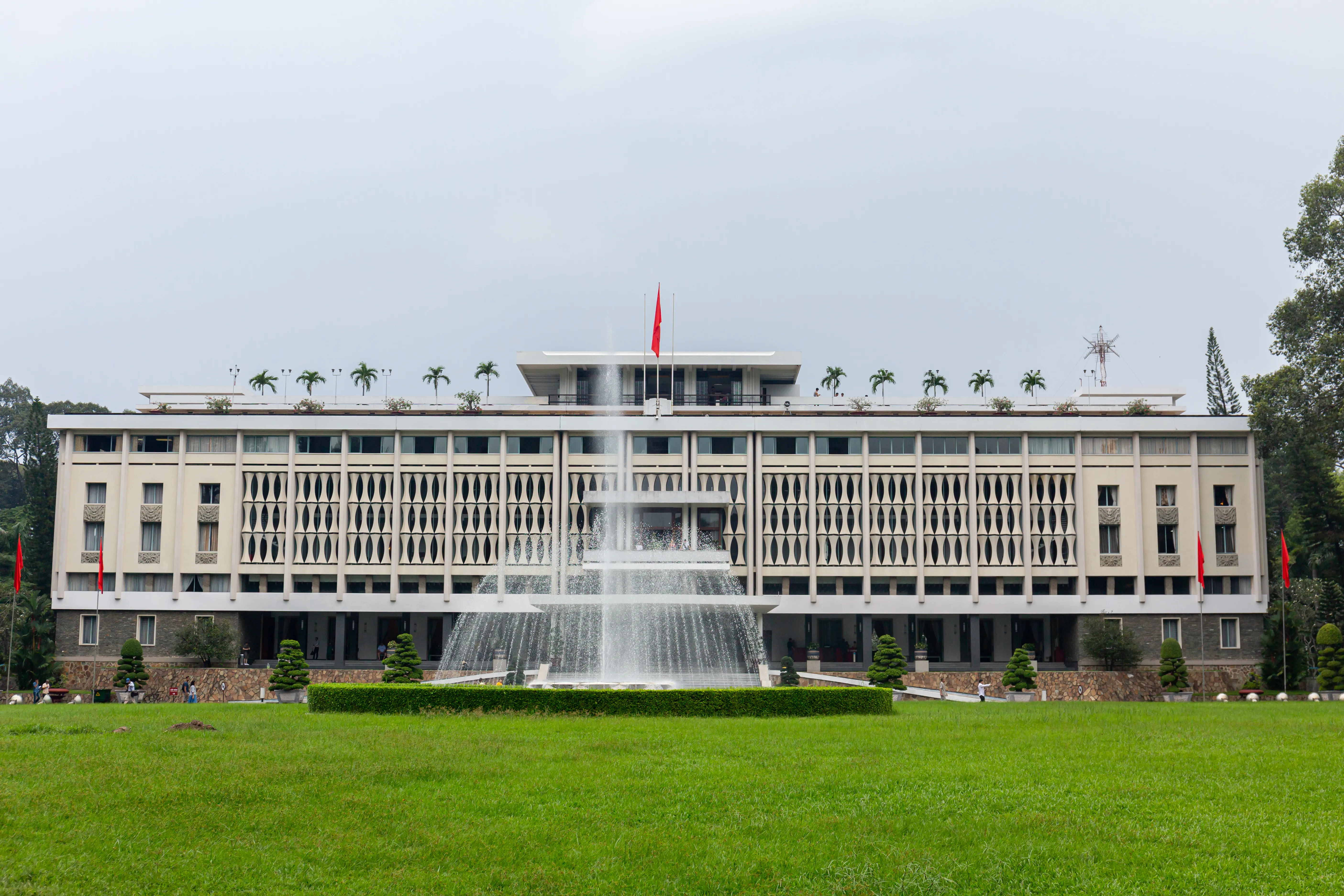
Historical Significance
The palace embodies the full arc of Vietnamese 20th-century history in a single building: French colonial construction → Vietnamese nationalist assertion in the architecture of 1966 → the centrepiece of the American-backed South Vietnamese government → the site of the war's formal end. No other building in Vietnam contains so compressed a historical significance.
The basement war operations centre — with its original telecommunications equipment, coded maps, and the rooms from which President Ngô Đình Diệm reportedly directed operations before his assassination in 1963 and subsequent presidents continued through to April 1975 — is the most historically concentrated space in the building. The equipment has not been updated since 1975; the phones, radios, and situation boards remain as they were when the building was abandoned.
The rooftop helipad from which helicopters evacuated South Vietnamese officials and their families in the final days — and from which the last US military and CIA personnel departed in the early hours of 30 April — provides a particular historical vantage on the event: the distance to Tân Sơn Nhất airport, the direction from which the tank columns approached, and the geography of the fall can be read from the roof in a way impossible from ground level.
Architecture
Ngô Viết Thụ's 1966 design is one of Southeast Asia's most significant works of mid-century modernism. The main façade uses a five-part screen of concrete lattice in a pattern derived from Chinese and Vietnamese decorative traditions, through which the building's interior volumes are visible from the formal driveway. The roofline on the central section is shaped to suggest bat wings — dơi in Vietnamese, considered a symbol of good fortune — while the flanking wings use a stepped profile that references Vietnamese temple roofs in abstract form.
The internal planning separates official ceremonial functions (ground floor: reception halls, ballroom, formal rooms) from operational government functions (upper floors: cabinet room, presidential private quarters) and military command (basement: war room, communications, secure corridors). The separation of public ceremony and private power is made architectural: visitors move through the ceremonial sequence first, then descend into the operational underground that the ceremony was designed to conceal.
When to Visit
Open daily 8 AM–5 PM (last entry 4:30 PM). Closed for approximately 1–2 hours in the middle of the day on Mondays and Fridays when official functions are scheduled — check on arrival as these closures are not always predictable. The palace is busiest between 9:30 AM and 1 PM; arriving at 8 AM provides a quieter experience of the main reception rooms. Guided tours in Vietnamese, English, and other languages are posted at the entrance — timing varies but typically runs at 9 AM, 10 AM, 2 PM, and 3 PM on weekdays.
Admission and Costs
Admission: 40,000 VND (approximately US$2) per adult. Audio guide: 30,000–40,000 VND. Photography: Permitted throughout. Group guided tour included in admission (Vietnamese commentary, often with English translation available on request). Private city guide services covering the palace are available at standard Ho Chi Minh City guide rates (US$40–80 per group for a half-day including this site and War Remnants Museum).
Tips for Visitors
Rent the audio guide at the entrance — the English commentary is informative and the self-guided format allows you to spend longer in the rooms that interest you most, particularly the basement war room. The Tuesday to Friday early morning period (8–9:30 AM) is the quietest; weekend mornings bring large Vietnamese school groups that can make the basement corridors congested. After the palace, walk north through the formal gardens to Notre-Dame Cathedral (under restoration, exterior only) and the Central Post Office — both within 10 minutes on foot — to complete the French colonial quarter circuit before heading to the War Remnants Museum by Grab or taxi.
Frequently Asked Questions
What happened at the Reunification Palace on 30 April 1975?
At 11:30 AM on 30 April 1975, a North Vietnamese People's Army T-54 tank (Tank 843) crashed through the iron gates of the Independence Palace — as the building was then called — signalling the capture of Saigon and the end of the Vietnam War. A soldier ran up the main steps and raised the National Liberation Front flag from the balcony. President Dương Văn Minh, who had assumed power just the day before, was waiting inside with his cabinet to surrender unconditionally. The event, photographed by multiple journalists including Nick Ut and filmed by television crews, produced one of the defining images of 20th-century history. The tank that actually broke through the gates is on display in the palace grounds.
What can you see inside the Reunification Palace?
The palace is preserved in its 1966 furnishings and design — the presidential reception rooms, cabinet meeting room, war operations centre in the basement, and the private presidential quarters on the upper floors are all open to visitors. The basement war room contains the original telecommunications equipment, maps, and command furniture from which South Vietnam's military operations were directed. The rooftop helipad — from which the last helicopter evacuations took place in the days before the fall — is accessible. The building's interiors are a remarkable example of 1960s Modernist design applied to Vietnamese cultural motifs by architect Ngô Viết Thụ.
How long does a visit to Reunification Palace take?
A self-guided walk through the main reception areas, basement war room, and rooftop helipad takes approximately 1 to 1.5 hours. An audio guide is available at the entrance and extends the visit to approximately 2 hours. The adjacent grounds and garden contain the T-54 tank that broke through the gates and require an additional 20 minutes. The palace has limited explanatory signage in English; an audio guide or prior reading significantly enhances the visit. Private guides familiar with the palace can provide the most complete historical narration of both the building's architecture and its final days as a government seat.