
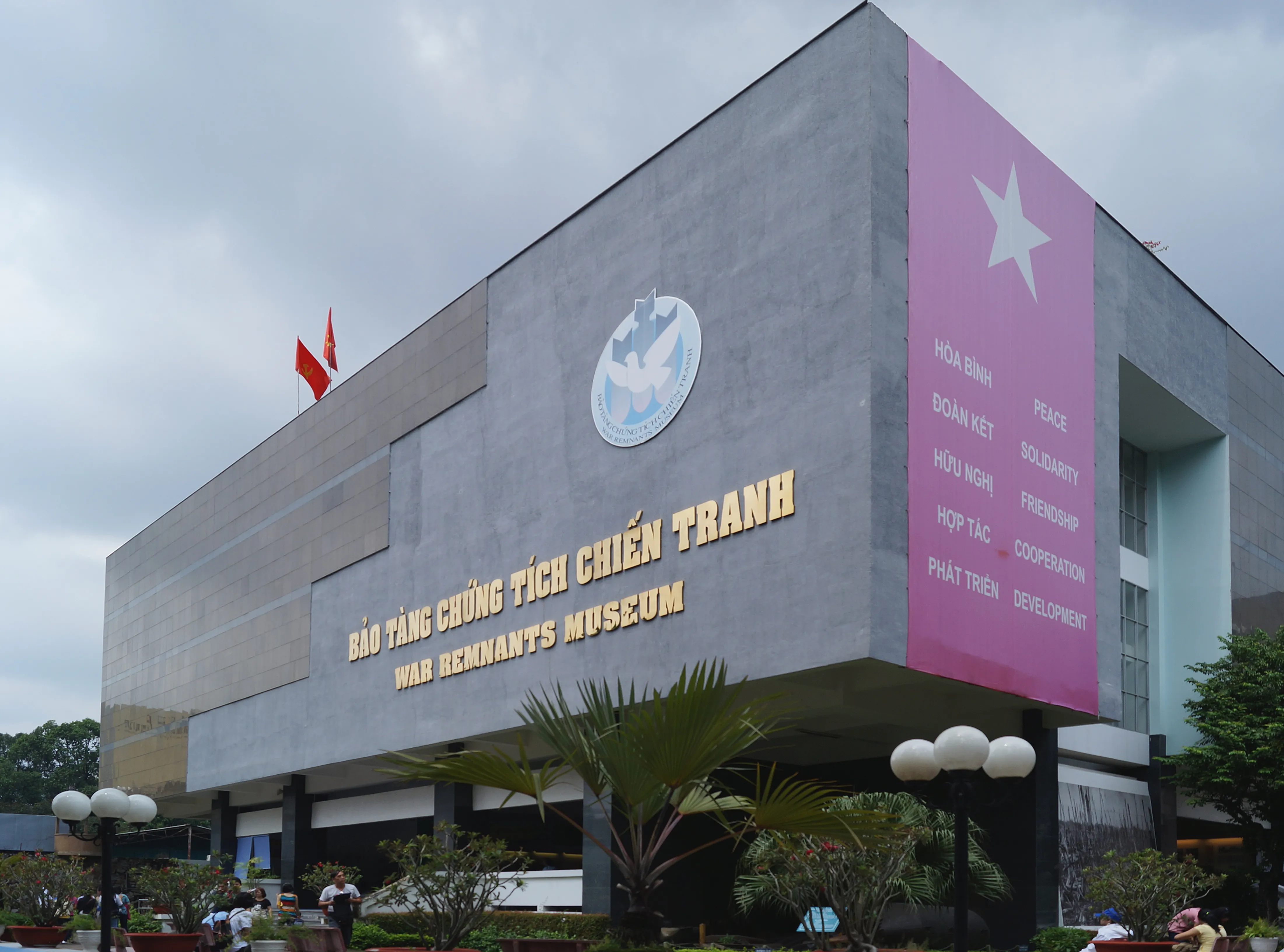
Collections Highlights
Requiem gallery (first floor): photographs by 135 photojournalists killed covering the Indochina wars, including the entirety of Nick Ut's contact sheets from the Trảng Bàng strike of 8 June 1972. The gallery includes text biographies of each photographer alongside their most significant published images.
Tiger Cages display: replicas of the cramped concrete cages used to confine political prisoners on Côn Sơn Island — brought to international attention by Life Magazine in 1970 — displayed with photographic documentation of the prisoners found inside.
Agent Orange gallery (second floor): the most distressing section of the museum for most visitors, documenting the physical effects of dioxin exposure on Vietnamese civilians across multiple generations. The gallery explicitly argues for the ongoing legal and compensatory responsibility of US chemical manufacturers. Presented with restraint but without mitigation.
Outdoor equipment: US military aircraft including a Cessna O-1 Bird Dog spotter plane, F-5E Tiger II fighter-bomber, and UH-1 Iroquois helicopter — equipment familiar from popular media images of the war, now stationary and accessible for close inspection.
Guided Tours
The museum does not offer in-house guided tours. Private English-speaking guides hired in Ho Chi Minh City typically include a 45-minute to 1-hour structured visit as part of a broader district tour covering the Reunification Palace and Notre-Dame Cathedral. For visitors wishing to spend the full 2.5–3 hours in the museum, a guide is most useful for the initial orientation and pre-visit briefing, after which independent exploration of the galleries is more appropriate than a continuous guided commentary.
When to Visit
Open daily 7:30 AM–6 PM, including public holidays. Last entry at 5:30 PM. The museum is busiest between 9:30 AM and 2 PM — arriving at opening time (7:30 AM) provides a significantly quieter experience for the photographic galleries. Visitor volume is highest in December and January (dry season peak) and lowest in September and October (wet season). No booking is required; purchase tickets at the entrance.
Admission and Costs
Admission: 40,000 VND (approximately US$2) per adult. No charge for children under 6. Photography: No additional charge — photography is permitted throughout, except for a small number of displays where signage indicates otherwise. Audio guide: Available at the entrance for 30,000–40,000 VND in English, French, Chinese, and Vietnamese. No guided tours are offered by the museum itself; private city guides typically include an orientation at the entrance, after which visitors explore the galleries independently.
The Case for a Guide
- Historical context for the photographic imagery — the Requiem gallery photographs are the most powerful material in the museum, but their full significance requires understanding of the specific military operations, dates, and political context in which they were taken; a guide who can provide this context before you enter the gallery transforms the experience
- Agent Orange science and policy — the health effects documented in the second-floor gallery are presented as evidence of deliberate policy rather than unintended consequence; a guide who knows the declassified documentation can explain the distinction between the military arguments for and against defoliation that were made in Washington at the time
- Perspective calibration — guides who have studied both Vietnamese and American accounts of the war can help visitors understand what the museum presents, what it omits, and how to situate both within the broader historical record
Tips for Visitors
Allocate time honestly: Most visitors underestimate how long they will spend here. The photography galleries — particularly the Agent Orange documentation and the photojournalists exhibition — require sustained engagement. Budget a minimum of 2.5 hours and do not schedule anything demanding immediately afterward.
Outdoor exhibits first: Begin with the outdoor courtyard exhibits (aircraft, vehicles, weaponry) before entering the indoor galleries. The outdoor section is best in the morning before the heat becomes intense, and beginning outside gives your eyes time to adjust before the interior photographic displays.
Context resources: The museum presents the war from a specific perspective. Reading one account of the war from a different perspective before or after your visit provides more complete understanding. The museum bookshop carries Vietnamese-published histories and English-language academic works that can supplement the exhibition's framing.
Frequently Asked Questions
Is the War Remnants Museum appropriate for children?
The museum contains graphic photographic documentation of wartime casualties, defoliation effects, and birth defects attributed to Agent Orange — images that are distressing for adult visitors and are not suitable for young children. The outdoor courtyard with captured military equipment (aircraft, tanks, howitzers, and a guillotine used by the French colonial administration) is more appropriate for children and is part of all visits. Most guides suggest that children under 12 should not visit the indoor exhibition galleries, while teenagers who are studying the Vietnam War period can benefit significantly from the museum's perspective and photographic evidence. Parents should review the museum's content before bringing children.
How long does it take to visit the War Remnants Museum?
A thorough visit to all three floors of exhibitions, the outdoor equipment courtyard, and the temporary exhibition space takes 2.5 to 3 hours. The ground floor covers war crimes documentation and international opposition to the war; the first floor presents the photographic work of journalists killed during the conflict, including many images that won Pulitzer Prizes and shaped world opinion; the second floor documents the effects of Agent Orange on Vietnamese civilians and the generational health consequences that continue to affect families. Visitors who move quickly through the photographic galleries typically take 1.5 hours; those who read the captions and engage with the material take 3 hours.
Who should visit the War Remnants Museum?
The museum presents the Vietnam War exclusively from the Vietnamese perspective and includes documentation of American military conduct that is graphic and disturbing. It is an important visit for anyone seeking to understand how the war is understood in Vietnam today, and particularly valuable for visitors from countries that were involved militarily. The presentation is sometimes described as one-sided by critics who note the absence of North Vietnamese military atrocities from the displays; this is an accurate observation that the museum itself does not contest. It is nonetheless considered an essential cultural experience in Ho Chi Minh City and one of Southeast Asia's most important museums of 20th-century history.