
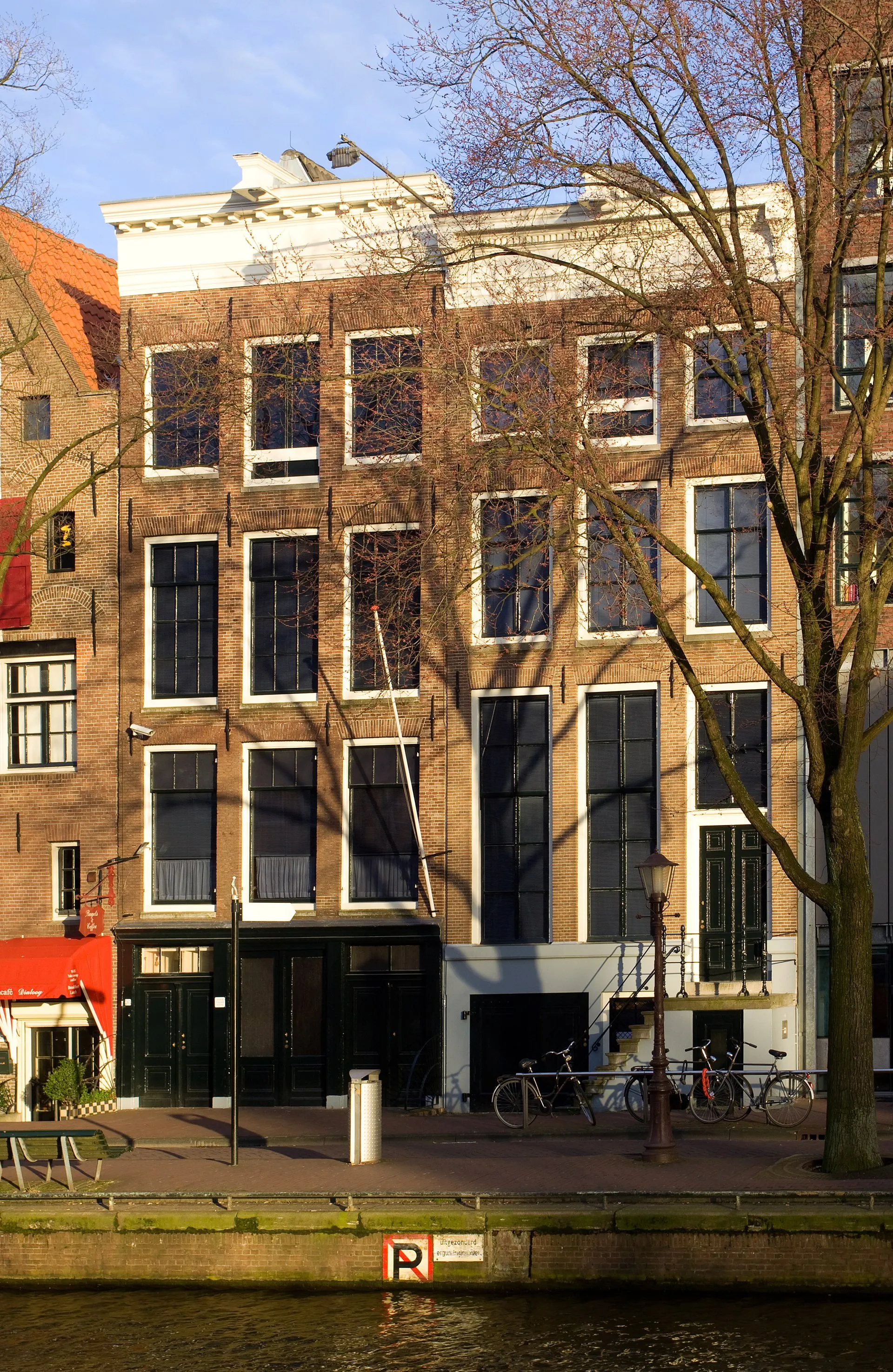
Collections Highlights
The Bookcase Entrance: The swinging bookcase that concealed the annex door is the museum's most powerful object — small, ordinary, and terrifying in its implications. Growth Marks: Pencil lines on the annex wall where Otto Frank marked his daughters' heights remain visible — mundane domestic ritual made heartbreaking by context. Anne's Room: The photographs of movie stars and the British royal family that Anne pasted to her walls are still there, a teenager's decoration in a prison. The Diary: The original red-checked diary and subsequent notebooks are displayed in the museum — Anne's handwriting brings her voice from the page into physical reality. Post-War Exhibition: The museum traces what happened to each of the eight people in hiding, the helpers who risked their lives, and the ongoing investigation into who betrayed the family.
Guided Tours
No guides operate inside the Anne Frank House — the museum is self-guided by design, preserving the intimate, contemplative atmosphere the space demands. However, independent guides offer invaluable pre-visit briefings covering the Frank family's story, wartime Amsterdam, and the broader context of the Dutch Holocaust. Post-visit walking tours through the Jordaan neighborhood and the Jewish Quarter connect the annex experience to the wider landscape of hiding, resistance, and betrayal across Amsterdam. A guide who specializes in WWII Amsterdam history can lead a half-day tour combining the Anne Frank House with the Resistance Museum, the Hollandsche Schouwburg, and the Stolpersteine (stumbling stones) that mark the former homes of deported Jewish families throughout the city.
Anne Frank House timeline
-
The canal house at Prinsengracht 263 is built
The building that would one day hide the Frank family goes up during Amsterdam's Golden Age — a merchant's house with a warehouse and offices at the front and living quarters in the rear back house, the achterhuis.
-
Otto Frank moves his business into the building
Otto Frank relocates his Opekta and Pectacon firms to Prinsengracht 263; the empty rooms above and behind the offices would later become the family's hiding place.
- 6 July 1942
The Frank family enters the secret annex
Days after Margot Frank received a call-up notice, the family slipped behind the bookcase into the hidden rooms, later joined by the van Pels family and Fritz Pfeffer — eight people in all.
- 4 August 1944
The annex is raided and its occupants arrested
After two years and one month in hiding, the group was betrayed and seized by the Gestapo; the identity of the informant has never been established.
-
Otto Frank publishes Anne's diary
The only survivor of the eight, Otto returned to Amsterdam, recovered the diary that Miep Gies had saved, and published Het Achterhuis in Dutch on 25 June 1947.
-
The Anne Frank Stichting is founded to save the house
With the building threatened by demolition, the Anne Frank Foundation was established to preserve Prinsengracht 263 and its annex for the public.
- 3 May 1960
The Anne Frank House opens as a museum
The restored building opened to visitors with the annex left deliberately unfurnished, as Otto Frank wished, so the emptiness would convey the loss.
-
A new entrance building reopens the museum
A multi-year renovation added a separate entrance and expanded exhibition space, reopening in November 2018 to manage well over a million visitors a year.
- Today
One of Amsterdam's most visited museums
Timed-entry tickets released six weeks ahead sell out within hours as more than 1.2 million people a year pass through the annex on Prinsengracht.
When to Visit
Open: Daily 9:00-22:00 (hours may vary seasonally; check the museum website). Best: Early morning (9:00-10:00) or late evening (after 19:00) for the most contemplative atmosphere. Busiest: Midday and early afternoon year-round; summer months see highest overall demand. Allow: 1-1.5 hours for the complete experience. Note: The museum is not suited for children under 10 — content is emotionally heavy and spaces are very narrow.
Admission and Costs
General admission: €16 ($17) adults; €7 ($8) ages 10-17; free for under 10, plus a small per-ticket booking fee. Booking: Online timed-entry tickets only — no walk-up sales. Ticket release: Tickets become available six weeks in advance and sell out rapidly; set a calendar reminder. Guided context: No guides operate inside the museum, but independent guides can provide pre-visit briefings and post-visit walking tours covering Jewish Amsterdam.
The Case for a Guide
No guides operate inside the Anne Frank House, but an expert on wartime Amsterdam transforms what happens before and after the museum visit — providing the human context that the building's deliberately sparse design leaves for you to fill.
- The betrayal mystery: The identity of the informant who tipped off the Gestapo on August 4, 1944 remains genuinely unsolved; a guide explains the competing theories — a warehouse employee, a Dutch member of the Security Service, an accidental discovery — and describes the cold-case investigation that used AI analysis of wartime records in 2021 without reaching a definitive conclusion.
- The helpers' extraordinary personal risk: Miep Gies, Bep Voskuijl, Johannes Kleiman, and Victor Kugler faced execution for concealing Jews; a guide reconstructs their daily routines of food procurement, information management, and emotional support for eight people in hiding, explaining the bureaucratic obstacles that made each shopping trip a potential exposure.
- Bookcase mechanism operation: The pivoting bookcase was constructed by helper Johannes Voskuijl specifically for the purpose — guides explain how it worked, where its hinges and latch were positioned, and why the mechanism was designed to look completely ordinary when closed from the street side.
- Wartime food rationing in hiding context: The eight people in the annex depended entirely on ration cards obtained through the Dutch resistance; a guide explains what those cards allowed, how the helpers acquired extra food through black market connections, and what the family's diet actually consisted of during two years of concealment.
- Otto Frank's post-war diary publication campaign: Otto survived Auschwitz and returned to Amsterdam to discover Anne's diary in Miep's keeping; guides describe his initial reluctance to publish, the fifteen rejections from publishers, and the specific editorial choices he made that shaped how Anne's voice reached the world — choices that have since generated scholarly debate about what was omitted.
Tips for Visitors
Book immediately: Tickets release six weeks ahead at 10:00 CET on Tuesdays and sell out within hours. This is not an exaggeration — treat it like concert tickets for a sold-out show. No photography inside: Cameras and phones must be put away throughout the annex. The rule exists to preserve the contemplative atmosphere — and it works. Pre-visit reading: Reading Anne's diary (or at minimum key passages) before visiting transforms the experience from historical site to personal encounter. Accessibility: The annex has steep, narrow staircases that cannot accommodate wheelchairs. The museum offers virtual reality alternatives for those unable to navigate the physical space. Combine with Jewish Quarter: Walk east to the Joods Historisch Museum, the Portuguese Synagogue, and the Hollandsche Schouwburg memorial for broader context on Jewish Amsterdam. Combine with Jordaan: The museum sits on Prinsengracht at the Jordaan's edge — a natural pairing with a neighborhood walking tour. Pace a full museum day carefully: the Van Gogh Museum and Rijksmuseum on Museumplein are about 25 minutes south by tram, but the annex is emotionally heavy — most visitors prefer to see it first thing and leave the art museums for the afternoon rather than the reverse. Emotional preparation: The museum is deliberately restrained rather than sensational, but the cumulative impact is profound. Give yourself time afterward to sit quietly — the Westerkerk church garden next door is a peaceful option.
Frequently Asked Questions
How do you book tickets for the Anne Frank House?
Every ticket is an online timed-entry slot bought through the museum's own website — there are no walk-up sales and no third-party resellers. Slots are released in a rolling batch six weeks ahead at 10:00 CET on Tuesdays and routinely sell out within the hour, so set a calendar reminder and log in a few minutes early, exactly as you would for concert tickets to a sold-out show.
How do you get to the Anne Frank House?
The entrance is at Westermarkt 20, on the corner of Prinsengracht and the Westerkerk. From Amsterdam Centraal it is a flat 15-20 minute walk, or take tram 13 or 17 to the Westermarkt stop, about two minutes from the door. There is no visitor car parking on the surrounding canals, so arriving on foot, by tram, or by bike is far simpler than driving.
When is the best time to visit the Anne Frank House?
The museum is open daily, typically 09:00-22:00, though hours shift seasonally, so confirm your date on the museum website. Because entry is timed, crowds are managed, but the earliest morning slots (09:00-10:00) and the late evening slots after 19:00 give the quietest, most contemplative atmosphere; midday and summer slots feel busiest.
How much does admission to the Anne Frank House cost?
General admission is €16 ($17) for adults, €7 ($8) for ages 10-17, and free for children under 10, plus a small per-ticket booking fee. Everyone pays the same timed-entry rate online; there are no on-site guided tours to add on, because the museum is self-guided by design.
How long does a visit to the Anne Frank House take?
Allow about 1 to 1.5 hours to walk the route through the former Opekta offices, the concealed bookcase, and the annex itself at an unhurried pace. There is no fixed exit time once you enter, but the one-way path and the museum's quiet, single-file rhythm mean most visitors are through in around an hour.
Can you take photographs inside the Anne Frank House?
No. Cameras and phones must be put away throughout the annex; photography is not permitted anywhere on the visitor route. The rule protects both the fragile historic interiors and the deliberately reflective mood of the space, and it is enforced consistently.
Is the Anne Frank House suitable for young children or wheelchair users?
The museum advises against visiting with children under 10 — the subject matter is emotionally heavy and the annex spaces are very tight. The annex is reached by original steep, narrow staircases that cannot accommodate wheelchairs; for visitors who cannot manage the stairs, the museum offers a virtual-reality tour of the hidden rooms instead.