
Royal Palace Amsterdam timeline
-
The first stone of the town hall is laid
Amsterdam began its vast new Stadhuis in the year the Peace of Münster ended the Eighty Years' War — a monument to a newly sovereign Dutch Republic.
-
The town hall is inaugurated
Jacob van Campen's building opened on 29 July 1655, its marble Citizens' Hall proclaiming Amsterdam the commercial centre of the world.
-
Louis Napoleon makes it a royal palace
Napoleon's brother Louis Bonaparte, installed as King of Holland, requisitioned the town hall as his residence and filled it with French Empire furniture.
-
The palace passes to the House of Orange
With the collapse of French rule the building became a royal palace at the disposal of the Dutch monarchy, a role it still holds today.
-
Reopening after a major restoration
A multi-year conservation of the marble floors, sculpture, and ceiling paintings was completed, and the palace reopened to visitors in June 2009.
-
Abdication and a new king
Queen Beatrix signed the Act of Abdication inside the palace on 30 April 2013, and King Willem-Alexander — inaugurated next door in the Nieuwe Kerk — greeted the crowds from the palace balcony.
Architecture
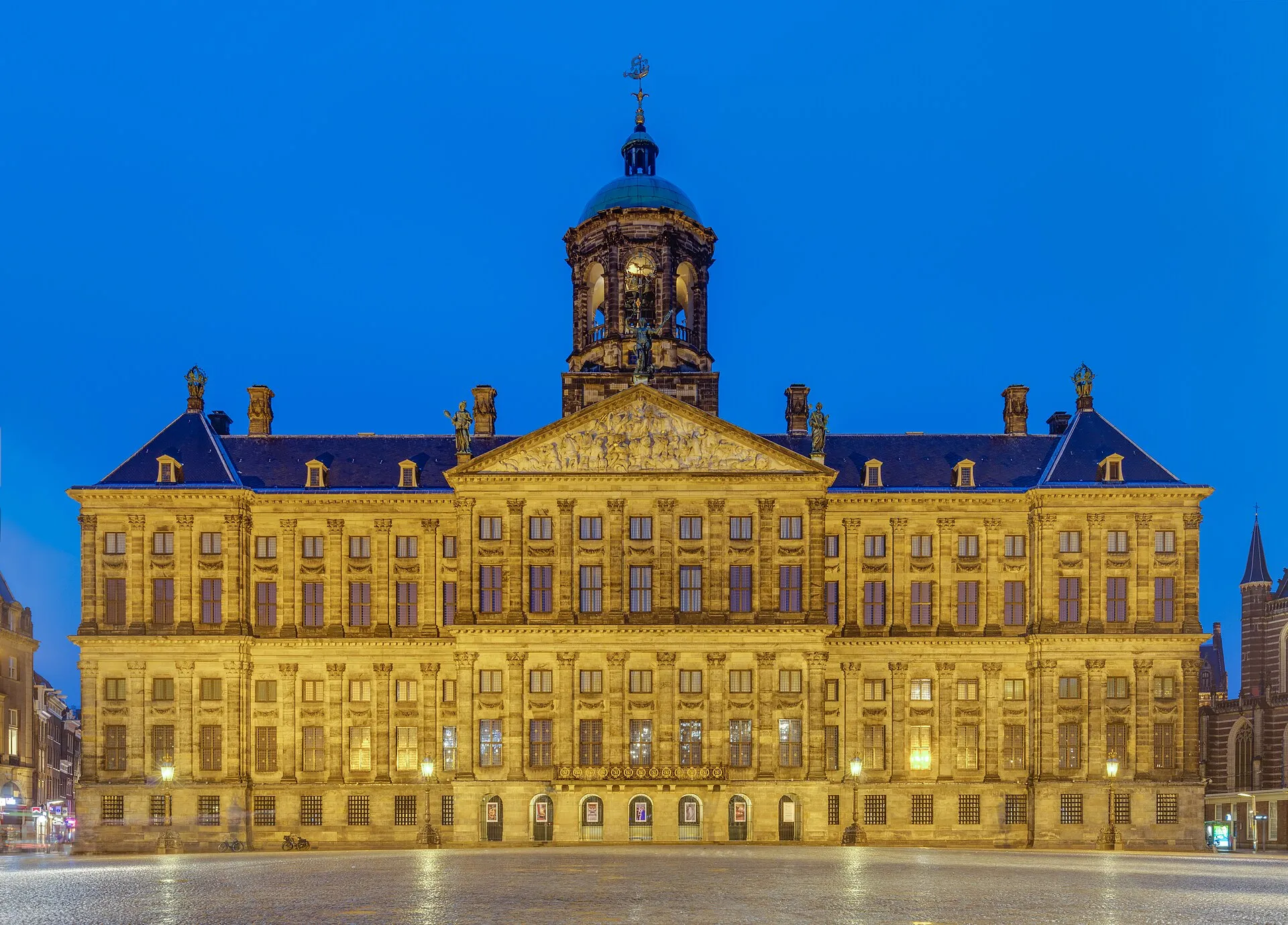
Jacob van Campen designed the building in the restrained Dutch Classicism he had helped invent, drawing on ancient Roman and Italian Renaissance models to express republican dignity rather than royal flourish. The sandstone facade is symmetrical and relatively sober outside; the drama is saved for the sculpture and for the vast marble interior, where Antwerp's Artus Quellinus led a decade-long programme of carving.
- Citizens' Hall (Burgerzaal) — the ceremonial core, rising the full two-storey height of the building, its white marble floor inlaid with maps of the eastern and western hemispheres and a celestial chart, flanked by sculpture and ceiling paintings glorifying Amsterdam's reach.
- The Tribunal (Vierschaar) — the marble hall of justice on the ground floor, where capital sentences were pronounced beneath reliefs of the Judgment of Solomon, opening toward Dam Square so the verdict could be witnessed by the crowd.
- The pediments — the front tympanum shows the maiden of Amsterdam receiving the homage of the peoples of the four continents; bronze figures of Peace, Prudence, and Justice crown the roofline, with a colossal Atlas bearing the heavens over the rear.
- Gallery paintings — works by Rembrandt's pupils Ferdinand Bol and Govert Flinck fill the galleries after Rembrandt's own Conspiracy of Claudius Civilis was removed and returned to him.
- Empire furniture — the French Empire pieces Louis Bonaparte brought in after 1808 remain, making the palace home to one of the finest collections of that style, a Napoleonic layer atop a Dutch republican frame.
- 13,659 piles — the whole mass rests on wooden piles driven through Amsterdam's soft peat into the firm sand below, a feat of 17th-century engineering illustrated in the cross-section displays inside.
For photographers, the richest compositions are the Citizens' Hall floor maps shot from the mezzanine, the pediment sculpture picked out in raking morning light from across Dam Square, and the full facade framed against the Nieuwe Kerk.
Historical Significance
The Royal Palace embodies the audacity of the Dutch Golden Age — a city hall built to surpass every royal palace in Europe by a republic that had no king. The Citizens' Hall floor maps placed Amsterdam at the centre of both hemispheres, a visual claim to global commercial dominance that, in 1648, was close to literally true.
Artus Quellinus's sculptural programme across the facade and interior is one of the most ambitious decorative schemes in Northern European Classicism, and the building's conversion from town hall to royal palace under Louis Bonaparte in 1808 makes visible a pivotal shift in Dutch governance — from merchant republic to monarchy.
That constitutional role is still living. When Queen Beatrix signed the Act of Abdication here on 30 April 2013 and her son was inaugurated next door in the Nieuwe Kerk, King Willem-Alexander appeared on the palace balcony above the same square where capital sentences were once read from the Tribunal — eight centuries of Dutch public life concentrated on one building.
Today the palace also hosts the state's highest honours, from the royal awards for painting to receptions for visiting heads of state. To see where the wealth behind all this grandeur went, combine a visit with the Rijksmuseum, whose collection shows how the same Golden Age prosperity produced both civic architecture and the art that still defines Dutch cultural identity.
When to Visit
Open: Tuesday-Sunday 10:00-17:00 (closed Mondays; closed during state events — check the official website), with last admission around 16:00. Best: Mid-morning on weekdays, right after the 10:00 opening, when the coach groups funnelling off Dam Square have not yet arrived; late afternoon after 15:30 also thins out. Closures: The palace shuts without much notice for royal functions — inaugurations, receptions, and ceremonies such as King's Day in late April — so always verify before building a day around it.
Allow: 1-1.5 hours for the full audio-guided route across the state floor and Citizens' Hall. Getting there: it is a flat 10-minute walk south from Amsterdam Centraal down the Damrak, or a short ride on any tram stopping at the Dam.
Admission and Costs
General admission: €12.50 (about US$14) for adults; free for under 18. Audio guide: included with admission and available in multiple languages — essential for making sense of the allegorical sculpture. Passes: entry is covered by the Museumkaart annual pass (€65, about US$70, for 400+ Dutch museums) and by the I amsterdam City Card, which also bundles public transport and a canal cruise.
Guided tours: dedicated palace group tours are offered only occasionally, so most visitors who want in-depth commentary book an independent guide — roughly €100-180 (about US$108-195) for a combined Dam Square and palace walk that sets the building in its Golden Age context.
The Case for a Guide
The Royal Palace rewards context more than almost any monument in Amsterdam: without it, the marble halls read as generic classical grandeur rather than the pointed political argument they actually are. A guide trained in Dutch Republic history turns the decoration back into the message its builders intended.
- The Citizens' Hall as a world map: The marble floor inlays the eastern and western hemispheres with a celestial map between them, placing Amsterdam literally at the centre of the known world; a guide explains how this was a deliberate commercial boast at a moment when, in 1648, Dutch trade genuinely did span the globe.
- The Tribunal (Vierschaar) and public justice: The marble ground-floor chamber where death sentences were pronounced opens toward Dam Square, so the condemned could be shown to the crowd before execution on a scaffold outside; its reliefs of the Judgment of Solomon were a warning to the magistrates about the weight of their office.
- Rembrandt's rejected masterpiece: The Conspiracy of Claudius Civilis was commissioned for the gallery but returned to the painter and replaced; a guide explains why the Republic's most famous artist was passed over for his own pupils, Bol and Flinck, whose canvases hang in his place.
- Reading Quellinus's sculptural programme: The allegories of Peace, Prudence, and Justice and the pediment's tribute of the four continents form one of the most ambitious decorative schemes in Northern European Classicism; a guide decodes figures that otherwise blur into ornament.
- From town hall to palace: The French Empire furniture Louis Bonaparte installed in 1808 still fills the rooms, an intriguing imperial layer laid over a republican building — a guide traces how one monument carried Amsterdam from merchant self-rule to monarchy.
Tips for Visitors
- Check the opening status first. State events close the palace at short notice; the official website posts closures, but call ahead if your visit depends on a specific date.
- Take the free audio guide. It supplies the context for the allegorical sculpture and ceiling paintings that would otherwise read as generic classical decoration.
- Spend time on Dam Square before entering. The National Monument (the WWII memorial) and the Nieuwe Kerk, where Dutch monarchs are inaugurated, frame the palace and explain its civic role.
- Photography is allowed throughout without flash. The Citizens' Hall is best captured from the mezzanine level for the full sweep of the floor maps and ceiling; the facade and its pediment sculptures photograph well from the Nieuwe Kerk side of the square in morning light.
- Combine with the Jordaan. A 10-minute walk west from Dam Square reaches the neighbourhood — a natural contrast between mercantile grandeur and everyday Amsterdam — and the Anne Frank House sits at its edge on the Prinsengracht.
Frequently Asked Questions
Does the season matter for visiting the Royal Palace Amsterdam?
The palace's lavish marble interior is a year-round attraction largely unaffected by weather, with consistent ratings from April through October. However, the palace frequently closes for state events including the King's Day celebrations in late April and the Prinsjesdag ceremony in September, so always verify availability. Summer months draw more visitors but also offer longer opening hours, while quieter winter weekdays provide a more intimate experience with the Golden Age art and Citizens' Hall.
When can visitors tour Royal Palace Amsterdam?
Open: Tuesday-Sunday 10:00-17:00 (closed Mondays; closed during state events — check the website). Best: Mid-morning on weekdays when tour groups haven't yet arrived.
How much is the entrance fee for Royal Palace Amsterdam?
General admission: €12.50 (about US$14) for adults; free for under 18. Audio guide: Included with admission (available in multiple languages), and the Museumkaart and I amsterdam City Card both cover entry.
What should visitors know before visiting Royal Palace Amsterdam?
Check opening status: State events close the palace without much advance notice. The official website posts closures, but schedules change — call ahead if your visit depends on it.
How do you get to the Royal Palace Amsterdam?
The palace stands on Dam Square in the heart of the old city, a flat 10-minute walk south from Amsterdam Centraal straight down the Damrak, or a short ride on any of the trams that stop at the Dam. There is no visitor parking on the square itself, so arriving on foot, by tram, or by bike is far simpler than driving into the centre.
Is the Royal Palace Amsterdam wheelchair accessible?
Largely, yes. A lift serves the main state floor and the grand Citizens' Hall, and most of the visitor route across that level is step-free. A few historic rooms keep raised thresholds, and because the palace can close without notice for royal functions, visitors with specific access needs should contact the palace before travelling to confirm arrangements on their chosen date.