
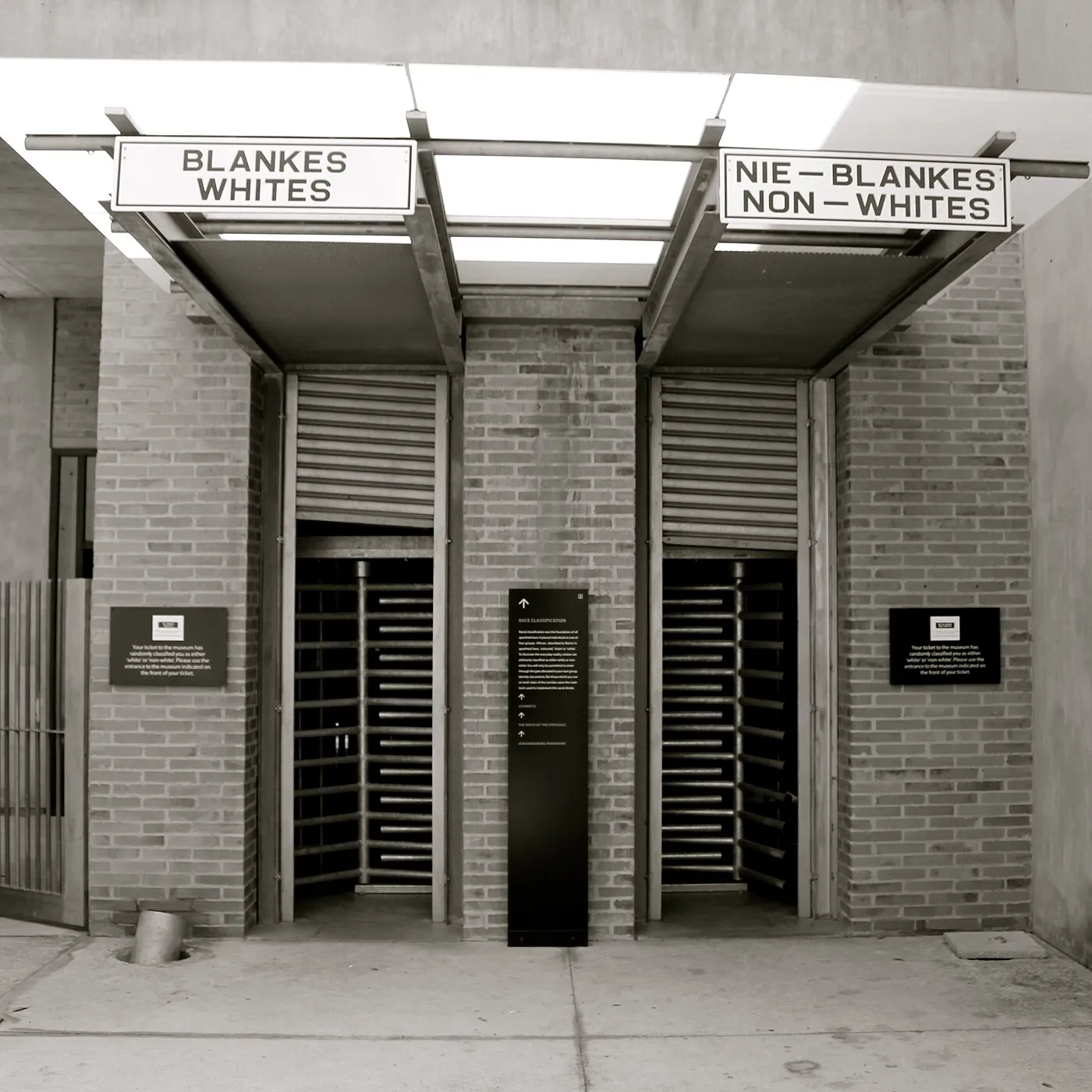
Collections Highlights
Segregated entrance - the first exhibit is the walk itself, through "white" or "non-white" cages assigned at random by your ticket. Pillars of the Constitution - seven tall concrete columns at the threshold, inscribed with the values of democratic South Africa: democracy, equality, reconciliation, diversity, responsibility, respect and freedom. Casspir
- a hulking armoured police vehicle of the kind that patrolled the townships, displayed as a monument to state force. Nooses installation - a stark hanging exhibit, one noose for each of the political prisoners executed under apartheid-era security legislation. Sharpeville and Soweto footage - riveting newsreel of the 1960 massacre and the 1976 student uprising that galvanised global condemnation. Nelson Mandela exhibition - a dedicated gallery tracing his life from the rural Transkei through 27 years of imprisonment to the presidency. Solitary confinement cell - a bare recreated cell that conveys the isolation inflicted on detainees. Truth and Reconciliation gallery - testimony from the hearings that chose public reckoning over revenge.
Guided Tours
Expert guides transform the Apartheid Museum from a dense, sometimes exhausting walk into a coherent and deeply human story. The best lead you to the hinge moments — the Sharpeville footage, the nooses, the Soweto uprising room — and explain how each connects, rather than letting you drift past panel after panel. Many hold the Gauteng provincial guide badge and grew up in or around apartheid-era Johannesburg, so they layer personal memory over the archival record: what a pass book meant in practice, how forced removals emptied neighbourhoods like Sophiatown, why the release of Nelson Mandela in 1990 felt impossible until it happened. Most guides offer the museum as half of a themed day, pairing it with a Soweto tour that visits the Hector Pieterson Memorial and Vilakazi Street, or with Constitution Hill, where the country's highest court now sits on the grounds of a former prison.
Apartheid Museum timeline
-
National Party wins power
The National Party's election victory ushered in apartheid as official state policy, turning decades of segregation into a codified legal system.
-
Population Registration Act
Every South African was classified by race, the law the museum dramatises the moment you enter through a randomly assigned 'white' or 'non-white' gate.
-
Sharpeville massacre
Police killed 69 people protesting the pass laws; the museum's film footage of the day is among its most harrowing exhibits.
-
Soweto uprising
The 16 June student protests against Afrikaans-medium schooling, and the killing of Hector Pieterson, mark a turning point documented in detail here.
-
Release of Nelson Mandela
Mandela walked free after 27 years, the pivot toward negotiation that the permanent Mandela exhibition traces in full.
-
First democratic election
South Africans of every race voted together for the first time, the triumphant close to the museum's chronological journey.
-
Apartheid Museum opens
Opened on 30 November 2001 beside Gold Reef City, built and endowed by the casino's developers as a condition of their gaming licence.
When to Visit
Open Tuesday to Sunday, 9 AM to 5 PM, with the last tickets sold at 3:30 PM; the museum closes on Mondays and most public holidays. Allow a full two to three hours, since the galleries are designed as one continuous narrative and lose their impact if rushed. The calmest time to arrive is right at opening, before the mid-morning school groups file in on weekdays. Because the whole route is indoors, the museum works in any weather — a useful anchor for a day when Johannesburg's summer thunderstorms (November to February) threaten outdoor plans.
Admission and Costs
Adult admission is R120 (about $7) and children under 18 pay R65. A guided tour of the museum itself runs roughly R500-800 per group, while a combined Apartheid Museum and Soweto day tour — typically including hotel pick-up and a Soweto lunch — costs about R1,500-2,500 per person. Tickets are bought at the on-site office, and there is a large car park, which matters because the museum sits on the city's southern fringe with little else within walking distance.
The Case for a Guide
The Apartheid Museum is unusually text- and film-heavy, and a knowledgeable guide is what turns its dense walls of documents, photographs and footage into a story you carry out with you. Walking it alone, many visitors photograph the panels without grasping how the individual laws interlocked or who the faces in the images are; a registered Gauteng tourist guide reads the museum through South African eyes and earns the fee several times over:
- Context for the laws — explaining how the Population Registration, Group Areas and pass laws reshaped daily life, not just reciting their names from a plaque.
- Pacing the narrative — steering you through the 22 exhibition areas to the pivotal rooms so you leave moved rather than overwhelmed.
- First-hand perspective — many Johannesburg guides grew up under or just after apartheid and add lived memory to the recorded history.
- Joined-up day planning — bundling the museum with Soweto or Constitution Hill so the sites reinforce one another.
Tips for Visitors
Brace for emotional intensity: the exhibits are designed to unsettle, and the garden café is the place to decompress afterwards. Photography is allowed in most galleries but flash is prohibited in the film rooms. Because the site is a car ride south of the city centre, build it into a wider day — a morning here and an afternoon in Soweto is the classic pairing, and the themes continue at Freedom Park across in Pretoria. Wear comfortable shoes for the long indoor-and-outdoor route, and avoid arriving much after 2:30 PM, when too little time remains to do the full narrative justice.
Frequently Asked Questions
What time of year is best for visiting the Apartheid Museum?
Because the experience is almost entirely indoors, the museum is a reliable rain-or-shine option year round. The most comfortable months to pair it with an outdoor Soweto tour the same day are the mild Highveld shoulder seasons — March to May and September to November — when Johannesburg sits around 20-25°C. The summer months of November to February bring short, dramatic late-afternoon thunderstorms, so an early start keeps the day on track.
What are the opening hours of the Apartheid Museum?
The museum opens Tuesday to Sunday, 9 AM to 5 PM, with the last tickets sold at 3:30 PM, and it closes on Mondays and most public holidays. Arriving right at opening gives you the full narrative without feeling rushed and keeps you ahead of the weekday school groups that arrive mid-morning.
What does admission to the Apartheid Museum cost?
Adult entry is R120 (about $7) and children under 18 pay R65. A guided tour of the museum runs roughly R500-800 per group, while a combined Apartheid Museum and Soweto day tour, usually with hotel pick-up, costs about R1,500-2,500 per person. There is a large on-site car park.
How much time should visitors set aside, and how intense is the content?
Allow a full two to three hours: the 22 exhibition areas are built as one continuous story and lose their power if rushed. The content is deliberately confronting, with graphic footage of state violence and the Sharpeville and Soweto killings, so pace yourself and use the garden café afterwards to decompress. It suits older children and adults rather than young kids.
How do you get to the Apartheid Museum and what is nearby?
The museum stands in Ormonde on the southern edge of Johannesburg, beside the Gold Reef City casino and theme park, about 8 km south of the city centre — roughly a 15-minute drive or a short metered taxi or e-hailing trip. Most visitors combine it with Constitution Hill in the inner city and a guided tour of Soweto.