
Architecture
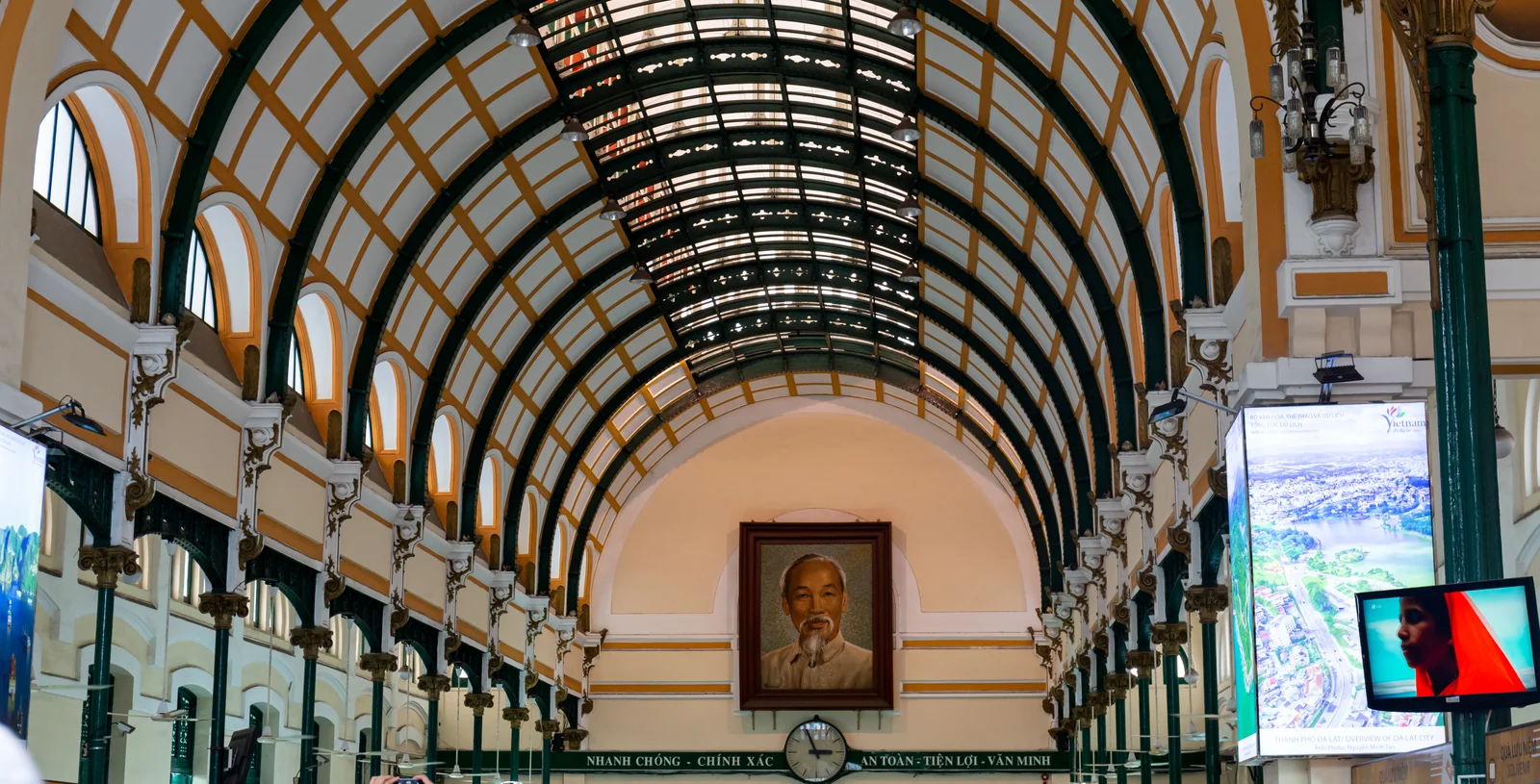
The building's signature is its interior structure: a long barrel-vaulted ceiling carried on a row of slender cast-iron columns and arched trusses, painted a soft green, with a clerestory of tall windows flooding the hall with daylight. The effect is deliberately church-like — a nave for the mail.
The facade is restrained neoclassical: a symmetrical composition with a central clock flanked by the names of European scientists and inventors in moulded cartouches, a colonial statement that this was an outpost of French rationalism. The two curving staircases and the original tiled floor complete a space that has changed remarkably little in over a century.
Historical Significance
When it opened in 1891 the post office was the communications hub of French Cochinchina, the colony's telegraph and mail nerve-centre, linking Saigon to Hanoi, Phnom Penh, and the wider French empire. The surviving wall maps record that network at its height.
It passed through every later chapter of the city's history — the Republic of Vietnam, the end of the war in 1975, and reunification — without losing its function, which is why it feels less like a monument than a survivor. The portrait of Ho Chi Minh added over the far arch marks the single clearest change of regime in a room that otherwise still works exactly as the French built it.
When to Visit
The post office is open daily, roughly 7 AM to 6 PM on weekdays and slightly shorter hours at weekends, following normal Vietnamese postal service times. A look around the hall takes 15 to 30 minutes, more if you queue to post a card or browse the souvenir stalls along the sides.
It is busiest in the middle of the day when tour groups cross from the cathedral. Come soon after opening for the quietest light in the hall and the shortest queues at the historic wooden booths, and pair it with an early look at the cathedral exterior before the square fills up.
Admission and Costs
Entry is completely free, which makes the post office one of the best-value sights in the city — a genuine colonial interior you can walk straight into at no charge. You only spend money if you choose to.
Stamps and postcards cost a few thousand đồng each, so mailing a card home runs well under US$2, and the souvenir counters sell the usual lacquer and handicrafts at tourist prices worth a polite haggle. A cyclo or walking guide of the colonial quarter that includes the post office typically costs US$8–15 for a short loop or US$40–80 for a half-day private city guide.
Tips for Visitors
Post a postcard from one of the original wooden booths — it is cheap, quick, and the most characterful souvenir you will send from Ho Chi Minh City. Buy the card and stamp at the counter, write it at the booth, and drop it in the box on the way out.
Photograph the hall from just inside the main doors, down the central aisle, to get the vault, the windows, and the Ho Chi Minh portrait in one frame — and do it early before the tour groups arrive. Next door, the shaded Book Street (Đường Sách) is a pleasant five-minute detour before you move on to the Reunification Palace.
Frequently Asked Questions
Is the Saigon Central Post Office still a working post office?
Yes — this is what sets it apart from a museum. More than 130 years after it opened, the building is still the city's main post office, with staffed counters selling stamps, handling parcels, and running a currency-exchange and phone desk down the sides of the hall.
You can genuinely post a letter or postcard home from the original wooden booths, which is the most atmospheric souvenir in Ho Chi Minh City. The tourist crowds fill the central aisle, but the side counters are doing ordinary daily business for Saigon residents the whole time.
Did Gustave Eiffel build the Saigon post office?
Almost certainly not, though the claim is on half the guidebooks and on signs inside. The building is credited to the French architect Alfred Foulhoux, and the attribution to Gustave Eiffel appears to be a persistent local legend rather than documented fact.
The myth sticks because the hall's iron-and-glass vault looks like Eiffel's railway-station engineering of the same era. The same false credit is attached to the Notre-Dame Cathedral across the square. Enjoy the ironwork for what it is; the real designer's name is simply less famous.
What are the old painted maps inside?
Two large hand-painted maps survive on the upper walls of the hall. One shows the telegraph lines of southern Vietnam and Cambodia as they stood in 1892; the other maps Saigon and its surroundings in 1892, when the city was the capital of French Cochinchina.
They are original features, not reproductions, and reward a few minutes with your neck craned. At the far end, a large portrait of Ho Chi Minh presides over the hall — the single clearest sign that you are in a reunified Vietnam and not a surviving corner of colonial France.