
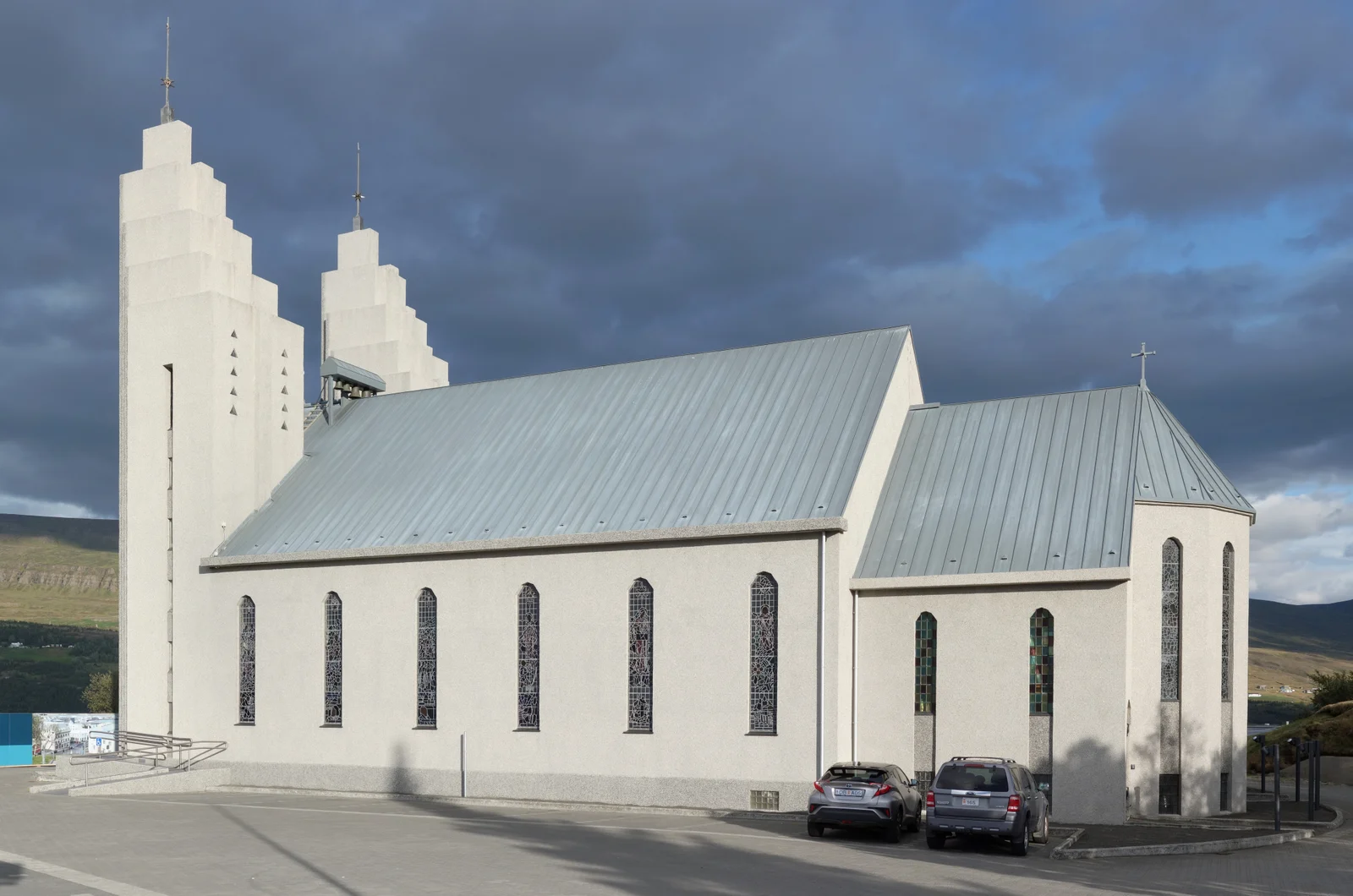
Spiritual Significance
Akureyri Church serves as the principal Lutheran parish for Iceland's second-largest urban area, part of the National Church of Iceland (Þjóðkirkjan) that traces its institutional roots to the Reformation of the 16th century. For a town of its size, the building's scale and architectural ambition reflect how central the church remained to civic identity even as Iceland urbanised and secularised through the 20th century. The suspended votive ship inside is more than decoration: it belongs to a long Nordic maritime tradition of churches holding a model vessel as a symbol of protection for parishioners who make their living, and sometimes lose their lives, at sea — a resonant image in a fjord town built on fishing. The Coventry window, though foreign in origin, has taken on local meaning as an emblem of survival and unlikely inheritance, regularly pointed out to visiting school groups and confirmation classes as a reminder that Akureyri's small church holds an artefact tied to one of the 20th century's defining wartime tragedies.
Visitor Etiquette
As an active place of worship, Akureyri Church expects the same quiet courtesy shown at any working church: speak softly inside, switch phones to silent, and avoid photographing during services, weddings, or funerals, which take precedence over sightseeing. Modest dress is appreciated though not strictly enforced. The stairway and plaza outside are treated as public space and can be used freely for photographs at any time, including outside opening hours. Because the church is small and intimate compared with grander European cathedrals, large tour groups are asked to keep noise down so the building retains the calm atmosphere its Lutheran congregation values. Donations toward the church's maintenance are welcomed but never required, and visitors are free to sit quietly in the pews without being approached by staff.
When to Visit
The church is generally open to visitors on weekday mornings and early afternoons, though exact hours shift with the season and with services, weddings, or concerts taking priority — it is worth checking current opening times locally before making a special trip, particularly outside the summer months. The exterior, stairway, and hilltop views are accessible at any hour and cost nothing. Midsummer visits benefit from Akureyri's near-continuous daylight in June and July, when the church and its stairway are lit long into the evening. Winter visitors should be prepared for icy steps and shorter daylight, though the interior lighting makes the nave atmospheric on dark afternoons.
Admission and Costs
Entry to Akureyri Church is typically free, in keeping with most parish churches in Iceland, though a small donation box near the entrance supports the building's upkeep. Occasional organ recitals or choir concerts may carry a modest ticket price, usually announced locally rather than sold in advance online. There are no facilities to book or reserve — visitors simply walk up the stairway and enter when the doors are open. Combine a visit with a stroll through central Akureyri's pedestrian shopping street, Hafnarstræti, a short walk downhill, where cafés and small museums offer an easy way to fill out a half-day itinerary around the church.
Tips for Visitors
Climb the stairway rather than driving up, if you are able — the view back over the harbour and across Eyjafjörður improves with every step, and the final approach frames the towers dramatically overhead. Early morning and late evening in summer bring the softest light for photographs, particularly when the sun sits low over the fjord. If you plan to go inside, check for scheduled services or weddings, which can temporarily close the nave to sightseers. Pair the church with a walk through the nearby Akureyri Botanical Garden, a ten-minute walk away, for a gentle half-day covering two of the town's most distinctive sights. Winter visitors should wear boots with good grip, as the long stairway ices over readily in the sub-Arctic cold.
Frequently Asked Questions
Who designed Akureyri Church, and is it related to Hallgrímskirkja in Reykjavik?
Akureyri Church (Akureyrarkirkja) was designed by Guðjón Samúelsson, who served as Iceland's state architect from 1920 until his death in 1950 and left a deeper mark on the country's civic architecture than almost anyone else. He designed both this church and Reykjavik's far larger Hallgrímskirkja around the same design philosophy — stepped concrete towers meant to evoke the hexagonal basalt columns found across Iceland's lava fields. Akureyri's church was consecrated first, in 1940, sixteen years before construction even began on its Reykjavik cousin, making it an earlier and more compact expression of the same idea. Locals sometimes call it "the little sister" of Hallgrímskirkja, though it stands entirely on its own architectural merits.
What is the story behind the stained-glass window inside?
The most talked-about feature inside is a stained-glass window in the centre of the choir that was originally made for England's medieval Coventry Cathedral. It had been removed from display and was in storage in London when a merchant purchased it and eventually arranged for it to be installed in Akureyri instead. That decision proved fateful: Coventry Cathedral was almost entirely destroyed by German bombing during the Blitz in November 1940, so the window survives today only because it never went back into its original home. The church's other windows, by contrast, were made specifically for the building and depict scenes from Icelandic religious life.
Do you need to climb the stairs to reach the church?
Yes — Akureyri Church sits on a hill overlooking the town centre and is approached by a long, straight flight of steps that has become a landmark in its own right, often used as a meeting point and a favourite spot for photographs looking back down over the harbour and Eyjafjörður fjord. There is also a road that winds up to the church for visitors who prefer not to climb, with limited parking near the entrance. Either way, the elevated position is the whole point: the church was sited deliberately so its twin towers would dominate the Akureyri skyline from almost every angle in town.