
Activities
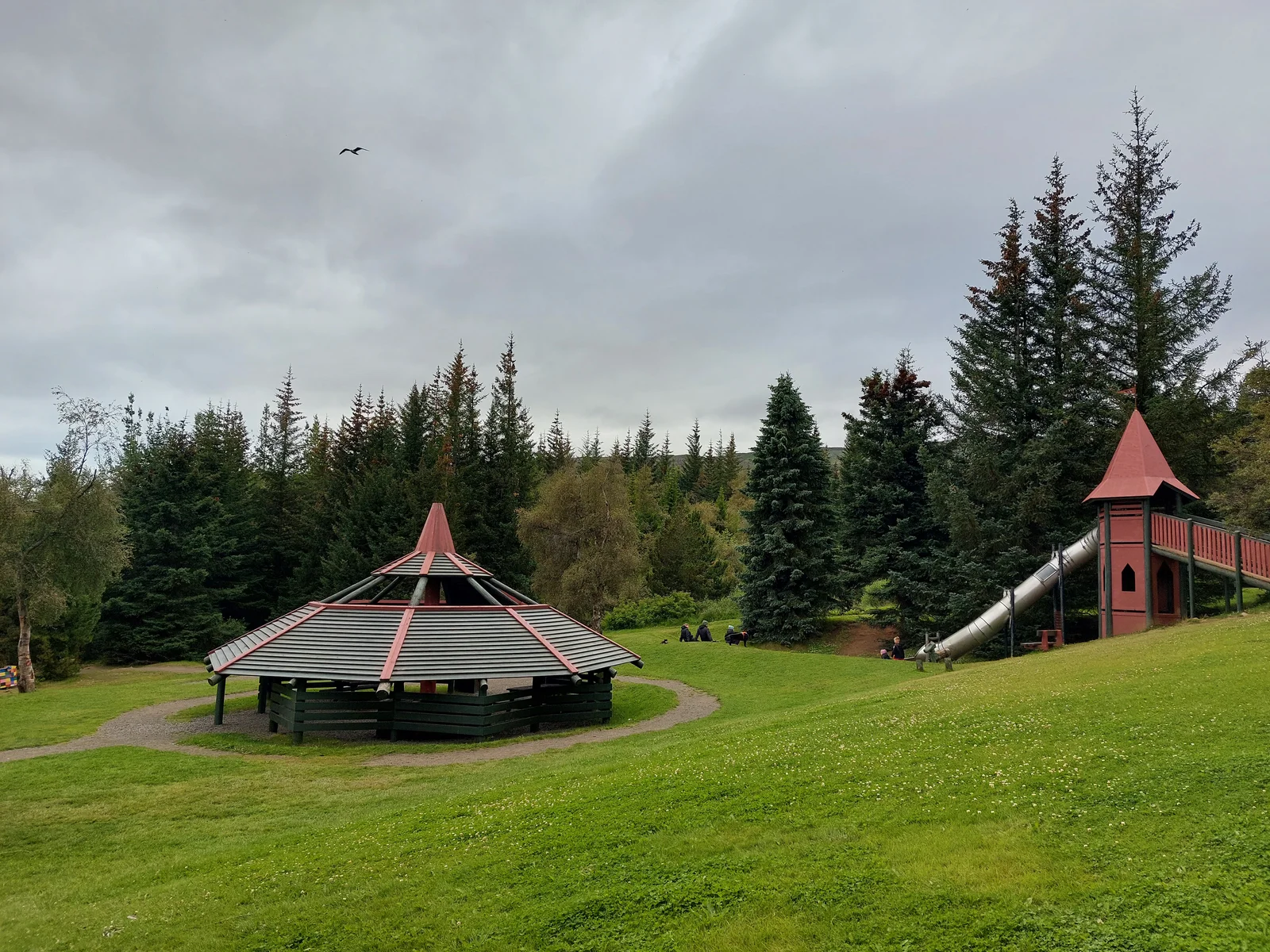
Kjarnaskógur is built for movement. Walking and running are the mainstays, on a graded network that ranges from flat, buggy-friendly gravel loops near the entrance to longer, rougher trails climbing the wooded slopes. Mountain biking has its own marked routes, and the forest is a favourite training ground for local riders. There is an outdoor exercise circuit with fixed equipment, a disc-golf-style course in places, and generous picnic and barbecue areas for gatherings. In winter, the same trails are groomed for cross-country skiing, and the lit paths make walking and running possible through the dark months. For families, the playground near the main car park is a destination in itself. None of it requires booking or a guide — you arrive, choose a loop to match your energy, and go.
Seasonal Highlights
Each season reshapes the forest. Midsummer brings near-perpetual daylight, the peak of the greenery, and the best conditions for long evening walks under a sun that barely sets. Late summer is berry season, when locals forage among the undergrowth. September turns the birch and larch gold and amber, a brief, vivid autumn rare enough in Iceland to be worth timing a visit around. Deep winter transforms Kjarnaskógur into a cross-country skiing landscape, with groomed tracks and lit paths cutting through snow-laden conifers under the polar night — and, on clear evenings, a chance of the Northern Lights overhead once you step into a clearing away from the town's glow. The spring thaw is the low point, muddy and bare, before the cycle begins again.
When to Visit
Kjarnaskógur is open and free at all hours, all year, and each season offers something different. Summer (June–August) is the obvious highlight: long daylight — including near-midnight brightness around the solstice — mild temperatures, and lush foliage make it ideal for walking, biking, and family picnics. Autumn brings colour to the birch and larch in September. Winter is quieter but far from closed: the paths are lit against the polar darkness and the tracks are groomed for cross-country skiing, so the forest stays in daily use even when the fjord is frozen at the edges. Spring is the muddiest, thaw-softened season and the least rewarding underfoot. Any visit is best matched to Akureyri's changeable weather — the trees themselves are a welcome shelter when a wind is coming off Eyjafjörður.
Admission and Costs
There is no admission fee to Kjarnaskógur — it is a public recreational forest, free to enter on foot, bike, or ski at any time, with free parking at the main entrance. The only costs are optional: bike or ski-equipment hire arranged in town, or a coffee and cake afterwards in central Akureyri. Guided nature or forestry walks, when arranged through a local operator, are inexpensive by Icelandic standards and generally run as part of a broader Akureyri walking programme rather than as a standalone ticket. Because the forest asks nothing of visitors beyond ordinary outdoor clothing and a little daylight, it is one of the few genuinely free-of-charge highlights in a country where organised sights and tours are otherwise expensive.
The Case for a Guide
Kjarnaskógur needs no guide to enjoy — that is rather the point of a free town forest. Where a guide adds value is in context and combination. A local guide can explain why a forest is such an unlikely, hard-won thing in Iceland, pointing out the introduced spruce and larch among the native birch and telling the story of the decades of planting that created the wood. Guides running Akureyri walking tours often fold the forest into a wider loop that takes in the botanical garden, the church, and the waterfront, turning a simple stroll into a portrait of how the "Capital of the North" has greened its Arctic setting. In winter, a guide who knows the groomed tracks and the aurora-viewing clearings can make the dark months genuinely rewarding rather than merely cold.
Tips for Visitors
Dress for Akureyri's weather rather than the calendar — even in summer a fjord wind can turn a warm afternoon sharp, and the forest's shelter is part of its appeal. In winter, stick to the lit and groomed paths and bring a head torch if you plan to wander beyond them, since daylight is scarce and the deeper trails are unlit. Families should head straight for the playground and picnic area near the main car park, which has barbecue spots and open ground for children. Cyclists will find dedicated mountain-bike trails, but should keep to them and yield to walkers on the shared gravel paths. Combine a forest walk with the nearby Akureyri Botanical Garden and the town's church for a full, low-cost half-day on foot.
Frequently Asked Questions
Why is a forest a notable attraction in Iceland?
Because Iceland has almost no forest. Centuries of settlement, grazing sheep, and a harsh sub-Arctic climate stripped the island of the birch woodland that once covered perhaps a quarter of it, leaving the famously treeless landscape visitors expect. A genuine, mature, walkable forest is therefore a novelty and a point of local pride — hence the old Icelandic joke about what to do if you get lost in a forest here: stand up. Kjarnaskógur is the country's most-visited forest, the result of decades of deliberate planting by the local forestry society on the southern edge of Akureyri, and for the town's residents it is the everyday green lung that a city park would be elsewhere.
What can you do in Kjarnaskógur?
A great deal, in every season. The forest is laced with a network of gravel and paved paths for walking and running, many of them lit through the dark winter months, plus dedicated mountain-biking trails, outdoor exercise stations, and one of Akureyri's best children's playgrounds with picnic areas and barbecue spots. In summer it is a place for family strolls, berry-picking, and escaping any wind off the fjord; in winter the tracks are groomed for cross-country skiing and the lit paths stay usable through the long polar nights. Because it sits just minutes from the town centre, locals use it daily rather than as a special outing.
How do I get to Kjarnaskógur from central Akureyri?
The forest lies on the southern edge of town, a short drive or bus ride — roughly five to ten minutes by car — from the centre of Akureyri, with a car park at the main entrance near the playground and picnic area. Fitter visitors can reach it on foot or by bike along the shoreline paths in perhaps half an hour. There is no admission gate and no fee; you simply arrive and walk in. Because it is a working recreational forest rather than a remote wilderness, it needs no guide or special preparation beyond ordinary outdoor clothing.