
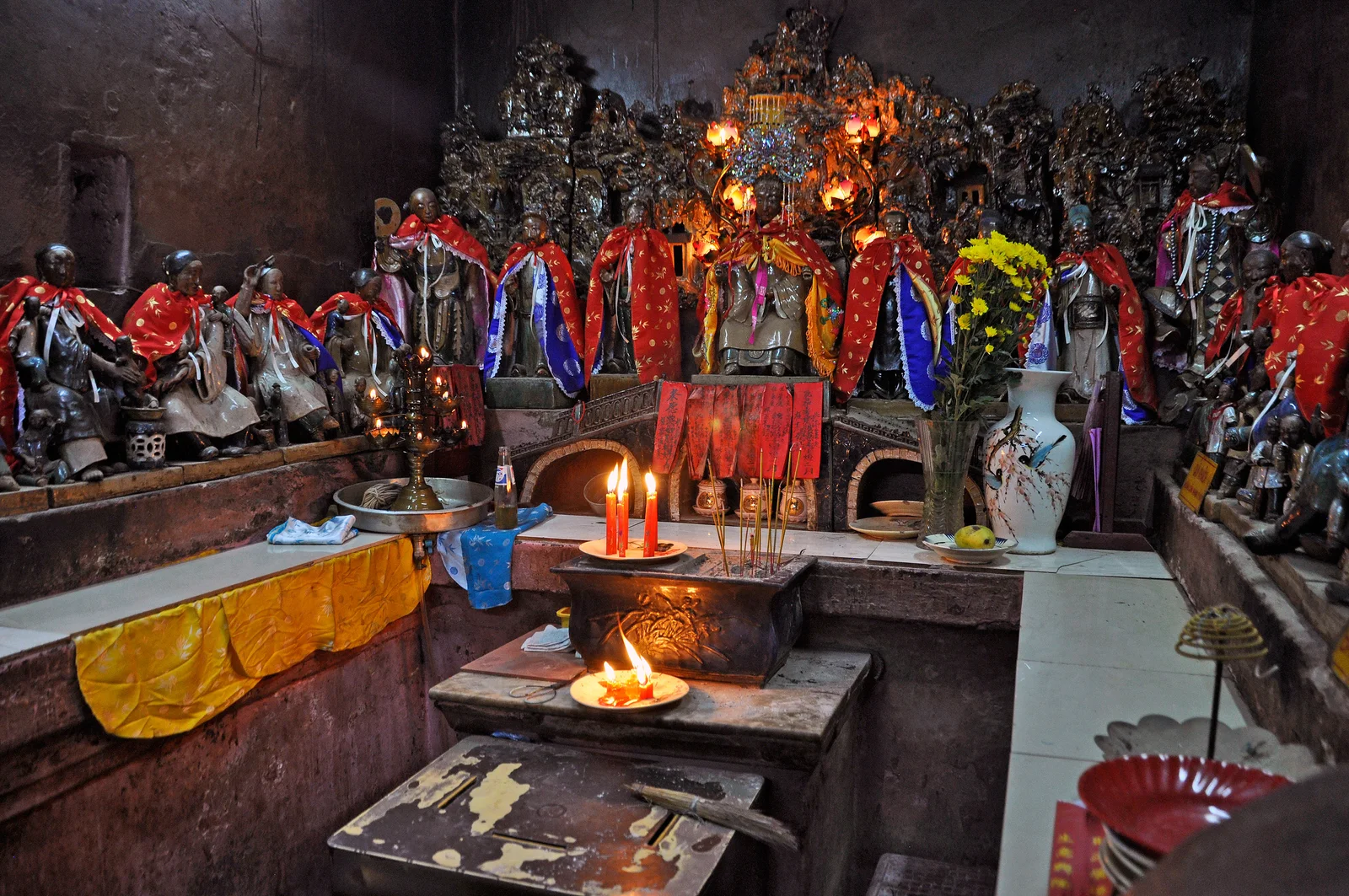
Spiritual Significance
The temple is dedicated to the Jade Emperor, in Taoist belief the supreme deity who rules heaven and judges the dead, and its layout maps that cosmology: the Emperor in the centre, his guardians and generals around him, and the courts of hell in a chamber to the side. It is a working theology rendered in carved wood.
Beyond the Taoist core, the temple is a focus of popular devotion — above all the fertility shrine to Kim Hoa Thánh Mẫu, where women come to pray for children and give thanks for births. For the city's Chinese-Vietnamese community it is also a tie to Cantonese heritage, kept alive through more than a century of Saigon's upheavals.
Visitor Etiquette
Dress modestly — covered shoulders and knees — and move slowly and quietly; this is an active temple, not a photo set. Step around people who are praying rather than in front of them, and never climb on or touch the altars or statues.
Photography is generally tolerated, but avoid using flash, do not photograph worshippers at prayer without consent, and put the camera away in the Hall of the Ten Hells if people are praying there. If you light incense, follow what local visitors do, and take your shoes off where signs or worn thresholds indicate. A small donation on the way out is a courteous close to the visit.
When to Visit
The temple is open daily, roughly 7 AM to 6 PM, with longer hours and much bigger crowds on the 1st and 15th of each lunar month, when worshippers pour in to pray and the incense haze is at its thickest. A visit takes 20 to 40 minutes.
For the quietest experience, come mid-morning on an ordinary weekday. If you want to see the temple at full devotional intensity — and do not mind the crush — time it for a lunar festival day instead. Either way, the interior stays dim and smoky, so give your eyes a moment to adjust.
Admission and Costs
Entry to the Jade Emperor Pagoda is free, like most working temples in Vietnam. There is no ticket desk; you simply walk in, though a small donation in the offering boxes is appreciated and helps maintain the building.
You may be offered incense, birds, or turtles by vendors near the gate — buying incense to make your own offering is fine and costs very little, but think twice about the animals (see the FAQ). A private guide who can read the shrines typically folds the temple into a half-day District 3 or local-life tour at standard city rates of US$40–80 per group.
Tips for Visitors
Pair the pagoda with a wander through leafy District 3, which trades the landmarks of District 1 for café culture and some of the city's best street food — the temple makes a calm, incense-scented start to that kind of local-life morning in Ho Chi Minh City.
Go early on a weekday to avoid both the heat and the lunar-festival crush, let your eyes adjust to the dim interior before reaching for the camera, and give the carved Ten Hells panels a few unhurried minutes — they are the detail you will remember long after the gilded statues blur together.
Frequently Asked Questions
Is the Jade Emperor Pagoda a Buddhist or Taoist temple?
It is primarily a Taoist temple, built by Saigon's Cantonese community and dedicated to the Jade Emperor (Ngọc Hoàng), the supreme deity of Taoist heaven. In practice it blends Taoist and Buddhist worship, as many Vietnamese and Chinese temples do, with Buddhist figures sharing the halls.
That syncretism is part of what makes it feel so dense and layered: the main chamber centres on the Jade Emperor, flanked by his guardians, while side rooms hold shrines to deities of fertility, childbirth, and the underworld. It is one of the most actively worshipped temples in Ho Chi Minh City, not a museum piece.
What is the Hall of the Ten Hells?
In a side chamber, a series of intricately carved wooden panels depicts the ten courts of hell and the punishments meted out to sinners in each — one of the most striking pieces of religious folk art in the city, and the detail most visitors remember.
The carvings illustrate the Taoist vision of judgement after death and remain an object of genuine devotion, not decoration. Look, but do so quietly: worshippers come to these panels to pray, and the chamber is often thick with incense smoke.
Should I release the turtles or birds offered outside?
It is best not to. The pond beside the temple is full of turtles and tortoises, many left by worshippers as a merit-making release, and vendors outside may offer you animals or caged birds to free for luck.
Conservationists discourage buying animals to release: it fuels a trade that captures them in the first place, and released turtles crowd an unsuitable pond. You can admire the turtles without adding to it. The respectful way to visit is to leave the animals where they are and simply observe the ritual.