
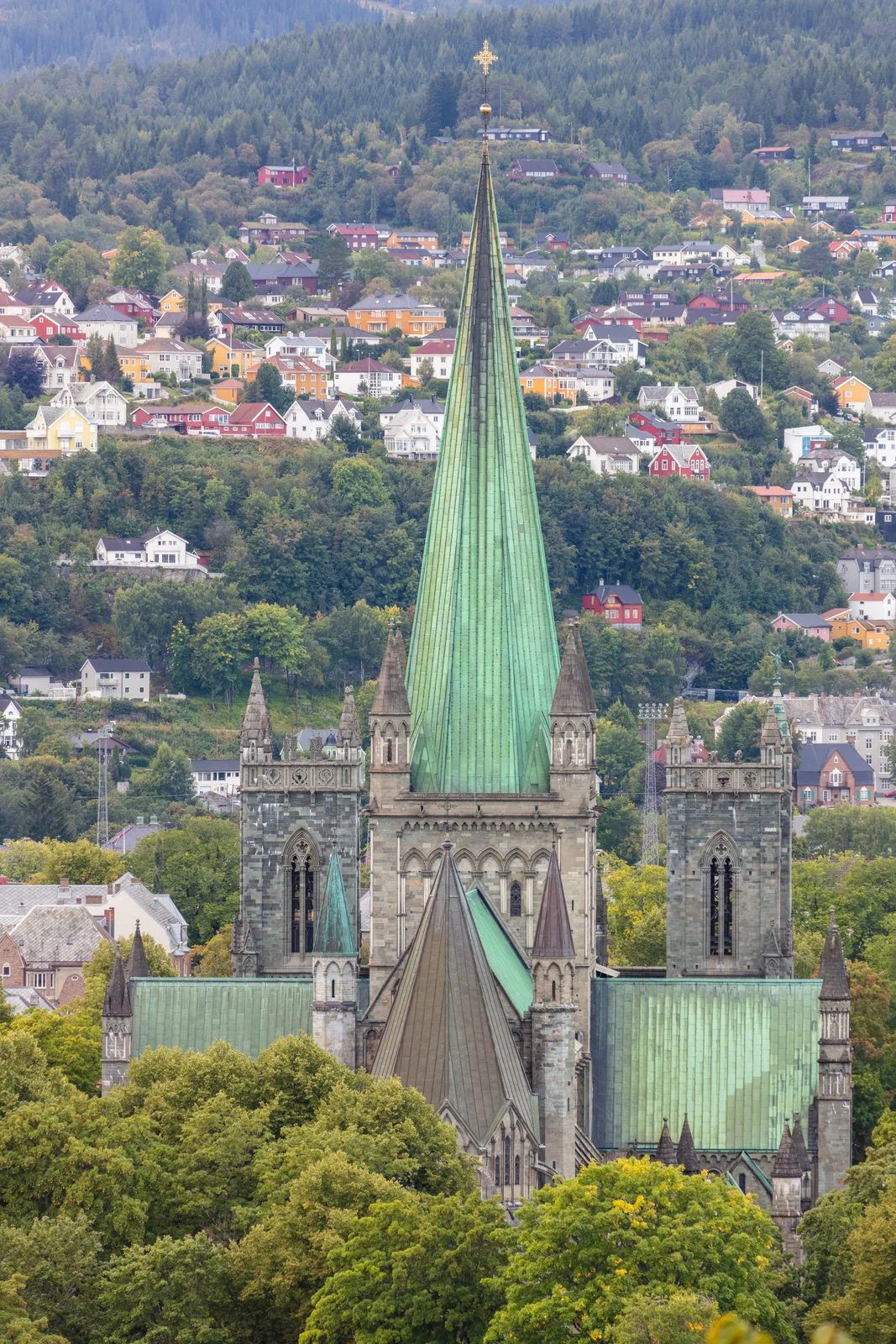
Spiritual Significance
Nidaros is, above all, the shrine of St Olav, the king whose martyrdom and cult unified and Christianised Norway. For five centuries it was the greatest pilgrimage church of the north, its high altar raised over the saint's tomb in the octagon that was purpose-built to receive streams of pilgrims. The Reformation stripped away the cult and the relics, but the building's sacred role never wholly lapsed.
Today that spiritual identity is doubly alive: as Norway's national sanctuary and coronation church, it binds the monarchy and the nation to a thousand years of Christian history, and as the goal of the revived St Olav Ways, it once again welcomes pilgrims who walk hundreds of kilometres to reach it and receive the Olav Letter. Few churches so completely fuse national symbolism with genuine, living devotion.
Visitor Etiquette
As a working cathedral and national shrine, it asks the respect due to any place of worship: dress modestly, keep your voice hushed, silence your phone, and remove hats indoors. Sightseeing is suspended during services, weddings, funerals and concerts, though visitors are welcome to attend worship.
Photography is restricted in parts of the interior and prohibited during services — look for the posted rules and never use flash near the medieval stonework and altars. Move quietly and slowly, give pilgrims and worshippers space at the shrine and in the choir, and don't touch the carvings or furnishings. A donation or the paid admission helps maintain a building whose upkeep is a continuous and costly task.
When to Visit
The cathedral keeps seasonal opening hours for visitors and is closed to sightseeing during services, concerts and events, so check the current schedule — hours are longest in the summer pilgrimage and festival season. The most special time to come is around St Olav's feast (Olsok, late July), when the Olavsfestdagene festival fills the city and cathedral with music and pilgrims.
A visit to the interior takes about forty-five minutes to an hour, longer if you climb the tower or tour the adjoining Archbishop's Palace and Crown Regalia. The west front can be enjoyed from the churchyard at any hour and is beautifully lit in the dark months. Set aside a half-day to combine the cathedral, the palace museum and a walk to the nearby Old Town Bridge.
Admission and Costs
Adult admission to the cathedral is around NOK 120–150 ($11–14), with a combined ticket covering the cathedral, the Archbishop's Palace museum and the Crown Regalia offering better value at roughly NOK 220–260 ($20–24). Children are reduced or free, and entry is free if you attend a service. Climbing the tower carries a small extra charge in season.
Concert tickets are sold separately and are a rewarding way to hear the great organ in its proper setting. A guided tour of the cathedral, sometimes included in the ticket, brings the architecture and the St Olav story to life. All prices are estimates that change over time, so confirm the current rates and ticket combinations when planning.
The Case for a Guide
A guide is invaluable at Nidaros, where a thousand years of history are written into stone that gives up little without explanation. They tell the story of St Olav and the pilgrimage, distinguish the medieval fabric from the great modern restoration, decode the crowded statuary of the west front, and lead you through the octagon built around the saint's tomb. Guides can arrange the combined visit to the Archbishop's Palace and Crown Regalia so the cathedral, monarchy and pilgrimage make a single narrative, and they link it to the wider city — the wooden Bakklandet and the Kristiansten Fortress above it. For Norway's most historically dense building, that guidance is the difference between admiring a facade and understanding a nation.
Tips for Visitors
Buy the combined ticket if you have any interest in history — the neighbouring Archbishop's Palace and the Crown Regalia add enormously to the cathedral and are steps away. In season, climb the tower for the view over Trondheim's coloured wharves and river.
Time a visit for a concert or, best of all, for the Olsok festival in late July if your dates allow. Admire the carved west front slowly from the churchyard, spotting the saints and kings among the statues. Respect any service in progress, and combine the cathedral with a walk across the river to the wooden lanes of Bakklandet and up to Kristiansten Fortress.
Frequently Asked Questions
Why is Nidaros Cathedral so important to Norway?
It is built over the burial place of St Olav — King Olav II Haraldsson, killed at the Battle of Stiklestad in 1030 and soon venerated as a saint — and became the greatest pilgrimage destination in northern Europe. It is Norway's national sanctuary and its coronation church: Norwegian monarchs are ceremonially blessed here, and the Crown Regalia are kept in the neighbouring Archbishop's Palace. No other church holds the same place in Norwegian identity.
Can I climb the tower or go inside?
Yes. Visitors can tour the interior and, in season, climb the central tower for views over Trondheim, subject to opening times and a separate ticket. The cathedral is a working church, so access is limited during services and concerts. The elaborately carved west front, covered in statues of saints and biblical figures, can be admired for free from the churchyard at any time.
What is the pilgrimage connection?
Nidaros is the end point of the St Olav Ways (Pilegrimsleden), a network of medieval pilgrim routes — the best known running roughly 640 km from Oslo — that were revived in recent decades. Pilgrims who complete the walk receive the Olav Letter at the cathedral, and the pilgrimage tradition, suppressed after the Reformation, is once again a living part of the building's life.