
Fortification History
Kristiansten is a classic late-seventeenth-century bastioned fortress, built to the geometric principles of the age so that its angled ramparts and the central donjon could cover every approach with defensive fire. Cicignon's rebuilding of Trondheim after the 1681 fire gave the city both a new street grid and this hilltop citadel as its landward shield, replacing older, weaker defences.
Its defining moment was the 1718 siege, when the fortress's guns and garrison helped repel Armfeldt's Swedish army and preserve Trondheim for Norway. The fortress was formally decommissioned as a military installation in 1816, its walls preserved thereafter as a monument, and it gained a further, sombre layer of history in 1940–1945, when the occupying forces used it as a place of execution — commemorated today by the memorial on the site.
Notable Rooms
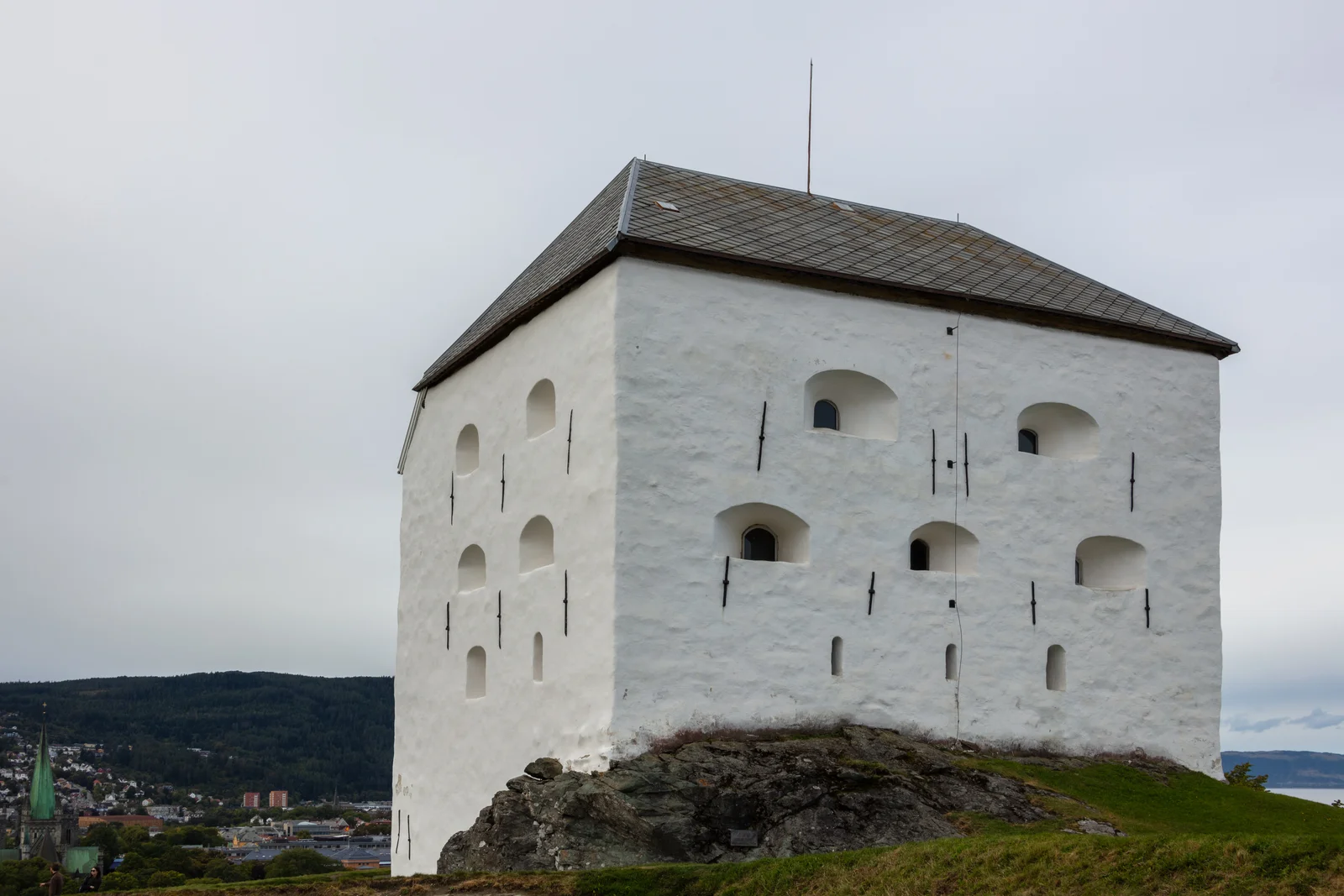
The heart of the fortress is the whitewashed keep (donjon), the tall central tower that anchors the defences and now holds a small museum interpreting the fortress's construction, the 1718 siege and its later history. Its thick masonry and simple, sturdy chambers convey the plain military purpose of the place far better than any grand interior.
Around the keep run the star-shaped ramparts and gun positions, from which the panorama over Trondheim opens in every direction and where old cannon still point toward the eastern approaches. The site also contains the wartime memorial to executed resistance members, a quiet counterpoint to the martial architecture. Together the keep, the walls and the memorial tell three chapters of the city's story — defence, endurance and remembrance — in a single compact hilltop.
When to Visit
The grounds are open all hours and free, so the fortress can be enjoyed at any time, but it is at its best in clear weather for the view and in the long light of a summer morning or evening. The white keep and museum keep seasonal hours, generally open in the summer months, so check ahead if you want to go inside.
Allow thirty to sixty minutes for a relaxed visit — longer if the museum is open or if you picnic on the ramparts to take in the panorama. The short uphill walk from Bakklandet takes ten to fifteen minutes, so most visitors reach it on foot as part of a wider city circuit. In winter the hilltop is exposed and cold, but the snowy view over the city is memorable.
Admission and Costs
Walking the ramparts and grounds is free, and the panorama over Trondheim costs nothing — reason enough to make the climb. The green hilltop is a popular spot for a picnic with a view.
The small museum inside the keep charges a modest admission of around NOK 100 ($9) for an adult when open in season, with reductions for children. A guided history tour taking in the fortress, usually as part of a wider city walk, runs roughly NOK 300–500 ($28–46) per person. As always these are estimates; confirm current museum hours and prices before you go, as the interior is not open year-round.
The Case for a Guide
A guide brings Kristiansten's grassy ramparts alive with the drama they now conceal — Cicignon's rebuilding of a burned city, the desperate winter siege of 1718 and the catastrophe that overtook the retreating Swedes, and the darker wartime history marked by the memorial. From the walls a guide can name every landmark in the panorama, tying the fortress to the wharves of Bakklandet below and the spire of Nidaros Cathedral across the river, and explaining how the three fit together in the defence and life of the city. For a site whose meaning is entirely historical, that storytelling is what turns a pleasant viewpoint into a vivid lesson in Trondheim's past.
Tips for Visitors
Go on a clear day for the view, which is the main reason to climb, and time it for the golden hour if you can — the low sun over the coloured wharves, the river and the cathedral spire makes the panorama unforgettable. Bring a windproof layer, as the exposed hilltop is cooler and breezier than the streets below.
Approach on foot uphill from Bakklandet for the most rewarding route, completing a circuit that also takes in Nidaros Cathedral. If the keep museum is open, step inside for the siege story; pause too at the memorial to the resistance members shot here during the war. A picnic on the ramparts is a fine way to end a Trondheim afternoon.
Frequently Asked Questions
When and why was Kristiansten Fortress built?
It was built between 1681 and 1685, immediately after a great fire destroyed much of Trondheim, to defend the city from the east — the direction of the Swedish threat. The overall plan for rebuilding the city and its defences was drawn up by Johan Caspar von Cicignon, and the fortress on the hill was the key strongpoint guarding the landward approach.
Did the fortress ever see battle?
Yes — famously so. During the Great Northern War, a Swedish army under General Armfeldt besieged Trondheim in the winter of 1718, and the fortress's defence helped force the Swedes to withdraw. That retreat across the mountains ended in disaster for the Swedish troops in a notorious blizzard. The citadel is remembered as the stronghold that saved the city.
Is there an entry fee and what can I see?
The grounds and ramparts are free to walk at any time and are chiefly visited for the sweeping views over Trondheim and the cathedral. The white keep (donjon) houses a small museum with a modest admission and seasonal opening hours. A memorial on the site also marks Norwegian resistance members executed here during the Second World War.