
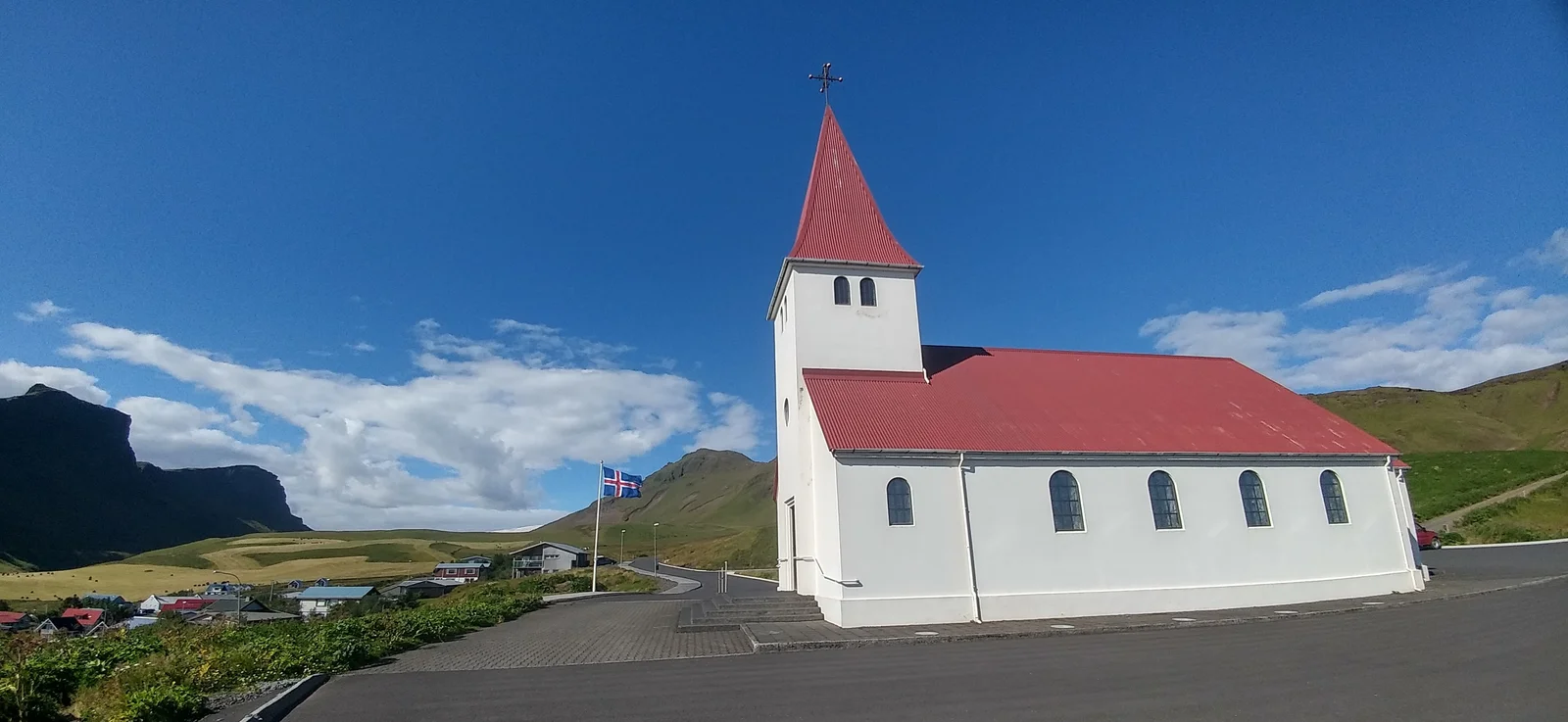
Spiritual Significance
Víkurkirkja holds a dual weight for the people of Vík that few churches anywhere can match: it is at once their place of worship and their promised refuge. As an active Lutheran parish church it marks the ordinary rhythm of village life — services, weddings, funerals, and the small congregation of a remote community — in a building whose plainness reflects the unadorned tradition of Icelandic country churches. But layered over that ordinary role is the extraordinary knowledge that this hill is where the village would run for its life. Living in the shadow of Katla, a volcano overdue for a major eruption, the residents of Vík carry the awareness that a jökulhlaup could one day sweep across their homes, and that the church on the height is the one place expected to stand above the flood. That the community's spiritual centre and its literal high ground are the same building gives Víkurkirkja a resonance that visitors sense even without knowing the geology — a small white church that quietly embodies both faith and survival on the edge of the ice.
Visitor Etiquette
Víkurkirkja is a living parish church and a genuine civic landmark, so a little restraint goes a long way. If the church is open and a service, wedding, or funeral is in progress, do not enter as a sightseer; wait outside or come back later, and never let a photograph intrude on a gathering. Inside, keep your voice low, dress modestly, remove hats, and ask before photographing people at prayer. On the hill, stick to the worn path rather than trampling the grass of the knoll, which is both church ground and an actively used space, and take any litter away with you. Be mindful, too, of the emergency signage marking the church as an assembly point — it is there for a real hazard, not for atmosphere. Above all, share the small viewpoint courteously in high season: it is a compact space, and everyone has come for the same red roof against the black beach.
When to Visit
The church hill is an open viewpoint you can walk up at any time, and it rewards visits in every season. Summer brings long daylight and the greenest hillside, the easiest footing on the path, and the classic bright-roof-against-black-beach photographs. Winter offers a different picture entirely — the white church against snow, low golden light, and, on clear dark nights, a real chance of the Northern Lights arcing over the roof, since the hill sits just above the village lights. The interior keeps only informal, seasonal opening hours and may well be locked, so treat going inside as a bonus rather than a plan. As everywhere in Vík, the weather is the deciding factor: the exposed hill is windy, and the finest views come on the calm, clear windows between the coast's frequent squalls.
Admission and Costs
Visiting Víkurkirkja is free. There is no admission charge to the church or its hill, and the walk up from the village centre costs nothing but a little effort. Parking in Vík is straightforward and generally free, and the church is close enough to reach on foot from anywhere in the small village. If the church is open, entry to the interior is likewise free, as befits an active parish church, though a small donation toward its upkeep is a courteous gesture. The only paid way to experience it is as a stop on a guided south-coast tour, priced per person for the whole day rather than for the church, which typically pairs Vík with Reynisfjara, Dyrhólaey, and waterfalls farther west.
The Case for a Guide
A guide transforms Víkurkirkja from a pretty roadside photo into a window on how Vík lives with its volcano. The church's real story — why it stands on that particular hill, what a Katla eruption and its glacial flood would mean, how the community rehearses gathering here — is invisible to a passing visitor and exactly the kind of context a local guide supplies. Guides running the south-coast route weave the church into the wider geological narrative of the region, linking it to the black sands and the Reynisdrangar stacks and to the ice cap inland, so a five-minute stop becomes a lesson in living on Iceland's most dangerous doorstep. They also handle the practicalities — when the interior is likely to be open, where to stand for the light, and how to fit the church around the tides and closures that govern nearby Dyrhólaey and Reynisfjara.
Tips for Visitors
Wear sturdy shoes and a windproof layer — the path up the knoll is short but steep and often slick, and the exposed top can be far windier than the sheltered village. For photographs, the church is loveliest with low light, early or late in the day, when the red roof glows against the dark beach; in winter, linger after dark on a clear night for a chance of aurora over the roof. Remember this is a working church and a serious civic landmark, not merely a photo prop: keep clear of any service or funeral, and read the emergency-assembly signage rather than treating it as decoration. Combine the short climb with the village's other sights and the coast walk toward Reynisfjara, and you have a satisfying half-day entirely on foot from central Vík.
Frequently Asked Questions
Why is Víkurkirkja built on a hill above the village?
The church's hilltop position is not only scenic — it is a matter of survival. Vík sits on a low coastal flat directly in the path of a potential glacial flood (jökulhlaup) from the Katla volcano beneath the Mýrdalsjökull ice cap just inland. A major Katla eruption would melt vast quantities of ice and send a wall of meltwater and debris across the plain, and Víkurkirkja, on its raised knoll, is the one building high enough to be expected to survive — so it is the village's designated assembly and evacuation point. Residents rehearse gathering there, which gives the modest white church a significance far beyond its size.
How old is the church and can I go inside?
The present Víkurkirkja dates from the 1930s — it was consecrated in 1934 — and its clean white walls and bright red roof make it the visual anchor of the whole village, visible from almost everywhere in Vík. It is a small, active Lutheran parish church, and visitors are generally welcome to step inside its simple interior when it is open and no service is under way, though opening hours are informal and not guaranteed. Even when the doors are shut, most people come for the exterior and the view from the hill over the red roof to the black beach, the sea stacks, and the ocean beyond.
What can I see from the church hill?
The knoll under Víkurkirkja is one of the best free viewpoints in Vík. Looking south, the red church roof sits in the foreground against the black-sand shoreline and, out to sea, the Reynisdrangar basalt sea stacks that also loom over Reynisfjara beach around the headland. Turning inland, you face the slopes leading up to the Mýrdalsjökull ice cap. The composition of white church, red roof, green hill, and black beach is one of the most photographed scenes on Iceland's south coast, and it is only a short, steep walk up from the village centre.