
Formation
The columns that give Reynisfjara its distinctive look are columnar basalt, formed when a thick lava flow cooled slowly enough for the contracting rock to crack into regular, mostly hexagonal columns — the same process responsible for Scotland's Giant's Causeway. At Reynisfjara the columns are stacked in tight, organ-pipe ranks around Hálsanefshellir cave, then fan outward near the roofline in a pattern that geologists call a colonnade-and-entablature structure, visible if you look closely at how the angle of the columns shifts from base to ceiling.
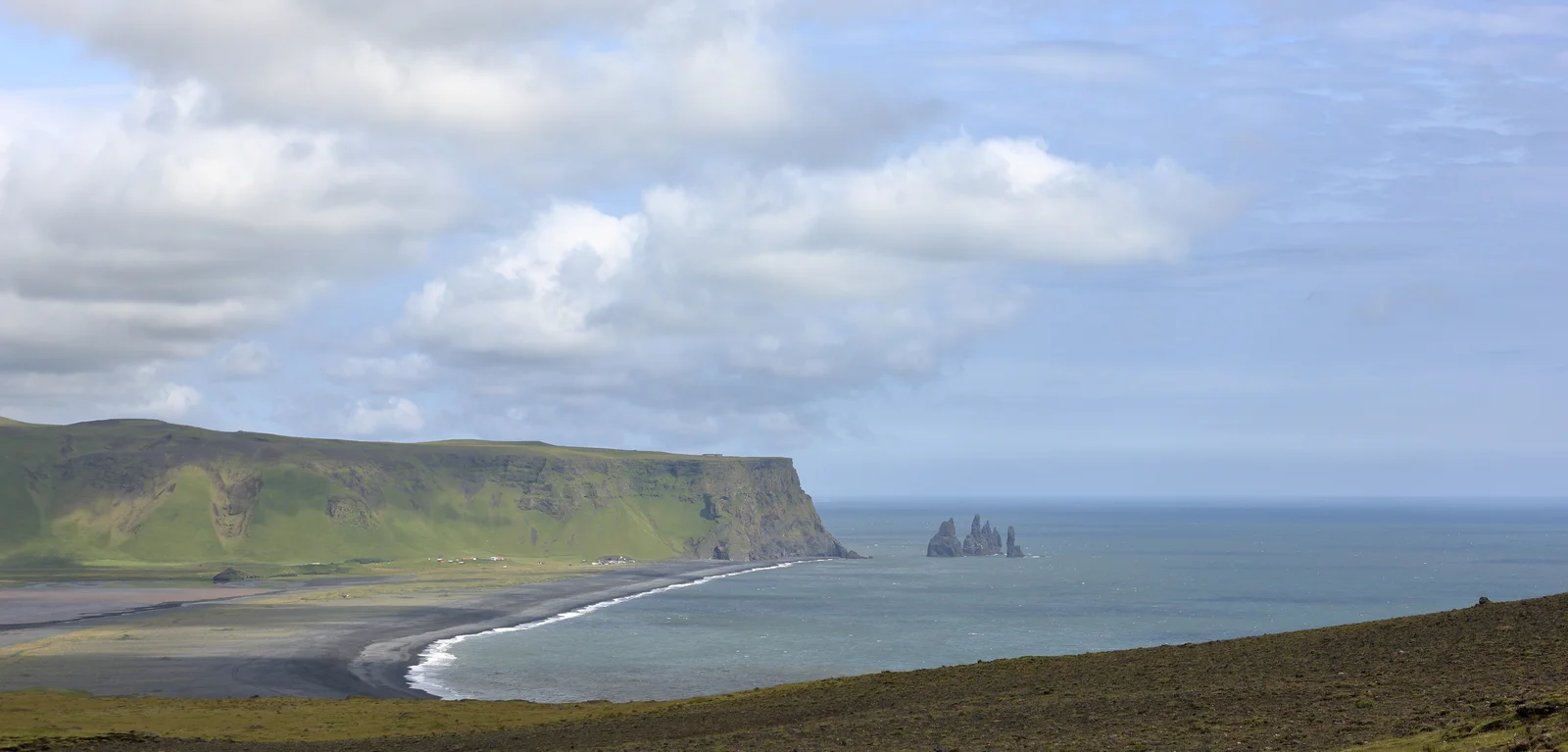
The black sand in front of the columns is the same basalt, broken down by an unusually energetic wave climate into fine, dark grains that stay wet and compact underfoot even well above the current waterline — one reason the beach looks deceptively safe far from the surf. Offshore, the same volcanic bedrock rises from the sea as the Reynisdrangar stacks, remnants of the same lava system left standing after the softer surrounding rock eroded away.
Geologically, the whole bay sits within a landscape shaped by Iceland's position on the Mid-Atlantic Ridge, where the North American and Eurasian plates pull apart and feed the volcanism that built this coastline. The nearby Mýrdalsjökull ice cap conceals the active Katla volcano, whose eruptions over thousands of years have contributed ash and lava to the same coastal system that produced the beach beneath your feet.
Wildlife
Reynisfjara's cliffs host nesting seabirds through the summer months, most visibly Atlantic puffins, which arrive from around May and stay into August, digging burrows into the grassy cliff tops above the columns. They are easier to see well at nearby Dyrhólaey, where the colony sits closer to eye level, but small numbers can be spotted from the beach itself on the cliffs east of the cave. Fulmars nest directly on the basalt ledges around Hálsanefshellir and are a near-constant presence, gliding along the cliff face on stiff wings even when the puffins have gone quiet for the day.
Arctic terns, fiercely territorial during nesting season, patrol the grassland above the beach and will dive at anyone who strays too close to a nest — a minor hazard worth knowing about if you walk the coastal path rather than staying on the sand. Offshore, harbour seals are occasionally visible bobbing beyond the surf line, though the rough water here makes sightings less reliable than at Iceland's calmer seal-watching beaches further north.
None of the wildlife at Reynisfjara requires a guide or permit to observe, but the same sneaker-wave hazard that threatens visitors also means birdwatching is best done from the upper sand or the grassy clifftop path rather than close to the water, where attention is better spent watching the ocean than the sky.
When to Visit
Reynisfjara is open around the clock and unstaffed, so there is no ticketed entry or fixed closing time — only daylight, weather, and tide govern a good visit. In the height of summer, June through early August, near-continuous daylight means the beach can genuinely be visited at any hour, and a late-evening trip after the coach tours have left is one of the best-kept secrets of the South Coast circuit. In winter the visiting window narrows to a few hours either side of midday, and storms can make the beach unsafe or simply unpleasant for days at a stretch.
Tides matter more here than most visitors realise. At high tide the flat sand in front of the cave narrows considerably and the safe standing area shrinks with it; low tide exposes more beach and generally feels calmer, though sneaker waves are not strictly tide-dependent and can occur at any state of the sea. Checking a tide table alongside the forecast from the Icelandic Meteorological Office before setting out is a habit worth forming.
Allow 45 minutes to an hour for an unhurried visit, longer if you plan to walk the full length of the black sand toward the cliffs at the bay's western end. Combine it with Dyrhólaey and the Skógafoss/Seljalandsfoss waterfalls further west for a full South Coast day, or treat Reynisfjara as a standalone stop if you are overnighting in Vík.
Admission and Costs
Reynisfjara itself is free to visit, and the car park beside the beach carries no parking charge as of the current season — a point worth reconfirming locally, since several South Coast sites have introduced small fees in recent years. There are no turnstiles, guides stationed at the entrance, or admission booths; the beach is simply a stretch of public coastline reached via a short paved road off Route 1.
Independent travellers with a rental car incur no cost beyond fuel and, if desired, coffee or a light meal at the small café near the car park, which also has restroom facilities. Those without a car typically join a South Coast day tour from Reykjavík, which folds Reynisfjara in alongside Skógafoss, Seljalandsfoss, and often Dyrhólaey; group coach tours run roughly ISK 11,000–16,000 per person, while a private guided car tour for up to four or five people runs considerably higher, often ISK 40,000–60,000 for a full day, but buys flexibility on timing and a guide who reads the surf conditions on arrival.
Glacier walks and ice-cave tours on nearby Mýrdalsjökull are sold separately by local operators based in and around Vík and are not bundled with a Reynisfjara stop, though many visitors combine both in a single South Coast trip.
Tips for Visitors
Treat the ocean, not the sand, as the thing to watch. Never turn your back on the water, stay well back from the waterline even when it looks calm, and do not approach the cave or the columns during periods of visibly heavy swell. If you see a wave retreat unusually far down the beach, move back immediately rather than treating it as an opportunity to get closer.
Wear proper footwear with grip — the wet basalt near the cave is slick, and the loose sand higher up the beach is tiring to walk in trainers. A windproof outer layer is not optional; even a calm-looking day at Reynisfjara often carries a stiff onshore wind that makes standing photography uncomfortable without one.
For the calmest visit, come at first light in summer or immediately after a tour convoy has departed. Pair the beach with Vík Church on the hill above the village for a wide photographic view that places Reynisfjara and the Reynisdrangar stacks in the same frame, and check the Safe Travel Iceland advisories before setting out if a storm system is forecast anywhere near the South Coast.
Frequently Asked Questions
Why is Reynisfjara Beach considered dangerous?
The threat comes from sneaker waves — swells that arrive without the visual build-up of normal surf and can surge 30 metres or more up the flat sand with little warning. Because the seabed shelves steeply just offshore, energy that would dissipate gradually on a shallower beach instead arrives in short, powerful bursts, and the backwash can pull a standing adult off their feet. Fatalities have occurred here, which is why rescue authorities post permanent warnings and why locals repeat one simple rule: keep your eyes on the ocean and never turn your back on it, even for a photograph.
What time of day is best to visit Reynisfjara?
Early morning, ideally before 9 AM in summer, gives you the beach with the fewest coach parties and the softest light for the basalt columns. In winter, the low midday sun sits close to the horizon for hours, which flatters the black sand and the distant Reynisdrangar stacks equally well. Whatever the season, avoid arriving in the hour after a South Coast tour bus convoy departs Vík, roughly mid-morning, when the car park and the cave fill up fastest.
How do I get to Reynisfjara from Vík?
Reynisfjara sits about 4 km west of Vík along Route 215, a short paved spur off the Ring Road; the drive takes under ten minutes and the car park is free. There is no public bus to the beach itself, so most independent visitors arrive by rental car, and most other visitors arrive as part of a South Coast coach tour that also stops at the Reynisdrangar viewpoint and often at Vík Church on the way back into the village.
Are the basalt columns safe to climb?
Climbing the lower, weathered sections near the cave mouth is common and generally tolerated, but the rock is often wet, and falls onto the columns or the sand below have injured visitors. Rangers and local guides discourage climbing above head height, and during high swell the entire column formation can be reached by surge even when the sand in front of it looks dry, so treat the rock face itself as part of the hazard zone rather than a refuge from the waves.