
Rhodes: Which Tour for the Walled City, Which for the Coast
How to choose the right guided tour in Rhodes — Old Town walks, guided visits inside the Palace of the Grand Master.
Read the full guideUpdated · 12 min read
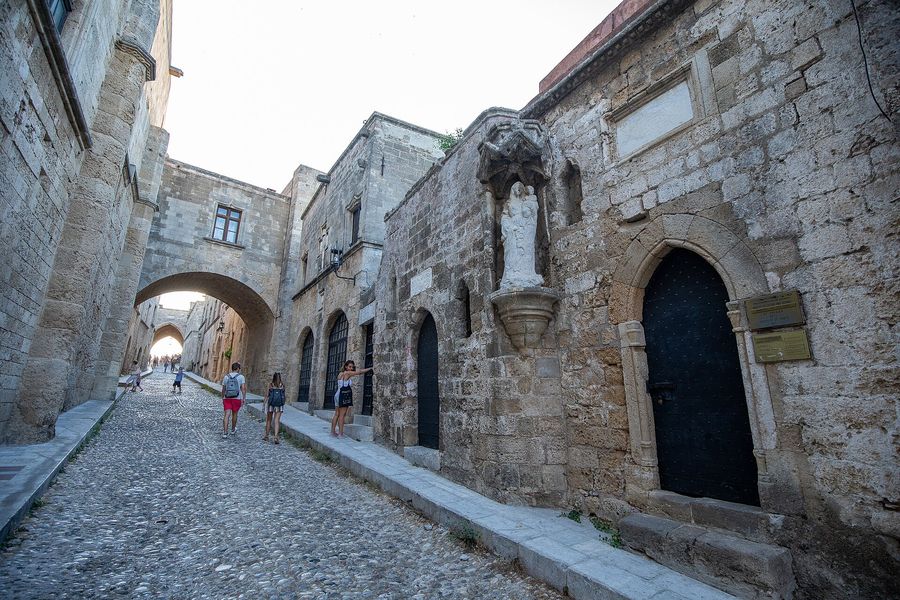
Rhodes hands you two trips in one — a complete medieval walled city and the ancient Aegean beyond it — so the smart move is spending your tour budget where it changes the experience. Book a guide for the Old Town's medieval history, the Palace of the Grand Master interior, and the day trip to Lindos; wander the lanes and the harbour on your own.
Few Mediterranean islands stack their history as visibly as Rhodes. The capital holds a complete medieval walled city raised by the Knights Hospitaller between 1309 and 1522, and forty kilometres south the whitewashed village of Lindos rises to an ancient acropolis whose Doric columns have stood for two and a half thousand years. That range is exactly why the useful question here is rarely whether to book a guided tour, but which one actually adds something you couldn't manage with a good map and a pair of shoes. This guide sorts the options by what they're genuinely good for, what they cost, when to go, and the island logistics that decide whether a day runs smoothly. Read it alongside the Rhodes city guide and the wider Greece overview for the bigger picture.
What does a local guide add in Rhodes?
A great deal of Rhodes is free and self-explanatory, so a guide earns its fee on the layer beneath the postcard. It buys medieval and ancient context you can't read off the stones, access and interpretation inside monuments like the Palace of the Grand Master, and the logistics of reaching Lindos or the island's interior without planning them yourself.
You don't need anyone to help you photograph the harbour at Mandraki, get lost in the Old Town's lanes, or find a taverna. Where a guide changes the visit is the history that isn't written on the walls:
- Story and context. A good guide explains why the Knights Hospitaller arrived from Jerusalem in 1309, how their walls — up to twelve metres thick — withstood siege after siege before falling to Suleiman the Magnificent, and how Byzantine churches, Ottoman mosques, and Crusader auberges came to share the same street.
- Access and interpretation indoors. The Palace of the Grand Master, with its rescued Roman mosaic floors, and the perfectly preserved Street of the Knights reward someone who can tell you what you're looking at.
- Logistics handled. A guided day trip to Lindos or the interior removes the bus timetable, the parking, and the route-finding — the value is highest exactly where doing it yourself is hardest.
If your trip is short and your interests are mainstream, you can see much of Rhodes without a paid tour. The skill is spending your budget where it deepens the experience rather than packaging something you could do alone.
What are the main types of guided tour in Rhodes?
Rhodes' tours sort into a handful of distinct experiences: Old Town walking tours, guided visits inside the Knights' monuments, full-day trips to Lindos and its acropolis, road tours of the island interior, and coastal boat trips. Matching the format to your interests matters far more than booking the priciest option.
| Tour type | Best for | Typical length | Rough cost |
|---|---|---|---|
| Old Town walking tour | First-timers, history lovers | 2 hours | €15–25 per person |
| Guided palace & museums | Medieval-history travellers | 2–3 hours | Group or private rates |
| Lindos & Acropolis day trip | Ancient history, coast | Full day | €150–250, transport included |
| Island road tour | Scenery, families, wine | Full day | Private hire, priced per group |
| Coastal boat trip | Families, swimming | Half day | €25–45 per person |
| Specialist private guide | Deep medieval or ancient history | Full day | €200–350 |
The Old Town walking tour is the natural first-day orientation — tip-based free walks and licensed small-group tours cover the same medieval core, but a licensed guide goes deeper and can time the route to dodge the cruise crowds. A guided visit to the palace and the Street of the Knights turns a walk past façades into the story of the Knights' eight national "tongues" and their fortress capital. The Lindos day trip pairs the clifftop Acropolis of Lindos with the village and its bay, and an island road tour reaches the Valley of the Butterflies, the Seven Springs, and inland wine villages that buses barely serve. Coastal boat trips from Mandraki or Kolymbia trade history for swimming stops and are the easy win with children.
How do you match tours to the length of your stay?
Think in days rather than booking tours one at a time. With one day, take a morning Old Town walk and spend the afternoon inside the palace and museums. A second day is made for Lindos. Three days or more justify an island road tour or a coastal boat trip, with time left to wander.
- One day: A morning walking tour of the Old Town to absorb the medieval history, then the palace and the archaeological museum in the afternoon. That pairing captures the heart of Rhodes without leaving the walls.
- Two days: Keep day one as above, then give day two to Lindos — the acropolis, the village lanes, and the bay — either on a guided trip or the public bus.
- Three days or more: Add an island road tour to the Valley of the Butterflies and the wine villages of the interior, or a coastal boat trip, and leave one slow afternoon for the quiet ramparts and the sea gate.
Resist over-booking. Rhodes rewards unstructured time — a coffee in a shaded courtyard, the Old Town after the day-trippers leave — as much as any ticketed tour.
When is the best time to take a tour in Rhodes?
Tours run across most of the year, but the season and the heat shape them. May, June, and September are the sweet spot; July and August are hot, crowded, and expensive; spring brings wildflowers and empty lanes. Whatever the month, walk the Old Town and Lindos early or late — midday inside the walls is punishing and the acropolis offers no shade.
- Spring (April–early June): Wildflowers on the hillsides, comfortable walking temperatures, and the island nearly to yourself early in the season.
- Peak summer (July–August): Warmest seas for boat trips and swimming, but the Old Town can top 35°C with little shade and cruise crowds pack the main lanes by late morning.
- Autumn (September–October): Warm sea, softer light, and thinning crowds — arguably the best all-round month for combining town and coast.
- Winter (November–March): Many resort facilities close and boat trips pause, but the walled city carries on its daily life and you'll have the ramparts to yourself.
Whatever the month, start marquee sights in the morning or from about 4 PM. For a fuller month-by-month breakdown, the Rhodes city guide covers seasonal conditions, and if you're island-hopping, the best time to visit Mykonos pairs well with a Rhodes stop.
How much should you budget for tours in Rhodes?
A group Old Town walk runs €15–25, a private half-day city guide €80–150 for a small group, a full-day Rhodes-and-Lindos tour €150–250 with transport, and a specialist medieval-history guide €200–350. Coastal boat trips are €25–45 per person. The free layer is large, so spend on the access-only and logistics-heavy experiences.
| Tour type | Approximate cost |
|---|---|
| Group Old Town walking tour | €15–25 per person |
| Private half-day (Rhodes Town) | €80–150 for a small group |
| Full-day Rhodes + Lindos | €150–250, transport included |
| Specialist medieval-history guide | €200–350 for a full day |
| Coastal boat trip | €25–45 per person |
A few cost notes worth knowing before you book:
- Private-guide fees are per group, not per head. Splitting a half-day guide across four or six people brings the per-person cost down sharply.
- Admissions are usually separate. The palace, the archaeological museum, and the Acropolis of Lindos charge their own entry; ask whether a tour price includes tickets.
- The Lindos donkey ride is extra. The traditional climb to the acropolis is a small add-on paid on the spot, not part of most tour fees.
- Buses undercut day trips. If you'd rather self-guide, the bus to Lindos from Mandraki is a fraction of a tour price, though you trade away the context and the door-to-door convenience.
Treat every figure here as a planning guide rather than a quote — guide, boat, and admission prices change each season, so confirm current rates when you book.
What local logistics make a Rhodes tour day run smoothly?
Most of the difference between a smooth day and a frustrating one is practical. The Old Town is car-free and walked on foot; Lindos is an hour south by bus or car; cruise ships flood the lanes by late morning; and the summer heat and glare demand an early start, water, and sun cover.
- Walk the Old Town. It's entirely car-free and its labyrinthine plan is the whole point — Mandraki harbour is a ten-minute walk from the gates, so you rarely need transport within the core.
- Plan the trip to Lindos. Buses depart from two stands near Mandraki and take about an hour; the timetable is reliable in summer but sparse in winter. A hire car adds the freedom to reach the interior and the quieter southern beaches.
- Beat the cruise crowds. Ships dock in the morning and the main Old Town lanes fill fast; start early or explore the side streets and the ramparts while the crowds queue for the palace.
- Dress for the heat and the stones. Cobbles and marble steps make sturdy shoes essential, and the Acropolis of Lindos has no shade — carry water, a hat, and sun cover even in the shoulder seasons.
How do you find a good guide in Rhodes?
Greece licenses its tour guides through a formal qualification, so for the palace interior, the museums, and the Acropolis of Lindos, look for a licensed guide — the accreditation signals real training in the island's archaeology and medieval history. The Rhodes tourist office and reputable operators can book certified guides, and small groups leave room for questions.
Greece requires an official qualification to guide inside its archaeological sites and monuments, so for the Palace of the Grand Master, the archaeological museum, and the Acropolis of Lindos, a licensed guide is the mark of real training rather than a memorised script. The tourist information office in Rhodes Town and established operators can book licensed guides for city walks, museum visits, and Lindos excursions, and reputable guides list their accreditation openly. For walking tours, small groups leave room for questions, and the best guides read the room — adjusting the pace, following a good question, and turning a maze of medieval lanes into a coherent story of Knights, sieges, and the sea.
Related Guides
- Rhodes city guide — neighbourhoods, attractions, and practical tips for the wider stay
- Greece country guide — how Rhodes fits into a longer trip across the country
- Athens Archaeological Tours — pairing the medieval island with the ancient mainland
- Best Time to Visit Mykonos — extending the trip to the Cyclades
Final thoughts: On an island that hands you a medieval fortress city and an ancient clifftop temple in the same trip, the smartest approach is to spend on the experiences that genuinely need a guide — the Old Town's history, the palace interior, the day trip to Lindos — and lean on your own two feet for the rest. Decide which layer of Rhodes you came for, start your walks early to beat the heat and the cruise crowds, and let the walls and the sea do the rest.
Frequently Asked Questions
Do you need a guided tour to see Rhodes?
Not for the basics. The Old Town is compact, car-free, and free to wander, so you can find the harbour, the ramparts, and the tavernas on your own. A guide earns its fee on the layer beneath the surface — the medieval history of the Knights Hospitaller that turns a maze of lanes into a story, the interior of the Palace of the Grand Master, and full-day trips to Lindos or the island's interior where the alternative is planning bus timetables or driving unfamiliar roads yourself.
How much does a guided tour in Rhodes cost?
A group walking tour of the Old Town runs roughly €15–25 per person. A private half-day guide for Rhodes Town is €80–150 for a small group, a full-day tour combining Rhodes Town with Lindos is €150–250 including transport, and a specialist medieval-history guide for a full day is €200–350. Coastal boat trips are about €25–45 per person. Museum admissions and the Lindos donkey ride are usually separate.
Is a guided day trip to Lindos worth it?
For most visitors, yes. Lindos sits about an hour south of Rhodes Town, and a guided day trip removes the bus timetable or the drive while adding the ancient context that a self-guided visit misses — the 2,500-year-old Doric Temple of Athena Lindia on the acropolis, the Byzantine and Crusader layers below it, and the story of the ancient harbour. If you would rather set your own pace, the public bus from Mandraki is cheap and reliable in summer.
When is the best time to take a tour in Rhodes?
May, June, and September are the sweet spot — warm seas, long days, and crowds below the July–August peak. Whatever the month, time your Old Town and Lindos walks for the morning or late afternoon; midday inside the walls can top 35°C in summer with little shade, and the Acropolis of Lindos offers none at all. Spring brings wildflowers and near-empty lanes; in winter many resorts close but the walled city carries on.
Do you need a licensed guide inside the Palace of the Grand Master?
A licensed guide is strongly recommended and, for organised groups, effectively required for the palace interior and the wider Old Town. Greece licenses its tour guides through a formal qualification, and the accreditation signals real training in the island's archaeology and medieval history. The tourist information office in Rhodes Town and reputable operators can book a certified guide for the palace, the Street of the Knights, and the museums.