
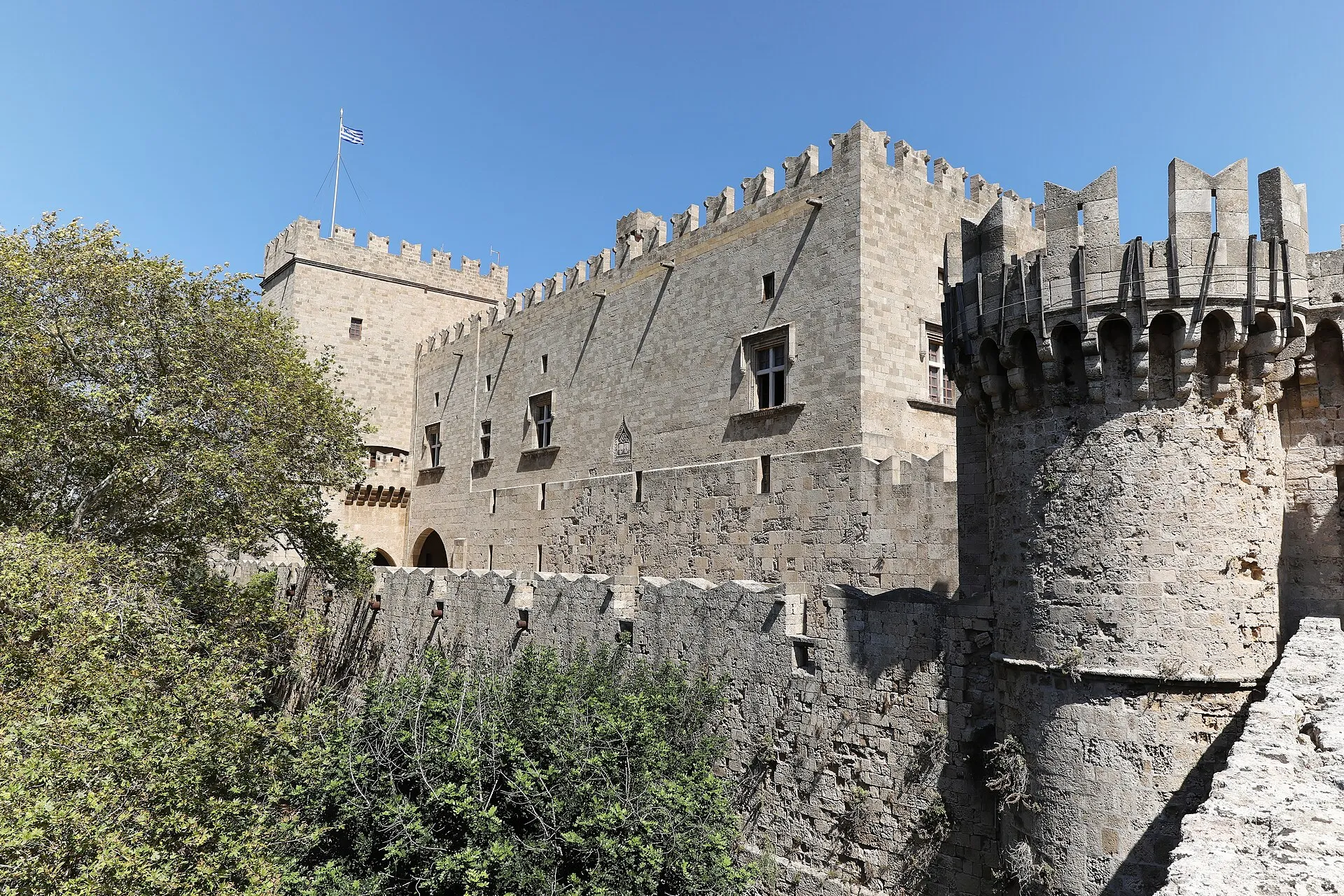
Historical Significance
The Knights Hospitaller used Rhodes as the operational base for their naval activities in the eastern Mediterranean and as the administrative centre of a complex organisation stretching from Portugal to Cyprus. The Palace of the Grand Master was the fulcrum of that enterprise — where diplomatic communications were received, military campaigns planned, and the governance of the island conducted. The twenty Grand Masters who resided here included some of the most significant figures of the late medieval Crusader movement: Pierre d'Aubusson, who repelled the first great Ottoman siege in 1480, and Philippe Villiers de L'Isle-Adam, who negotiated the honourable surrender of 1522 to Suleiman the Magnificent. The 1522 surrender terms — which allowed the Knights, their followers, and any Rhodian citizens who wished to leave to depart unharmed — were observed, and the Knights eventually settled in Malta, where their successors built another extraordinary fortress city. The Italian reconstruction of the 1930s introduced a colonial reading of the medieval past that a guide can help visitors interrogate critically.
When to Visit
Tuesday–Sunday, 8 AM–3 PM. Closed Monday and some public holidays. The Palace is busiest between 10 AM and 1 PM when cruise ship passengers are in the Old Town; visiting early morning or after 1 PM is considerably quieter. Allow 1.5–2 hours for a thorough visit including both floors. The ground floor houses chronological exhibitions from the prehistoric to the medieval period; the upper floor contains the Roman mosaics and the state rooms. The Palace's central courtyard can be entered separately for photographs of the exterior without purchasing a ticket for the interior galleries.
Admission and Costs
Palace admission: €10 (adults). Combined ticket with the Archaeological Museum of Rhodes: €12. Guided group tours of the Palace (1 hour): €10–15 additional per person on top of entry. Private guide for the Palace and Street of the Knights: €40–80 for up to 6 people, typically 1.5 hours. Students with valid ID receive reduced entry; EU students under 25 are often admitted free on production of a student card and passport.
The Case for a Guide
A guide transforms the Palace from an impressive architectural shell into a story of military power, medieval governance, and colonial archaeology:
- The Knights' organisational structure — The Hospitallers were divided into national 'tongues' (languages); understanding this explains the Street of the Knights' auberge buildings and the Palace's spatial arrangement
- Reading the reconstruction — Distinguishing between genuine medieval fabric and Italian additions helps visitors understand what they are actually seeing versus what was invented in the 1930s
- The Kos mosaics — Identifying the mythological subjects depicted in the floor mosaics (Medusa, Poseidon, marine scenes) and understanding their Roman-era origins adds another temporal layer
- Connection to the Street of the Knights — The Palace is the terminus of the Street of the Knights; a guide who covers both together provides the most coherent narrative
Tips for Visitors
The upper-floor rooms with the Roman mosaics are visually spectacular and should not be rushed. Photography is permitted throughout without flash. The central courtyard of the Palace — visible without entering the paid galleries — is itself an impressive space and worth a few minutes. Combine the Palace visit with the Street of the Knights immediately below it and the Archaeological Museum a short walk further, making a natural heritage circuit through the northern Old Town. The Palace can be very crowded in July and August from 10 AM–2 PM; an early morning or late afternoon visit provides a considerably more enjoyable experience.
Frequently Asked Questions
What is the history of the Palace of the Grand Master?
The palace was originally built in the fourteenth century on the foundations of a Byzantine citadel, serving as the administrative headquarters and residence of the Grand Master of the Knights Hospitaller — the military-religious order that controlled Rhodes from 1309 to 1522. After the Ottoman conquest in 1522, it was used as a prison and later as a barracks, and fell into disrepair. A massive gunpowder explosion in 1856 destroyed much of the interior. Italian archaeologists excavated and completely rebuilt the palace between 1937 and 1940, creating an interior that is more an Italian colonial reconstruction than a strict medieval restoration.
What are the Roman mosaics doing in a medieval palace?
The Italian architects who rebuilt the Palace in the 1930s furnished its rooms with Early Christian mosaic floors removed from the nearby island of Kos during Italian excavations. These magnificent third to fifth-century CE mosaics — depicting mythological scenes, marine subjects, and geometric patterns — were relocated to the Palace and now form an unintentionally spectacular combination with the medieval architecture. Their provenance and the ethics of their removal from Kos remain a subject of debate.
How much time should I spend at the Palace of the Grand Master?
Allow 1.5 to 2 hours for the Palace itself. A guided visit that covers both floors — the ground-floor gallery with exhibitions on the history of Rhodes from ancient times to the Ottoman conquest, and the upper-floor state rooms with the Kos mosaics — is significantly richer than self-guided exploration. Combining the Palace with the adjacent Street of the Knights and the Archaeological Museum makes for a natural half-day programme.