
Petra & Amman: Planning a Jordan Trip from the Capital
How to plan a Jordan trip built around Amman and Petra — the capital's citadel, Roman theatre, and downtown, a day at the ruins of Jerash.
Read the full guideUpdated · 9 min read
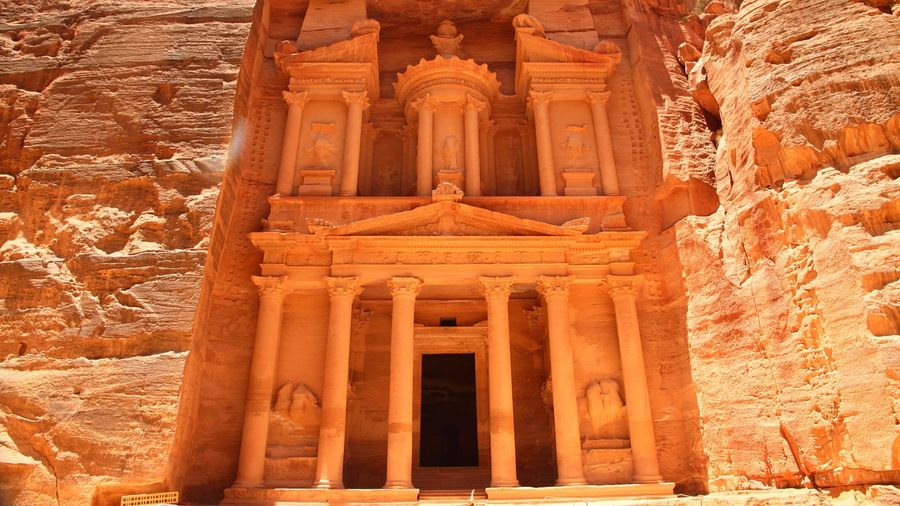
A first Jordan trip works best built around two bases: Amman for the capital's layered history and the northern day trips, then a move south to stay overnight near Petra for the country's headline wonder. Give it five to six days, drive or take the tourist bus between them, and treat Amman's citadel, the ruins of Jerash, and Petra's Siq as the three fixed points to plan around.
Most visitors arrive in Jordan for one reason — Petra, the rose-red city carved into desert cliffs — and discover a country that rewards a slower look. The capital, Amman, is the natural starting point: it holds the airport, the country's deepest concentration of ancient sites, and the road south to the wonders. This guide lays out how to sequence a trip that opens in Amman, reaches north to the Roman ruins of Jerash, and then commits a proper two days to Petra, so the famous set piece lands with the context it deserves rather than as a rushed day trip.
Why start your Jordan trip in Amman?
Amman is Jordan's gateway and its logical first base, holding the international airport, the deepest layer of the country's Roman and Islamic past, and the highway south to Petra. Two days here acclimatise you to the pace, the food, and the geography before you commit to the long desert drive, and the capital's own sights are worth the time.
Amman is easy to treat as a mere transit point, and easy to underrate for it. The city climbs across nineteen hills in a sprawl of pale stone, and its history runs from Ammonite and Roman through Umayyad to modern Hashemite in the space of a single downtown block. Beginning here rather than bolting straight south does two useful things: it lets you adjust to Jordan's rhythms — the call to prayer, the hospitality, the strong coffee — and it puts you within easy reach of the northern sights before the long haul to Petra. Spend your first two nights in the capital and you arrive at Petra already tuned to the country rather than jet-lagged and disoriented.
What are Amman's essential sights?
Amman's core is compact and layered: the Citadel crowns the highest hill with Roman and Umayyad ruins and the city's best view, the vast Roman Theatre cuts into the slope below, and the downtown Al-Balad district ties them together with markets, cafes, and street life. All three sit within a short walk or taxi hop of one another.
The capital's headline sights cluster tightly enough to cover in a single full day. The Amman Citadel sits atop Jabal al-Qal'a, the city's tallest hill, and stacks millennia into one hilltop: the columns of the Temple of Hercules, the domed Umayyad Palace, and a museum, all wrapped in a 360-degree panorama over the white city. Below it, the second-century Roman Theatre carves 6,000 seats into the hillside and still hosts performances, a reminder that Amman was the Roman city of Philadelphia. Between the two lies Al-Balad, the historic downtown, where gold souks, spice stalls, falafel counters, and old coffee houses make the best place to eat, wander, and feel the city's texture. Walk the theatre and downtown together, then take the short climb or taxi up to the citadel for sunset.
Is Jerash worth a day trip from Amman?
Yes — Jerash, an hour north of Amman, is one of the best-preserved provincial Roman cities anywhere, with colonnaded streets, two theatres, temples, and an oval forum you can walk for hours. It makes an easy half- to full-day trip from the capital and deepens the Roman thread before you turn south toward Petra.
If Amman shows Rome in fragments, Jerash shows it nearly whole. The ancient city of Jerash lies about 50 kilometres north of the capital, close enough for a comfortable day trip, and its ruins are extraordinarily complete: a monumental arch, the unusual oval Forum ringed by columns, the long colonnaded Cardo still rutted by chariot wheels, temples to Zeus and Artemis, and two Roman theatres. Walking it takes two to three hours at an unhurried pace, and it is far less crowded than Petra. Pairing Jerash with the drive back — or with a stop at a hilltop castle en route — fills a rewarding day out of Amman and rounds out the classical picture before Petra's very different, Nabataean world.
How do you get from Amman to Petra?
Petra lies about 235 kilometres south of Amman, a three-hour run down the fast Desert Highway or a longer scenic drive along the King's Highway. Most travellers self-drive, hire a driver for the day, or take the daily JETT tourist coach, then stay overnight in the town of Wadi Musa at the site's gate rather than commuting back.
The move south is the trip's main piece of logistics, and it is straightforward once you choose your road and your ride.
| Option | How it works | Best for |
|---|---|---|
| Desert Highway drive | Fast, direct, ~3 hours by car or hired driver | Travellers short on time who want Petra quickly |
| King's Highway drive | Scenic, ~5–6 hours past Karak castle and Wadi Mujib | Those who want the landscape as part of the day |
| JETT tourist bus | One daily coach each way, ~4 hours, booked ahead | Independent travellers without a car |
| Guided package | Driver-guide handles the route and the site | First-timers who want the history explained |
Whichever you pick, the golden rule is to sleep in Wadi Musa, the town at Petra's entrance. The distance is far too great for a day return, and staying overnight lets you enter the site at opening when the light is best and the crowds thinnest.
How should you spend your days at Petra?
Give Petra two days if you can. Day one walks the classic route — through the Siq to the Treasury, along the Street of Facades and the Royal Tombs — while day two tackles the long, rewarding climb to the Monastery and the high viewpoints. Enter early each morning to beat both the heat and the tour groups.
Petra is not a monument but a whole lost city, and one rushed day barely scratches it. The approach alone is theatre: a narrow, winding gorge called the Siq, over a kilometre long, delivers you with sudden drama to the Treasury, the pillared facade carved straight into rose-coloured rock. Beyond it the valley opens into an enormous site of tombs, a Roman-era colonnaded street, a theatre, and cliff faces honeycombed with Nabataean facades. A full first day covers this core comfortably. The second day is for the effort-rewarded corners — the 800-odd steps up to the Monastery, the largest carved facade of all, and the high trails to the viewpoints above the Treasury. If you truly have only one day, prioritise the Siq, Treasury, Royal Tombs, and Monastery, and accept that you are skimming. Bring water, sun protection, and sturdy shoes; the site is vast and largely unshaded.
How much time should you allow, and what can you add?
Budget five to six days for Amman and Petra done properly, and stretch to a week to fold in Wadi Rum's desert or a Dead Sea float. The core trip is two days around Amman and the north, a travel day south, and two days at Petra, leaving room to slow down rather than sprint between headline sights.
The most common Jordan mistake is trying to see everything in three days, which turns a rich country into a checklist. A realistic first itinerary spends two days on Amman and a Jerash day trip, one day moving south with a scenic-highway stop, and two full days at Petra — five to six days that never feel rushed. Given a week, the natural additions are Wadi Rum, the vast red desert an hour or two beyond Petra where you can sleep in a camp under the stars, and the Dead Sea, an easy trip from Amman for the surreal experience of floating in mineral water far below sea level. Both slot cleanly onto the Amman–Petra spine without backtracking. Keep the pace generous: Jordan's distances are long, its heat real, and its best moments — a coffee in Al-Balad, dawn light on the Treasury — come to those who are not watching the clock.
Related Guides
- Visiting the Taj Mahal — planning a trip around a single world-famous monument and its logistics
- Cairo & Giza Pyramids Practical Guide — a nearby-region capital paired with an ancient wonder
- Marrakech Medina & Souks Guide — navigating an old Middle Eastern and North African city centre with confidence
Jordan gives you two very different masterpieces — the layered, living capital of Amman and the silent carved city of Petra — joined by a long desert road. Plan it as two bases rather than one, give Petra the two days it deserves, and use Amman's citadel, downtown, and the ruins of Jerash to build the context that makes the rose-red city land as more than a photograph. Do that, and a short trip to Jordan feels complete rather than rushed.
Frequently Asked Questions
How many days do you need for Amman and Petra?
A comfortable first trip runs five to six days: two days in and around Amman for the citadel, Roman theatre, downtown, and a Jerash day trip, then two days built around Petra with a full day inside the ancient city and travel time each way. Adding Wadi Rum or the Dead Sea pushes it to a week.
How far is Petra from Amman?
Petra sits about 235 kilometres south of Amman, roughly a three-hour drive down the fast Desert Highway or a longer, more scenic run along the King's Highway past castles and canyons. Most visitors drive, hire a driver, or take the daily JETT tourist bus, and stay overnight in Wadi Musa rather than attempting a day return.
Can you see Petra in one day?
You can see Petra's highlights — the Siq, the Treasury, the street of facades, and the Royal Tombs — in a single full day, but the site is vast and the climb to the Monastery adds hours. Two days lets you go deeper and revisit the Treasury in different light, which is why many travellers stay two nights in Wadi Musa.
Is it better to base yourself in Amman or move around?
Use Amman as a base for the north — the capital's own sights plus day trips to Jerash and the Dead Sea — then move south and stay overnight near Petra rather than commuting. The distances are too great for day returns to Petra, so a trip works best as two bases rather than one.