
Excavation History
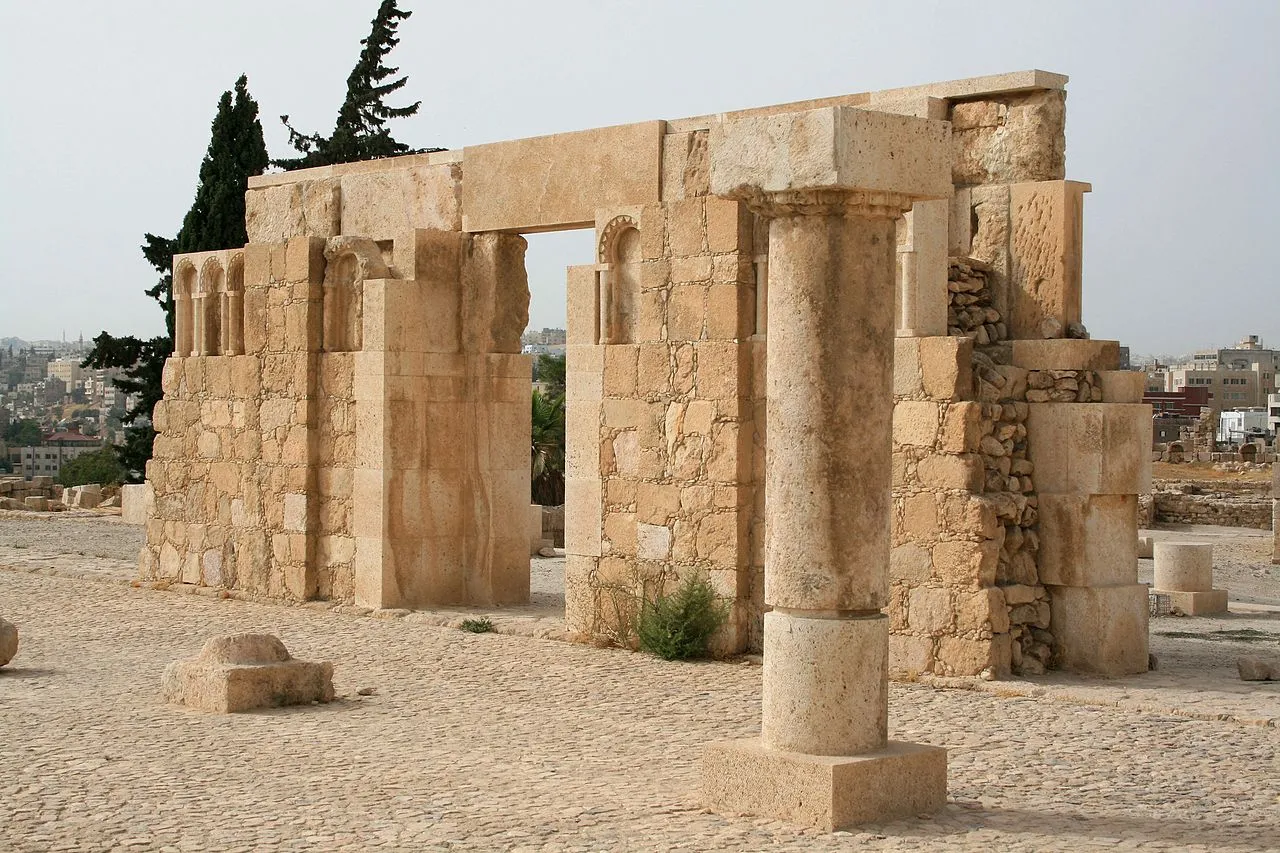
The plateau you walk today is the product of more than a century of archaeology rather than a single dig. Early surveys in the 1920s and 1930s, under the British Mandate, first mapped the Roman and Umayyad monuments; systematic excavation of the deeper Bronze and Iron Age levels — the Ammonite occupation that made this Rabbath Ammon — came later, in the trenches still open along the northern edge of the plateau. The most conspicuous modern intervention is the partial reconstruction of the Umayyad palace's domed vestibule, rebuilt in the 1990s by a Spanish archaeological mission so visitors can read the throne-room complex as a covered space rather than a bare footprint. Finds from these campaigns, alongside material from other Jordanian sites — including sculpture and coins from the Decapolis city of Jerash — fill the on-site Jordan Archaeological Museum, whose most celebrated exhibits — the Ain Ghazal plaster figures — were themselves unearthed a few kilometres away during road works in the mid-1980s. A guide who knows the excavation record can point out which walls are genuine ancient fabric and which are careful modern restoration, a distinction the ruins rarely signpost.
Key Artifacts
Three finds anchor a visit and reward knowing what you are looking at before you arrive:
- The Temple of Hercules — Amman's signature ruin, commissioned under Emperor Marcus Aurelius around 162–166 CE. Only a fragment of the colonnade was ever completed or survives: two re-erected Corinthian columns rising roughly 10 metres, framing the city and the modern Raghadan flagpole beyond. The temple platform is larger than any in Rome itself, which tells you how much civic ambition the provincial city of Philadelphia carried.
- The colossal marble hand — scattered near the temple are three carved marble fragments: a hand, an elbow, and part of the head of a statue that, scaled from the surviving hand, would have stood around 12 metres tall — a cult image of Hercules ranking among the largest marble statues of the ancient world. No torso has ever been found, which is exactly the kind of open archaeological mystery a guide can dwell on.
- The Ain Ghazal figures in the on-site Jordan Archaeological Museum — plaster statues from about 6750 BCE, among the oldest large-scale human representations ever made, unearthed a few kilometres away. Small, unshowy, and easy to walk past: ask at the museum desk so you do not miss them.
Between the Roman and Islamic layers sit the Umayyad Palace with its reconstructed domed vestibule and the foundations of a Byzantine church — the plateau reads as a vertical timeline once you know which stones belong to which century.
When to Visit
The Amman Citadel keeps daily hours year-round — it does not close for a weekly rest day — but the gate time shifts with the season, and the difference between the summer and winter closing is three full hours. Plan around the table below rather than a single remembered figure:
| Season | Approx. months | Opening hours | Last useful entry |
|---|---|---|---|
| Summer | April–September | 8 AM – 7 PM | ~6 PM |
| Winter | October–March | 8 AM – 4 PM | ~3 PM |
| Ramadan | varies annually | 8 AM – ~3:30 PM | ~2:30 PM |
During Ramadan the site closes early — usually mid-afternoon — so confirm the day's gate time before setting out. The on-site Jordan Archaeological Museum shuts roughly 30 minutes before the plateau itself, so see the Ain Ghazal figures and the marble hand fragments early in your visit rather than saving them for last.
The plateau receives the full sun and offers no shade between noon and 4 PM in summer, so the practical "best" hours are narrower than the posted ones: aim to be at the gate before 10 AM, or come in the last ninety minutes before closing when the low light falls warm across the Roman columns and the city panorama — the two most photographically rewarding windows. Spring (March–May) and autumn (September–November) are the most comfortable months overall; a summer visit is still worthwhile if you arrive at opening.
Admission and Costs
The Amman Citadel entrance fee is JOD 2 per person (about $2.80 USD), and that single ticket also covers the on-site Jordan Archaeological Museum — there is no separate museum charge. It is one of the best-value heritage tickets in the country: three millennia of ruins for less than the price of a coffee.
| Ticket | Price (JOD) | Price (USD) | What it covers |
|---|---|---|---|
| Standard entry | JOD 2 | ~$2.80 | Citadel plateau + Jordan Archaeological Museum |
| Jordan Pass — Wanderer | JOD 70 | ~$99 | Citadel, Petra (1 day) + 40 sites, waives the JOD 40 visa |
| Jordan Pass — Explorer | JOD 75 | ~$106 | As above, Petra 2 days |
| Jordan Pass — Expert | JOD 80 | ~$113 | As above, Petra 3 days |
Is the Jordan Pass worth it for the Citadel? Only as part of a wider trip — not for the Citadel alone. The pass must be bought online before you arrive, and for any stay of three nights or more it waives the JOD 40 (~$56) tourist visa on its own, so it effectively pays for itself the moment you add Petra. If Amman is your only stop, skip the pass and simply pay the JOD 2 at the gate. Bring cash in dinars — the ticket booth does not reliably take cards. A private licensed guide for the Citadel charges $80–150 for a half-day that typically folds in the Roman Theatre and Al-Balad downtown on the same itinerary.
The Case for a Guide
- Stratigraphic reading — only a guide can explain why you are standing on eight layers of human occupation simultaneously, and identify which stones are Ammonite, which Roman, which Umayyad
- Temple of Hercules scale — the colossal marble hand becomes comprehensible when a guide reconstructs the probable full statue height and explains how the temple's original column forest would have dominated the eastern Mediterranean skyline
- Umayyad Palace function — the throne room's architectural borrowings from Byzantine church geometry reveal how the early Islamic Caliphate actively absorbed and transformed the culture it inherited from Rome and Byzantium
- City panorama orientation — from the hilltop, a guide reads the modern city below, identifying which neighbourhood occupies which ancient district and explaining Amman's extraordinary demographic transformation over the past century
Tips for Visitors
Worth it if you have any interest in layered history, want the best free-standing view over downtown Amman, or are building a Jordan itinerary — at JOD 2 for Roman, Byzantine, Umayyad, and Ammonite ruins on one plateau, it is among the best-value sites in the country and an easy 1.5–2 hours. Skip it, or keep it brief, if you have already seen Jerash and Petra and have only a single sweltering summer afternoon free: the exposed hilltop is punishing between noon and 4 PM and the ruins are more fragmentary than either of those sites. In that case, go for the panorama at golden hour and the marble hand, and move on.
Wear solid shoes — the Citadel plateau is large, uneven, and includes active archaeological trenches protected by low ropes. Bring water and a hat; there is no vendor on the plateau itself and no shade at midday. The Roman Theatre is visible directly below the Citadel to the south — combining both sites in one morning is the logical half-day Amman programme, with the descent from the Citadel hill naturally leading into the theatre's back entrance and on into Al-Balad downtown. The view from the Citadel's western edge over the city's white-stone tiers toward the setting sun is one of Amman's finest urban panoramas.
Frequently Asked Questions
What are the Amman Citadel opening hours?
The Amman Citadel is open daily, with hours that change by season. In summer (roughly April to September) the gate is open 8 AM to 7 PM; in winter (October to March) it closes earlier, at 4 PM. During Ramadan the site shuts around mid-afternoon, so confirm the day's closing time before you set out. There is no weekly closing day. The on-site Jordan Archaeological Museum stops admitting visitors about 30 minutes before the plateau closes. Because the hilltop has no shade, the most comfortable times to arrive are before 10 AM or in the final ninety minutes before closing, when the light softens across the Roman columns.
How much is the Amman Citadel entrance fee?
The entrance fee is JOD 2 per person (about $2.80 USD), and that single ticket also covers the Jordan Archaeological Museum on the same plateau — there is no separate museum charge. Bring cash in Jordanian dinars, as the ticket booth does not reliably accept cards. If your trip includes Petra or other heritage sites, the Jordan Pass (JOD 70–80, bought online before arrival) bundles Citadel entry with 40-plus sites and waives the JOD 40 tourist visa for stays of three nights or more; for an Amman-only visit, simply pay the JOD 2 at the gate.
What are the main things to see at the Amman Citadel?
The four key sites on the plateau are the Temple of Hercules (2nd century Roman), the Umayyad Palace complex (8th century), the Byzantine church foundations (5th–6th century), and the Jordan Archaeological Museum. The Temple of Hercules' two remaining column capitals and the colossal marble hand — believed to be a fragment of a statue as large as the Statue of Liberty — are the most arresting individual elements. The Umayyad Palace's domed throne room, with its unusual cruciform floor plan, is a remarkable piece of early Islamic architecture. The museum houses finds from across Jordan including the Ain Ghazal statues, some of the world's oldest large-scale plaster figurines.
How long should I spend at the Amman Citadel?
Allow at least 1.5 to 2 hours for a thorough self-guided visit, or 2.5 to 3 hours with a guide who can decode the stratigraphic layers. Combine the Citadel with the adjacent Jordan Archaeological Museum (30 minutes) and the walk down the hill to the Roman Theatre below — together they form a coherent half-day archaeological itinerary. The hilltop plateau becomes very hot in July and August; arrive before 9 AM or after 4 PM if visiting in summer.
Can I see the Citadel without a guide?
The Citadel is accessible independently and some interpretive signs are posted at major features. However, the layers of history compressed into a single plateau — from Bronze Age foundations visible in the northern excavation trenches to the Islamic period throne room — are genuinely difficult to read without context. A licensed guide connects the fragments into a coherent narrative and can also identify architectural details that no signage explains, such as why the Umayyad engineers built their palace above the Byzantine church rather than demolishing it.
How do you get up to the Amman Citadel on Citadel Hill?
The Citadel crowns Jabal al-Qal'a — Citadel Hill — roughly 100 metres above downtown Amman. The simplest way up is a short Uber or Careem ride that drops you at the entrance gate on Al-Qal'a Street for around JOD 1.5–3 ($2–4), sparing the steep climb. Alternatively, walk up from the Roman Theatre and Al-Balad in about 15 to 20 minutes via switchback streets and a final staircase; many visitors take a taxi up and stroll back down into downtown afterward. A small car park at the gate serves those arriving by their own vehicle.