Getting Around Medellín: A Practical Transport Guide
How to move around Medellín by Metro, Metrocable gondola, tram, bus, and ride-hailing — the Cívica card, fares in pesos, airport transfers from Rionegro, and first-timer tips.
Read the full guideUpdated · 12 min read
Getting around Medellín starts with a Cívica card, the rechargeable pass for the Metro, the Metrocable gondolas, the tram, and the feeder buses. A single ride costs about COP 3,000 — under a US dollar — and one fare buys free transfers across the whole integrated system. Two Metro lines run the length of the valley floor, cable cars climb to the hillside barrios, and ride-hailing apps close the late-night gap after the trains stop around 11 PM.
Medellín is one of the easiest big cities in Latin America to navigate, largely because its public transport is genuinely good — and, in the case of the Metrocable, a tourist attraction in its own right. The capital of Colombia's Antioquia region sits in the narrow Aburrá Valley at 1,500 metres, with the metro tracing the river along the flat valley floor and gondolas fanning up the steep sides to neighbourhoods that buses once struggled to reach. The single most useful thing you can do on your first morning in Medellín is get a Cívica card in your pocket; almost everything else follows from there.
What is the Cívica card and do you need one?
The Cívica card is the free, rechargeable card that pays for every part of the integrated network — Metro, Metrocable, tram, and feeder buses — at a single fare, with free transfers between them. It is not strictly required for a short trip, since the Metro still sells paper tickets, but it is cheaper per ride and far more convenient.
The Cívica card is the backbone of Medellín's transport system. Unlike a paper Metro ticket, it works across the rail lines, the Metrocable gondolas, the Ayacucho tram, and the blue integrated buses, and it unlocks the free-transfer window that makes hopping between modes so cheap. Registering a personalised card takes a passport and a few minutes at a station taquilla (ticket office), and the card itself is free — you only pay for the credit you load onto it.
For a visit of just a day or two, buying single paper Metro tickets is perfectly workable. But if you plan to ride the cable cars, combine the metro with a bus, or simply avoid ticket queues, the Cívica pays for itself in convenience almost immediately. Load it with Colombian pesos at any station and tap on as you enter.
How does the Medellín Metro work?
The Metro is the fastest way along the valley, and Colombia's only urban rail system. Just two lines — A running north–south along the river, and B branching west — cover the districts most visitors need, so it is almost impossible to get lost. Trains are clean, frequent, and a source of real civic pride.
Opened in 1995, the Medellín Metro remains the only rail metro in Colombia, and locals treat it accordingly: it is spotless, punctual, and governed by an unwritten Cultura Metro etiquette that frowns on eating, drinking, or littering. For a visitor the simplicity is a gift — there are only two lines to learn.
- Line A (blue) is the workhorse, running north–south along the valley floor. It links the northern transport hubs to the centre at Parque Berrío and San Antonio — the latter your interchange for the tram and the closest stops to Plaza Botero and the downtown museums — and continues south toward El Poblado, the upscale district where many visitors stay.
- Line B (orange) branches west from San Antonio toward San Javier, which is the gateway station for the famous outdoor escalators of Comuna 13.
Trains run from roughly 4:30 AM to 11 PM on weekdays, with a later start and reduced hours on Sundays and holidays. Every station connects seamlessly to the cable cars, tram, or buses, so the two-line simplicity belies how far the network actually reaches.
What is the Metrocable and how do you ride it?
The Metrocable is Medellín's signature — a network of aerial gondolas that carry commuters (and their groceries) up the valley walls, and the world's first cable-car system built as mass transit rather than tourism. Most lines use the same integrated fare as the Metro; the exception is the scenic Line L to Parque Arví, which costs extra.
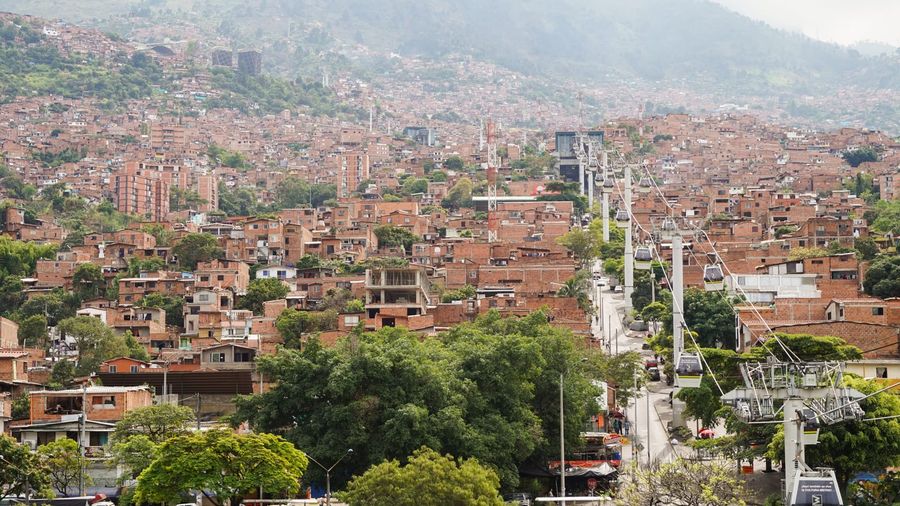
When Line K opened in 2004, connecting the Acevedo metro station to the hillside neighbourhood of Santo Domingo, Medellín became the first city in the world to use aerial gondolas as genuine mass transit. It cut a two-hour uphill commute to about fifteen minutes and became a symbol of the city's renewal. Today several lines — K, J, H, M, and P — thread up the valley sides, and riding one is both a practical journey and one of the best-value sightseeing experiences in the city, with the whole red-brick metropolis unfolding beneath your cabin.
Here is where the fares differ from the rest of the network:
| Metrocable line | Connects | Fare |
|---|---|---|
| K, J, H, M, P (integrated) | Metro stations to hillside barrios | Standard integrated fare (~COP 3,000), free transfer from the Metro |
| L (Arví) | Santo Domingo up to Parque Arví | Separate tourist fare (~COP 10,000–11,000 round trip) |
The distinction matters. Ride Line K up to Santo Domingo on your Cívica and it is effectively free as a Metro transfer. But Line L, which glides on over a ridge and into the cloud-forest reserve of Parque Arví, sits outside the integrated system and charges its own fare — pay it at the Santo Domingo station before you board.
What about the tram, buses, and bikes?
Three more modes fill in the gaps. The Ayacucho tram climbs east from the centre toward two more cable lines; the blue integrated buses feed the metro from neighbourhoods the rails miss; and EnCicla, the city's free bike-share, is handy for short flat hops along the river.
The Ayacucho tram (Tranvía) runs east from San Antonio up the historic Ayacucho corridor, connecting at its upper end to the H and M Metrocable lines. It is a pleasant, rubber-tyred ride through working neighbourhoods and takes the same Cívica fare. For everywhere the rail-and-cable spine does not reach, the blue integrated buses act as feeders — tap your Cívica and transfer for free within the window. Ordinary green-and-white city buses also crisscross Medellín, but their routes are opaque to newcomers, so lean on Google Maps or the official Metro app to plan a bus leg.
For short journeys on the flat valley floor, EnCicla is the city's free public bike-share; you register online and borrow a bike from staffed and automated stations, mostly along the river and near the universities. It is not built for climbing the comunas — that is what the gondolas are for — but it is a fine way to cover a flat mile without waiting for anything.
When should you take a taxi or ride-hailing?
After the Metro closes around 11 PM, or for door-to-door trips into the hills and the nightlife of El Poblado, taxis and apps take over. Medellín's yellow taxis are metered and plentiful; ride-hailing apps such as Uber, DiDi, and Cabify are cheaper, cashless, and spare you explaining your destination in Spanish.
Medellín's official taxis are yellow, metered, and easy to hail on the street or find at ranks; confirm the meter (taxímetro) is running when you set off, and keep small bills, as drivers rarely have change for large notes. Fares are modest by international standards — a cross-town trip runs only a few dollars' equivalent.
For most visitors, ride-hailing is smoother still. Uber, DiDi, Cabify, and Beat all operate across the city, let you pay by card, and remove the friction of describing where you are going to a driver who may speak no English — a genuine advantage late at night or when heading up into the residential barrios altos the metro does not serve. This is the sensible way home after dinner in El Poblado or Laureles once the trains have stopped.
How do you get to and from the airport?
Medellín has two airports, and they are wildly different distances from the centre. The main international gateway, José María Córdova (MDE), sits about 35 km east over the mountains near Rionegro; the small Olaya Herrera (EOH), used for some domestic flights, is right inside the city. Budget accordingly.
| Airport | Location | Getting to the centre |
|---|---|---|
| José María Córdova (MDE) | ~35 km east, near Rionegro | 45 min–1 hr+ by shared van (colectivo) from San Diego, official taxi, or ride-hailing |
| Olaya Herrera (EOH) | Inside the city | A short taxi or app ride, or the nearby Metro |
Most international arrivals land at MDE, which sits high in the mountains beyond the valley rim — the drive down is scenic but takes the better part of an hour, and longer in traffic or fog. The cheapest way in is a shared airport van (colectivo) that shuttles between the airport and the San Diego terminal near the city centre; an official taxi from the marked arrivals rank, or a ride-hailing app, is faster and better if you have luggage or arrive late. A word of advice familiar to any traveller: skip the airport currency desks, whose rates are poor, and carry just enough pesos for the ride into town.
How should you plan day trips and time your days?
Two rhythms shape the Medellín transport day: the afternoon rain and the popular day trips beyond the metro map. Save the Metrocable viewpoints and Comuna 13 for the morning, when the light is clearest and the crowds thinnest, and start early for out-of-town excursions like Guatapé.
Medellín earns its "City of Eternal Spring" nickname with mild weather all year, but light afternoon showers are possible in almost any month, so a packable rain jacket belongs in your day bag — particularly for the open-air escalators of Comuna 13 or a gondola ride to Parque Arví. Rush hour fills Line A through the centre roughly 6–8:30 AM and 5–7 PM; aim your metro-dependent sightseeing at the middle of the day and keep the walkable centre for the peaks.
The trips worth planning ahead are the ones the metro cannot reach. The reservoir town of Guatapé, with its 740-step granite monolith, sits about two hours east and is best reached on an early guided day trip or a bus from the Terminal del Norte. For these, and for the excellent-value city walking tours, the Medellín city guide lists typical prices, and the Colombia country guide sets out guide costs in pesos and dollars.
Why does a local guide still help?
None of this is hard after a day, but a resident guide erases the learning curve entirely. A good walking-tour guide hands you the Cívica logic, times the Comuna 13 escalators for the morning light, knows which cable line is a free transfer and which is not, and — most importantly here — narrates a neighbourhood's transformation in a way no map can.
Medellín's transport is not just a way to get around; it is central to the city's story of renewal, from the Metrocable that reconnected isolated barrios to the library-parks built at gondola stations. A local guide from a neighbourhood like Comuna 13 turns a simple cable-car ride into a first-hand account of that change, steers you onto the right line, and knows which San Antonio exit puts you closest to the door you actually want. For a first visit, pairing a half-day guided orientation with a loaded Cívica card is the fastest route to feeling like the city is yours.
Related Guides
- Getting Around Santiago: A Practical Transport Guide — how another Andean capital handles tap cards, metro lines, and hillside funiculars
- Getting Around Buenos Aires: A Practical Transport Guide — the SUBE card, subte, and airport transfers in another great South American city
- Planning a Trip to Cali — logistics for Colombia's salsa capital, an easy onward flight from Medellín
Sort out a Cívica card on day one, download the Metro or Google Maps app, and the rest of Medellín opens up at the cost of a few thousand pesos a ride. The Metro runs the valley floor, the Metrocable lifts you to the hillside barrios and their views, the tram and buses cover the gaps, and a late-night ride-hailing app closes the loop after the trains stop — leaving you free to explore from the downtown plazas to the cloud forest above the city without ever wondering how you will get home.
Hero photograph of the Metrocable climbing over Medellín's hillside barrios by Bernard Gagnon, licensed CC BY-SA 4.0 via Wikimedia Commons.
Frequently Asked Questions
What is the Cívica card and do I need one in Medellín?
Cívica is the rechargeable contactless card that pays for the Metro, the Metrocable gondolas, the tram, and the integrated feeder buses at a single fare. You do not strictly need one for a short visit — the Metro still sells paper tickets — but the card is cheaper per ride and lets you use free transfers between the rail, cable, and tram. Register and top it up for free at any station's taquilla.
How much does public transport cost in Medellín?
A single integrated Metro, Metrocable, or tram journey costs roughly COP 3,000 (about US$0.75) with a Cívica card, with free transfers across the system. The one exception is the Line L cable car to Parque Arví, which is a separate tourist fare of around COP 10,000–11,000 round trip because it runs outside the integrated network.
How do I get from Medellín's airport into the city?
The main international airport, José María Córdova (MDE), sits about 35 km east near Rionegro, over the mountains — reckon 45 minutes to over an hour. Shared airport vans (colectivos) from the San Diego terminal are the cheapest option; an official taxi from the arrivals rank or a ride-hailing app is faster door to door. The small Olaya Herrera airport (EOH) for domestic flights is inside the city, minutes from the centre.
Is the Medellín Metro safe and easy to use?
The Metro is clean, punctual, and a genuine point of local pride — eating, drinking, and littering are frowned upon, and it is the fastest way along the valley floor. Just two lines, A and B, cover the tourist core, so it is hard to get lost. As on any busy system, keep your phone and bag secure at rush hour, especially on Line A through the centre.