
One Perfect Day in Delft: A Walking Itinerary
A morning-to-evening walking route through Delft — the Markt and its two great churches, Royal Delft, Vermeer's old town, the Prinsenhof.
Read the full guideUpdated · 9 min read
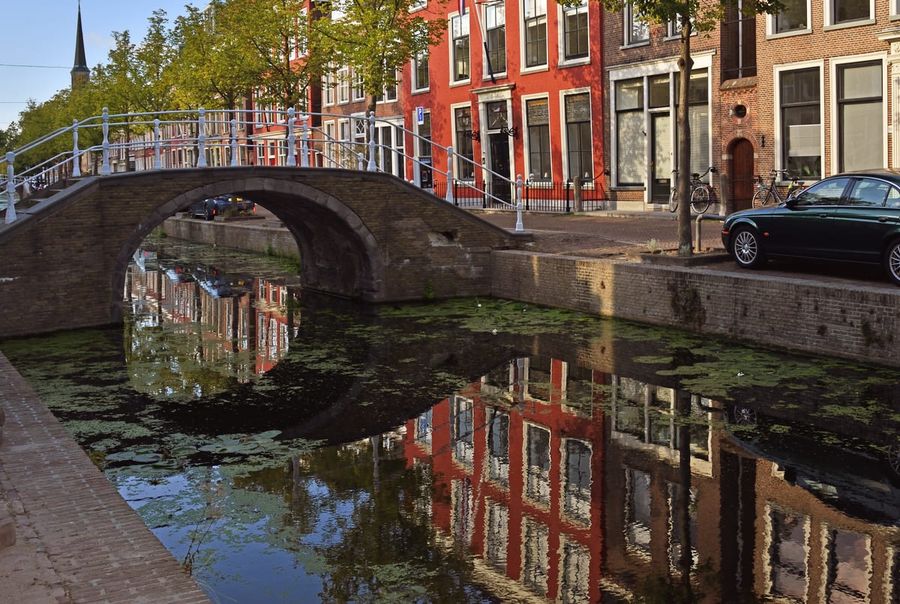
One well-planned day covers Delft's essentials within a single square kilometre. Start on the Markt, climb the Nieuwe Kerk tower early, walk to Royal Delft mid-morning, return through Vermeer's old town and the Oude Kerk, then finish with the golden-hour canal walk to the Oostpoort. Delft is just 55 minutes from Amsterdam by train.
Delft is the rare Dutch city that delivers a full day of history, art, and atmosphere within a single square kilometre. Wedged between The Hague and Rotterdam, it preserves a canal-laced centre so close to its 17th-century appearance that standing on the Markt feels like stepping into a painting — fitting for the city where Johannes Vermeer spent his entire life. This itinerary walks you from morning to evening with minimal backtracking, so you see the essentials of Delft at the right pace and in the best light.
What should you know before setting out in Delft?
Delft makes an effortless day trip, reachable in about 55 minutes from Amsterdam and just 15 from The Hague or Rotterdam, with the station a 10-minute walk from the centre. Wear comfortable shoes for cobbles, aim to arrive mid-morning, and come on a Thursday for the great general market. Note Museum Prinsenhof is closed until around 2027.
Delft makes an effortless day trip. Trains reach it in about 55 minutes from Amsterdam and just 15 minutes from The Hague or Rotterdam, and the station sits a 10-minute walk from the centre. Wear comfortable shoes for cobbles and bridges, and aim to arrive by mid-morning. If you can, come on a Thursday, when the great general market floods the Markt; otherwise any clear day works, and Saturdays add a flower market.
One important note for 2026: Museum Prinsenhof, the building where William of Orange was assassinated, is closed for renovation until around 2027. You can still stand in its courtyard, but plan your indoor time around the churches and Royal Delft instead.
How do you start the morning on the Markt?
Begin on the Markt, one of the Netherlands' largest historic squares, flanked by the Nieuwe Kerk and the red-shuttered Stadhuis. Climb the Nieuwe Kerk's 376-step tower first, while queues are short, for views reaching The Hague and Rotterdam. Back inside stands William of Orange's marble tomb above the royal crypt. Allow about 45 minutes.
Begin on the Markt, one of the largest historic market squares in the Netherlands and the natural place to get your bearings. At the east end rises the Nieuwe Kerk, at the west the red-shuttered Stadhuis (City Hall) — the two great civic symbols facing each other across the cobbles, both shaped by the architect Hendrick de Keyser.
Climb the Nieuwe Kerk tower first, while the morning is fresh and the queues are short. The 376-step spiral leads to views reaching The Hague and Rotterdam on a clear day, and you look straight down onto the square you just crossed. Back at ground level, the church interior holds the elaborate marble tomb of William of Orange, founder of the Dutch nation, above the Royal Crypt where Dutch monarchs are still interred. Allow about 45 minutes for the church and another 30 to 45 for the climb. A combination ticket with the Oude Kerk (around €9 / $10) saves money if you plan to see both, which you should.
Before leaving the square, glance at the Stadhuis opposite. Its festive Renaissance front conceals the medieval Het Steen prison tower, where William's assassin was held and tortured before his execution on this very square — a detail that rewards a moment's pause even though the interior is rarely open.
Why visit Royal Delft in the late morning?
Royal Delft, a 15-minute walk south of the Markt, is the last survivor of the 32 potteries that once made the city's blue-and-white earthenware. Founded in 1653, it still hand-paints every piece. Come late morning on a weekday, when the most painters work at their stations. Admission is about €17 and includes a tile-painting workshop.
From the Markt, walk about 15 minutes south to Royal Delft (De Koninklijke Porceleyne Fles), the last survivor of the 32 potteries that once made the city's famous blue-and-white earthenware. Founded in 1653, it still hand-paints every piece, and the factory tour walks you through a process that has barely changed since Vermeer's day: casting, the first firing, the freehand cobalt painting that takes artisans years to master, and the second firing that turns black pigment into the iconic blue.
Time your visit for late morning on a weekday, when the most painters are at their stations. Admission is about €17 ($18) and includes the museum and a tile-painting workshop; allow 1.5 to 2 hours. If you want a souvenir, this is where to buy the genuine article — and to learn how to tell hand-painted Delftware from the machine-printed imitations sold all over town.
What awaits in Vermeer's old town and the Oude Kerk?
Walk back through the quieter western canals — the Oude Delft and the Voldersgracht, where Vermeer grew up — the Delft of the paintings. Stop at the Vermeer Centrum for reproductions of all 36 known works, then reach the leaning Oude Kerk, whose 75-metre tower tilts two metres and shelters Vermeer's grave and Van Leeuwenhoek's tomb.
Walk back toward the centre through the quieter western canals — the Oude Delft, the city's oldest waterway, and the Voldersgracht, where Vermeer grew up. This is the Delft of the paintings: lime trees, humpback bridges, and brick gables mirrored in still water.
Stop at the Vermeer Centrum for context on the painter's life, his camera-obscura technique, and the Delft locations hidden in his backgrounds — reproductions of all 36 known Vermeers hang here, since the originals are scattered across the world's great museums. Then continue to the Oude Kerk, the leaning "Scheve Jan," whose 75-metre tower tilts two metres off vertical. Inside lie Vermeer's grave, the ornate tomb of Antonie van Leeuwenhoek — the Delft draper who discovered microbes — and the monuments of the admirals Tromp and Piet Hein. It is, in effect, the city's hall of fame in stone.
If the Prinsenhof has reopened by the time you visit, add it here: it sits just behind the Oude Kerk, and its preserved bullet holes are the emotional centre of the William of Orange story. During the renovation, simply step into its courtyard for the setting.
Where does the late-afternoon canal walk lead?
Save the prettiest stroll for golden hour. Head southeast along the canals to the Oostpoort, the only survivor of Delft's eight medieval city gates, built around 1400 with twin spired towers and a separate water gate. It is among the city's most photographed sights when reflected in the calm canal. Walk out one canal and back another.
Save the prettiest stroll for the golden hour. Head southeast along the canals to the Oostpoort, the only one of Delft's eight medieval city gates still standing. Built around 1400 with twin spired towers and a separate water gate, it is one of the most photographed sights in the city, especially when the towers reflect in the calm canal. You cannot go inside — it is a private home and gallery — but the exterior is the point. Walk out along one canal and back along another to make a scenic loop rather than an out-and-back.
How should you end the evening in Delft?
Return to the Markt as the terraces fill and the Nieuwe Kerk tower glows in the last light. Settle in for a drink or an early dinner on the church side of the square — the same view that has framed Delft life for four centuries. It is the fitting close to a single, unhurried day.
Return to the Markt for the end of the day, when the terraces fill and the Nieuwe Kerk tower glows in the last light. Settle in for a drink or an early dinner on the church side of the square — the same view that has framed Delft life for four centuries.
What can you add with a second day in Delft?
A second day rewards a slower pace: take a canal boat tour to see Delft from the water, ride the tram 15 minutes to The Hague for Vermeer's Girl with a Pearl Earring at the Mauritshuis, or wander the TU Delft campus for its contemporary architecture. But one focused day already captures the essential Delft.
A second day rewards a slower pace: a canal boat tour for the city from the water, a tram 15 minutes to The Hague to see Vermeer's Girl with a Pearl Earring at the Mauritshuis, or a wander out to the TU Delft campus to see the contemporary architecture that continues the city's tradition of invention. But if one day is all you have, this route captures the essential Delft — painters, potters, princes, and canals — without ever feeling rushed.
Frequently Asked Questions
Is one day enough to see Delft?
Yes. Delft's historic centre is small enough to cross on foot in twenty minutes, so a single well-planned day covers the Markt, both churches, Royal Delft, the Vermeer sites, and the Oostpoort without rushing. Two days lets you add Museum Prinsenhof (when it reopens after its 2025-2027 renovation) and a canal boat tour at a slower pace.
How do I get to Delft for a day trip?
Delft is about 55 minutes by train from Amsterdam, and only 15 minutes from both The Hague and Rotterdam, with frequent intercity and local services. The station is a 10-minute walk from the Markt, so a day trip from any of the three cities is easy and needs no car.
What is the best order to walk Delft in a day?
Start on the Markt for your bearings, climb the Nieuwe Kerk tower early before crowds, walk to Royal Delft mid-morning, return through Vermeer's old town and the Oude Kerk, then finish with the canal walk out to the Oostpoort in the late-afternoon light. This keeps walking to a minimum and puts the best light where it matters.
Is Museum Prinsenhof open to visit in Delft?
Not at the moment. Museum Prinsenhof Delft closed in January 2025 for a major renovation and is expected to reopen in 2027. Its courtyard and exterior remain accessible and worth a stop for the William of Orange story, but the galleries and the famous bullet holes are not viewable during the works.
Do you need a guide to visit Delft?
You can explore Delft independently with this itinerary, but a guide ties the scattered sites into one story — linking the assassination at the Prinsenhof, the prison tower in the City Hall, and the royal tomb in the Nieuwe Kerk. Free tip-based and paid group walks both start on the Markt and cost roughly nothing to €12.