
Excavation History
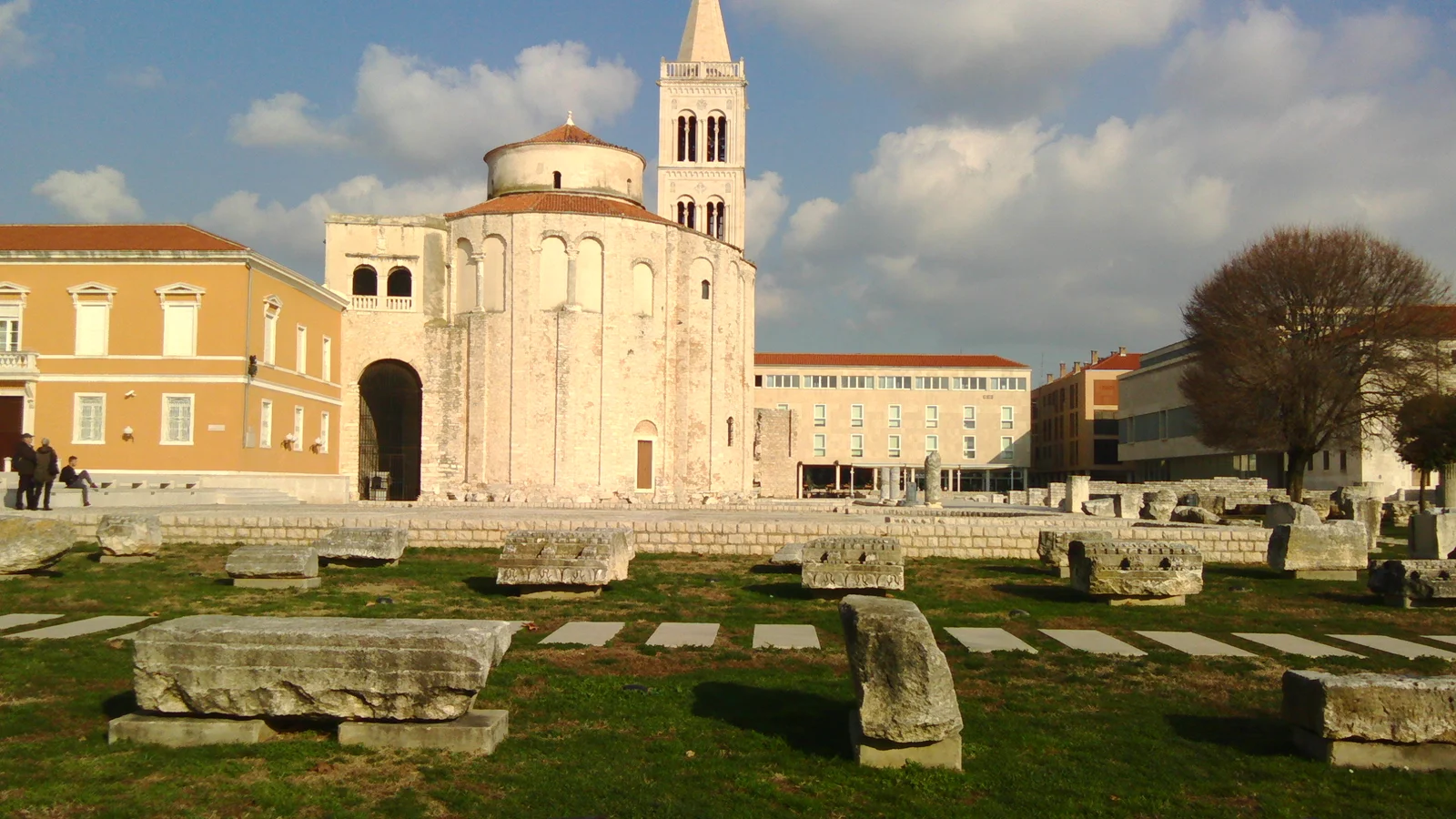
The Forum was buried and built over for much of the medieval and modern periods, its outline lost beneath later houses and streets as the old town grew across it. Systematic recovery came largely in the 20th century, and the site as visitors see it today owes much to the aftermath of the Second World War, when heavy bombing of Zadar in 1943–44 destroyed many of the buildings that had grown up over the ancient square. The clearance of that war damage exposed the Roman levels beneath, and subsequent archaeological work uncovered the paving, the Capitolium podium, altars, and column bases now on open display. Excavation and study have continued since, with finds from the Forum and the wider Roman colony of Iader — glass, sculpture, inscriptions, and everyday objects — distributed among Zadar's museums, including the Archaeological Museum overlooking the site. The Forum is therefore both a monument and an active record of the city's own destruction and rediscovery.
Key Artifacts
Several standout elements reward a closer look as you cross the square. The surviving monumental column at the northern edge is the single most striking artifact, notable both as the last of the Roman colonnade and for its medieval reuse as a pillar of shame. At the western end, the podium and steps of the Capitolium mark the temple of Jupiter, Juno, and Minerva, with column bases still in position. Scattered across the paving are sacrificial altars and two carved decorative pillars, along with fragments of entablature and inscribed blocks — including the Augustan dedicatory inscriptions that date the site. Many smaller and more fragile finds from the Forum, such as Roman glass and statuary, are held in Zadar's museums rather than left exposed, so the open-air site shows the monumental architecture while the portable treasures are preserved indoors nearby.
When to Visit
As an open public square the Forum has no opening hours and can be visited at any time of day or night, free of charge. Allow 20 to 30 minutes to walk the paving, read the site information panels, and take in the column and temple remains, or longer if you pair it with the adjacent church. Early morning is ideal for photography and for having the square almost to yourself before the day-trip crowds arrive, while late afternoon and dusk bathe the pale stone in warm light and connect naturally with a walk on to the Sea Organ for sunset. Spring and autumn are the most comfortable seasons; midsummer midday sun is fierce on the shadeless open square, so bring water and a hat if you visit in July or August.
Admission and Costs
Admission: €0 (US$0). The Roman Forum is an unenclosed archaeological square in the middle of the old town, so there is no ticket, gate, or timetable — you simply walk in. The only related paid attraction is the interior of the neighbouring Church of St Donatus, which charges roughly €5 (US$5). If you want the ruins explained, a licensed local guide is a separate optional cost; ask for a quote that states the meeting point, duration, and whether any indoor monument admissions are included, and treat any advertised "tip" walk as voluntary rather than a fixed fee.
The Case for a Guide
The Forum can be walked for free in a few minutes, but without interpretation it reads as an attractive scatter of old stone. A guide turns it into a legible Roman town square and, crucially, links it to the monuments around it.
- Reconstruct the square: a guide describes where the colonnades, basilica, and shops stood, so the empty paving takes on its original shape.
- Decode the column: hear both its Roman origin and its medieval life as a "pillar of shame," and where to find the surviving iron fittings.
- Follow the stone: understand how Forum masonry was quarried to build the Church of St Donatus next door — the site's most memorable connection.
- Set the timeline: place the Forum within the story of the Roman colony of Iader and the wartime bombing that ultimately re-exposed it.
Tips for Visitors
Look for the low information panels around the square, which map where the temple, basilica, and colonnades once stood — without them the scattered stones are hard to read. Examine the surviving column up close to find the medieval iron fittings from its time as a "pillar of shame," a detail most visitors overlook. Combine the Forum with the Church of St Donatus beside it to see the reused Roman stone in context, and time the visit for early morning or the golden hour before walking to the Sea Organ at the waterfront. Wear sturdy shoes: the original paving is uneven and can be slick after rain. There is little shade, so a summer visit is best early or late in the day.
Frequently Asked Questions
How old is the Roman Forum in Zadar and who built it?
Construction began in the 1st century BCE under the emperor Augustus and continued into the 3rd century CE, spanning the height of Roman rule on the Dalmatian coast. Dedicatory inscriptions found on the site name Augustus, dating the earliest phase to the very start of the imperial period, when the Roman colony of Iader was laid out on the peninsula that is now Zadar's old town. At roughly 90 by 45 metres, it is the largest Roman forum on the eastern side of the Adriatic, a scale that reflects Iader's importance as a regional administrative and commercial centre.
What is the tall column standing on the Forum?
It is the last surviving monumental column of the Forum's original colonnade, about 14 metres tall, left standing when most of the square was quarried for building stone over the centuries. In the Middle Ages it was repurposed as a "pillar of shame" (stup srama), where people convicted of crimes were chained in public view as punishment — an iron ring and chain fittings from that era can still be seen on it. So the column tells two stories at once: Roman civic grandeur and medieval justice, standing on the same spot.
Is there anything left of the Roman temple?
Yes — at the western end of the Forum are the substantial remains of the Capitolium, the main temple, which stood on a raised podium and was dedicated in the Roman tradition to the Capitoline triad of Jupiter, Juno, and Minerva. You can make out the podium, steps, and column bases, along with sacrificial altars and decorative pillars scattered across the paving. The temple ruins sit directly beside the Church of St Donatus, which was later built partly from stone taken from these very structures.
Do you need a ticket to see the Roman Forum?
No. The Forum is an open-air public square, freely accessible at any hour with no ticket or gate, so you can walk through it, sit among the ruins, and photograph the column and temple remains whenever you like. The only paid element nearby is the interior of the adjacent Church of St Donatus, which charges a modest admission. A licensed guide is an optional cost if you want the ruins interpreted rather than left to speak for themselves.