
Engineering Facts
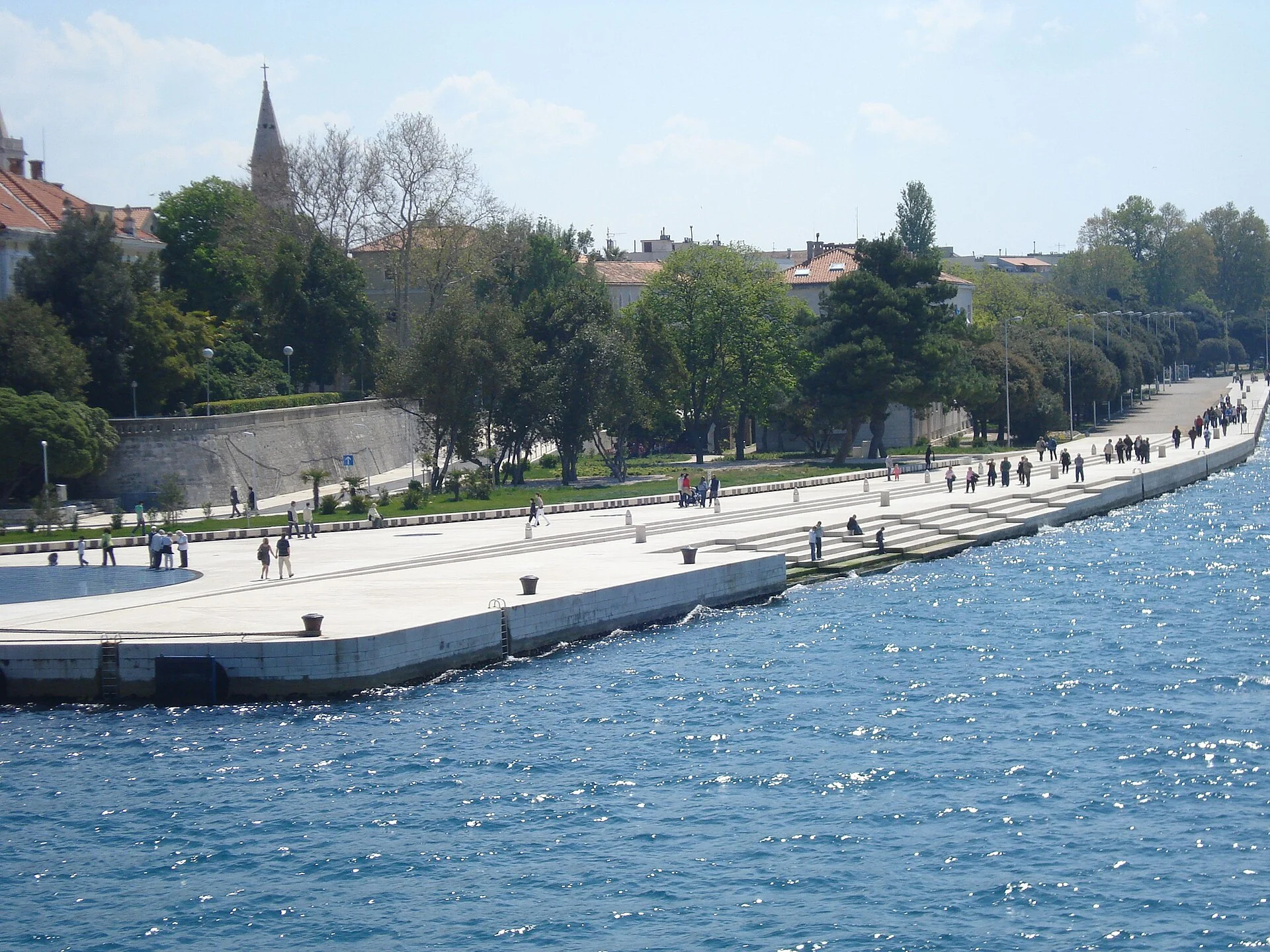
The mechanism is a modern take on a very old idea — a wave-driven wind instrument — engineered with considerable precision. Under the 70-metre run of terraced steps sit 35 polyethylene pipes of varying length and diameter, organised into seven groups that are each tuned to notes drawn from two alternating musical chords, so the overlapping sound is diatonic rather than random noise. Beneath the waterline, a row of channels captures incoming waves; as water floods in, it acts like a piston, compressing the air column and pushing it up and out through labium (whistle) openings cut into the promenade above, from which the sound emerges alongside a gentle exhalation of air. Because wave height, period, and direction change constantly, the instrument is effectively a self-playing composition with no repeating score. The project record credits Bašić alongside I. Stamać, V. Andročec and T. Heferer. Look at the different heights of the seven flights above the water: their changing profile is part of the instrument's architecture, not simply a row of identical seats.
Observation Points
Walk along the installation before choosing a place to sit. These details reward a closer look; stay back from wet edges and give other listeners room.
- 🌊 Waterline: watch a small wave reach the lower steps, then listen for the change in sound.
- 🪜 Stepped profile: compare the heights of the neighbouring flights instead of viewing the whole structure as one staircase.
- 🎵 Sound openings: listen near the openings in the upper pavement without covering or putting objects into them.
- 🪑 Marble seating: sit above the wet steps for a longer pause; the stone can feel cold outside summer.
- 🚶 Upper promenade: stay on the drier level behind the steps if waves or spray make the lower rows uncomfortable.
- 🌅 Island horizon: leave room around you at sunset so others can reach and leave the seating.
- ☀️ Greeting to the Sun: continue to the neighbouring light installation after dark, keeping the glass disc and the organ's steps clear of litter.
The mapped Sea Organ footprint lies on the north-western waterfront of the peninsula. Return along the promenade for views back towards the old town.
When to Visit
This open-air installation has no scheduled performances. Sound depends on the sea, and you may hear very little in calm conditions; follow any temporary waterfront closures or safety barriers. A moderate swell or the wake of a passing ferry produces the fullest, most resonant chords, while dead-calm, windless afternoons can reduce the instrument to a faint murmur. Aim for a breezy day, and above all for dusk: you can watch the light change over the islands while listening, and the adjoining Sun Salutation flickers to life just as the light fails. Summer evenings draw the largest crowds, so arrive 30 to 45 minutes before sunset to claim a step; spring and autumn offer the same spectacle with far more room to sit.
Admission and Costs
Admission: €0 (US$0). The Sea Organ is part of the public waterfront, so you do not need to book a performance or buy a ticket to listen. A guided old-town walk is an optional separate purchase. Ask the operator for a current quote, the meeting point, duration and any included monument admissions; the price of a tour is not an entrance charge for the organ. If you choose a tip-based walk, check the booking terms and decide your own gratuity rather than treating an advertised tip as a compulsory fee.
The Case for a Guide
You can sit and listen without a guide. A guided stop is most useful when you want to understand the structure beneath the water or connect this part of the seafront with the older city. Ask for time to hear the organ as well as an explanation: talking through the entire stop defeats its purpose.
- Follow the air path: a diagram helps show how waves move water and push air through the hidden tubes.
- Read the waterfront: the award project record explains the transition from the post-war concrete edge to a place where people sit beside the sea.
- Connect the walk: a guide can set the modern installation alongside the Roman Forum, Church of St. Donatus and Venetian defences without suggesting that those monuments are part of the organ itself.
Tips for Visitors
Bring something to sit on: the marble steps are beautiful but hard, and in the low-season months they hold the sea's chill well after sundown. Arrive well before sunset in July and August, when the best steps fill quickly, and consider visiting on a windier day for a louder performance rather than a mirror-flat calm one. Watch the steps closest to the water, which stay wet and can be slippery, especially when a ferry wake washes over them. Combine the visit with the neighbouring Sun Salutation and a short stroll back through the old town to the Roman Forum, and listen for changes as boat wakes reach the shore; their effect depends on the vessel, its distance and the water conditions.
Frequently Asked Questions
How does the Sea Organ actually make sound?
As waves and passing boat wakes push seawater into channels concealed under the marble steps, the rising water compresses the air trapped inside and forces it up through 35 tuned pipes, which sound like a slow accordion or harmonica. The pipes are grouped into seven sections tuned to two alternating chords, so the harmony drifts and overlaps without ever repeating exactly. Architect Nikola Bašić developed the project with collaborators I. Stamać, V. Andročec and T. Heferer, as listed in the European Prize for Urban Public Space project credits; the instrument is powered by the sea — see the neighbouring Roman Forum for the ancient counterpart to this modern landmark.
When is the best time to hear the Sea Organ?
There is no performance schedule: wave conditions determine the sound, which becomes fuller when there is a moderate swell or when a Jadrolinija ferry passes and its wake surges into the steps. Locals and visitors gather at sunset, when the chord carries over the water and the light drops behind the islands of the Zadar archipelago — the same view Alfred Hitchcock praised on his 1964 visit. In flat, windless conditions the instrument falls almost silent, so a breezy afternoon can be more rewarding than a calm one. For more on timing your visit, see the Zadar city guide.
Is there a charge to visit the Sea Organ?
No — the Sea Organ is a permanent piece of public waterfront and is completely free to visit at any hour, with no admission ticket or performance timetable. Follow temporary closures or barriers if access is restricted. You simply walk to the western tip of the old-town peninsula and sit on the steps. The only costs are optional: a licensed guide, or a drink at one of the nearby cafés along the Riva promenade. The adjacent Sun Salutation light disc, also by Nikola Bašić, is likewise free and best seen after dark.
What awards has the Sea Organ won?
Completed in 2005, the Sea Organ was a joint winner of the European Prize for Urban Public Space in 2006, as recorded by the award organisers that recognises outstanding recovery of public space. The jury praised how the project turned a bleak stretch of concrete waterfront, rebuilt after the Second World War, into a place people actively want to gather. It has since become the defining image of modern Zadar and a model widely cited in coastal urban design.