
Engineering Facts
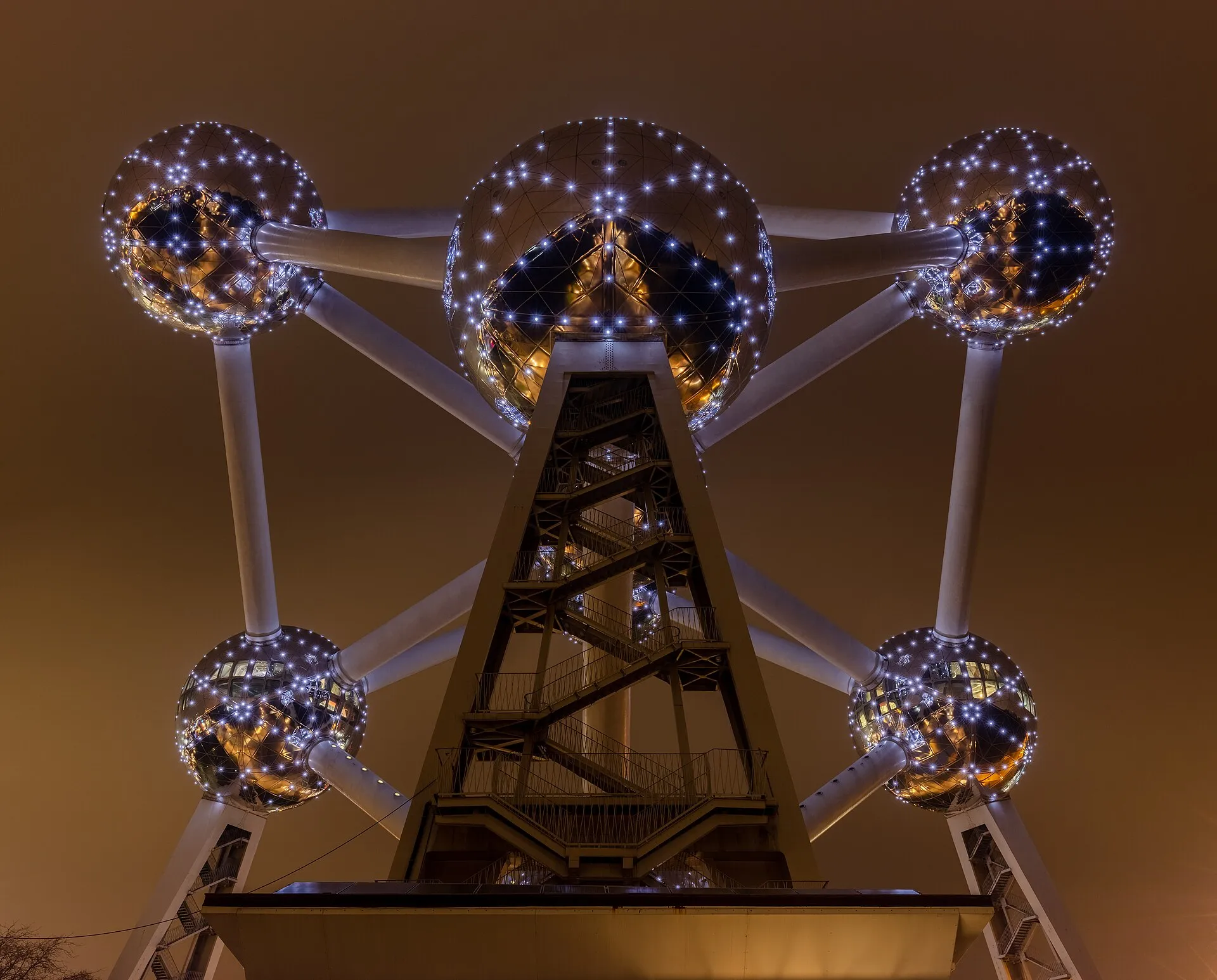
Engineer André Waterkeyn designed the Atomium to represent a unit cell of an iron crystal magnified 165 billion times, with each of the nine spheres positioned at the atoms' locations in a body-centered cubic lattice. The structure stands 102 meters tall and weighs approximately 2,400 tonnes, supported by a central pillar containing an elevator shaft and three bipod legs that distribute loads to massive concrete foundations. The original 1958 construction used aluminum cladding over a steel skeleton, but the 2004-2006 renovation by architects Conix and Bureau d'Etudes Arcadis replaced all exterior panels with 50,000 triangular stainless steel tiles that resist corrosion and reflect light with mirror-like intensity. The connecting tubes between spheres are 3 meters in diameter and contain escalators — the tube connecting the base to the top sphere houses an elevator that was, at the time, the fastest in Belgium, ascending 102 meters in 23 seconds. Six of nine spheres are accessible to visitors; the remaining three provide structural support but lack floor space suitable for public access. The entire structure was designed for a planned lifespan of 6 months as a temporary Expo 58 pavilion — its survival for over 65 years required continuous structural reinforcement as wind loads, thermal expansion, and material fatigue exceeded original engineering tolerances.
Observation Points
Top sphere panorama: At 92 meters up, the circular viewing platform provides 360-degree views. Identify landmarks with interpretive displays: the Palais Royal, Basilique de Koekelberg, and on exceptionally clear days, Antwerp's port cranes. Rotating exhibitions: Design-focused shows change every 6-12 months. Past exhibitions covered Tintin, Art Nouveau, and Belgian surrealism. Expo 58 permanent display: Photographs, videos, and artifacts from the 1958 World's Fair, which drew more than 41 million visitors between April and October — showing the atomic-age optimism and Cold War subtext of the era. Top-sphere restaurant: A rare opportunity to dine inside an architectural icon — reserve the sunset slot if visiting in summer. Evening illumination: The Atomium glows at night with sophisticated LED lighting — best photographed from the adjacent park or Mini-Europe entrance (free to approach exterior).
Atomium timeline
-
Waterkeyn's design chosen for Expo 58
Engineer André Waterkeyn proposed a body-centred iron unit cell magnified 165 billion times as the centrepiece of Belgium's coming world's fair.
-
Erected for the Brussels World's Fair
The nine-sphere structure rose on the Heysel plateau for Expo 58, the first post-war world's fair, which drew more than 41 million visitors between April and October.
-
Reprieved from demolition
Built as a temporary pavilion, the Atomium was scheduled to come down after the fair but public affection kept it standing indefinitely.
-
Stainless-steel renovation reopens the spheres
A 2004-2006 overhaul stripped the corroding aluminium cladding, re-skinned the spheres in stainless steel, and reopened the monument to visitors in February 2006.
-
ADAM design museum opens next door
The Art & Design Atomium Museum opened at the foot of the monument, anchoring the Heysel plateau as a hub for mid-century and contemporary design.
When to Visit
Daily: 10 AM - 6 PM (last entry 5:30 PM). Extended summer hours: Sometimes until 7 PM July-August — check website. Closed: Rare maintenance days (check ahead). Best: Late afternoon (4-5 PM) for golden hour light; early morning (10-11 AM) for fewer crowds. Avoid: Weekend afternoons in summer when tour buses and families peak. Duration: 60-90 minutes including ascent, exhibitions, and photography.
Admission and Costs
General admission: €16 adults, €12 students/seniors, €8.50 children 6-17. Restaurant reservation: No entry fee if dining at the top-sphere restaurant (book ahead). Guided tours: €80-120 for private 1-hour tours explaining architecture and Expo 58 context. Combined ticket: Atomium + Mini-Europe (miniature park next door) €29.50 adults — worthwhile if traveling with children.
The Case for a Guide
Left to its own devices, the Atomium reads as a striking silhouette and a lift to a view; a guide restores the layer of meaning that makes the climb worthwhile. Standing beneath the spheres, a knowledgeable guide explains why 1950s Belgium chose a magnified iron crystal as its emblem — the atomic-age optimism, the Cold War subtext of Expo 58, and the engineering gamble of building a structure meant to last six months that still stands more than 65 years later. Guides who know Brussels can also frame the monument within a fuller day, pairing the spheres' rotating design and surrealism exhibitions with the city's art heritage downtown at the Magritte Museum or the Royal Museums of Fine Arts, so a modernist landmark on the northern plateau becomes part of a coherent Brussels story rather than an isolated photo stop.
Tips for Visitors
Buy tickets online: Skip the ground-level queue by purchasing timed-entry tickets in advance — weekends sell out ahead. Photography strategy: The best exterior shots are from 50-100 meters away in the surrounding park. Inside, the escalator tubes provide dramatic perspectives but lighting is challenging. Accessibility: Despite escalators, some connecting tubes have stairs. Visitors with mobility limitations can access the top sphere via service elevator — ask staff. Restaurant booking: If dining at the top, reserve 2-3 weeks ahead for dinner slots. Lunch is easier to book last-minute. Combine with Mini-Europe: The miniature park next door recreates 350 European monuments at 1:25 scale. It's touristy but children love it, and the combined ticket makes sense if you're already at the Atomium. Getting there: Take Metro line 6 to Heysel/Heizel station (5-minute walk). Allow 25 minutes from central Brussels. The Atomium is far from other Brussels attractions — don't underestimate travel time, and slot it into a wider itinerary using our Brussels trip planning guide. Weather dependency: The views are the main draw. On overcast days, consider skipping unless interested in the exhibitions specifically.
Frequently Asked Questions
When is the best time of year to visit the Atomium?
June through August provides the longest days and occasionally extended evening hours, maximizing the panoramic views from the top sphere that are the main draw. Overcast winter days severely limit visibility from the observation deck, making the interior exhibitions less complementary to the architectural experience. Spring and early autumn offer a compromise of reasonable weather and fewer weekend crowds than the peak summer months.
Is Atomium accessible to visitors daily?
Daily: 10 AM - 6 PM (last entry 5:30 PM). Extended summer hours: Sometimes until 7 PM July-August — check website. Closed: Rare maintenance days (check ahead).
What does a visit to Atomium cost?
General admission: €16 adults, €12 students/seniors, €8.50 children 6-17. Restaurant reservation: No entry fee if dining at the top-sphere restaurant (book ahead).
What is the best way to experience Atomium?
Buy tickets online: Skip the ground-level queue by purchasing timed-entry tickets in advance — weekends sell out ahead. Photography strategy: The best exterior shots are from 50-100 meters away in the surrounding park.
How do I reach the Atomium using public transport?
The simplest route from central Brussels is Metro line 6 to Heysel/Heizel station, a ride of roughly 20 minutes that leaves a five-minute walk to the entrance. Because the monument sits well north of the historic centre, allow around 25 minutes each way and check live connections with the Brussels transit authority (STIB-MIVB) before you set out — the Atomium is too far to fold into a casual walk between the city-centre sights.
What is inside the Atomium's nine spheres?
Six of the nine spheres are open to the public, linked by escalators through the connecting tubes and a central lift to the top. The base sphere holds a permanent Expo 58 exhibition of film, objects, and photographs from the 1958 World's Fair; the mid-level spheres stage rotating design and architecture shows that change every 6 to 12 months; and the 92-metre top sphere is a panoramic deck with a restaurant. One sphere doubles as a dormitory, with pod-style beds that visiting school groups can reserve for a night under the stainless-steel shell. The remaining three spheres carry structural loads and hold no public floor space.
Is the Atomium worth visiting?
It depends on the weather and your appetite for mid-century design. The signature payoff is the view from the top sphere, so a clear day makes the trip worthwhile; on grey, low-cloud afternoons the panorama largely disappears and only the interior exhibitions justify the €16 ticket and the 25-minute journey from the centre. Families travelling with children get more from the combined Atomium and Mini-Europe ticket, which turns a single monument into a half-day out. Design and architecture enthusiasts find the structure and its rotating shows rewarding in any weather, while visitors chasing medieval Brussels may prefer to linger around the Grand Place and save the northern plateau for a return trip.
Is the Atomium suitable for visitors with limited mobility?
Largely yes: a central elevator lifts visitors from the base straight to the panoramic top sphere in well under a minute, so the signature view is reachable without stairs. Staff can route wheelchair users and pushchairs around the stair sections that link some of the lower spheres, but not every sphere is fully step-free, so travellers with specific access needs should confirm the current arrangements with the official Atomium visitor information before booking.