
Engineering Facts
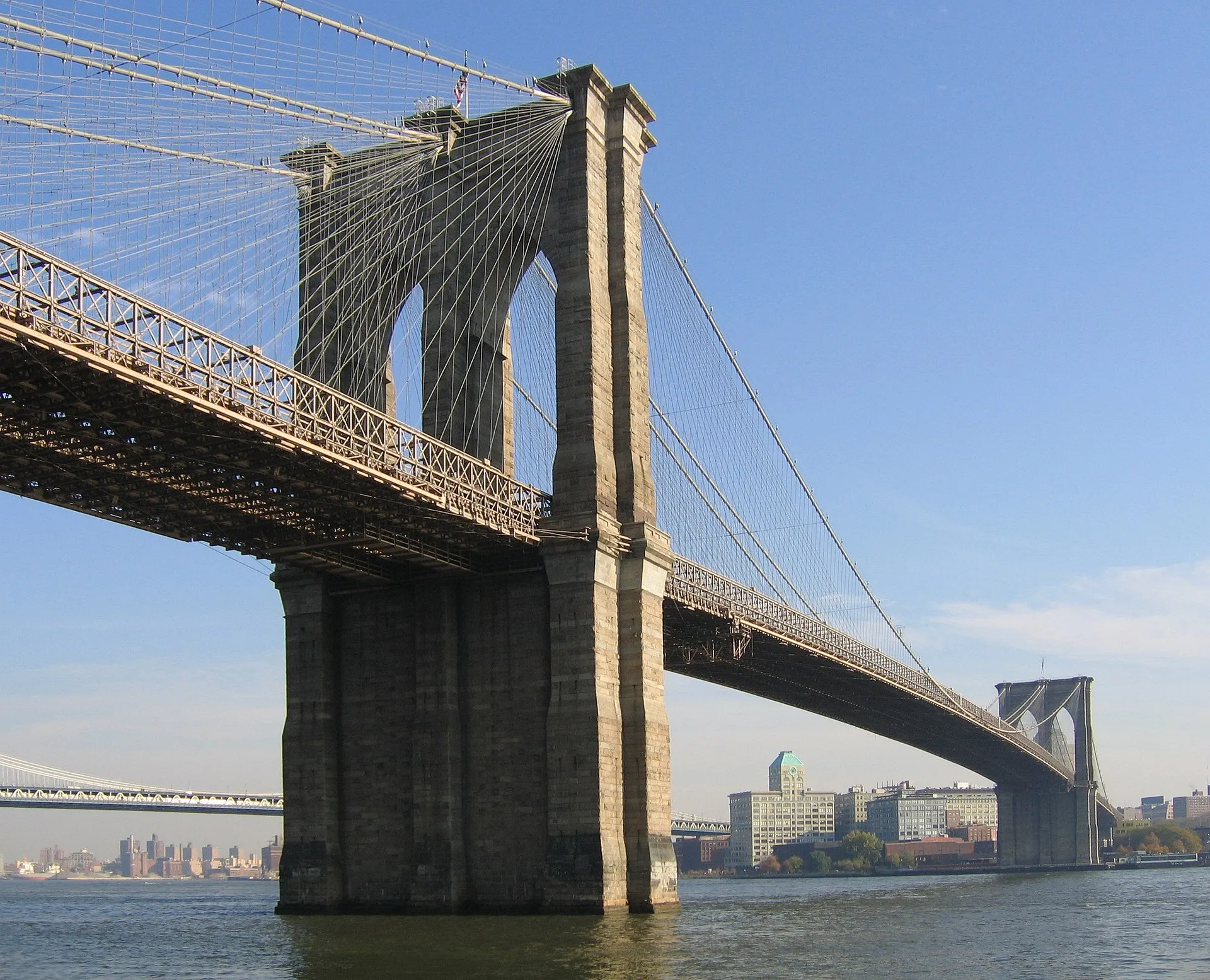
The Brooklyn Bridge was a structural gamble on a scale New York had never attempted. Its two masonry towers rise 276.5 feet above the mean high-water line, built of limestone, granite, and Rosendale cement, and their pointed Gothic arches — a deliberately cathedral-like flourish — carry the four main cables that hold the deck. Each of those cables is about 15.75 inches thick and bundles more than 5,000 galvanized steel wires spun in place over the river, the first large-scale use of steel wire in a suspension bridge and the innovation that let the main span reach 1,595 feet. The towers stand on caissons — vast timber-and-iron boxes sunk into the riverbed under compressed air — driven to 44 feet on the Brooklyn side and 78 feet on the Manhattan side, where Washington Roebling halted the descent rather than risk more lives digging to bedrock. Fourteen years of construction and an estimated twenty-plus deaths produced a structure so over-built that engineers still consider it several times stronger than its daily loads require.
Observation Points
The best views come at fixed points along the deck, and knowing where to pause turns a walk into a sequence of set-piece photographs. The two tower arches at each end frame the classic shot, pointed stone openings that cathedral-ize the skyline behind them; the midspan between the towers is the highest, breeziest spot and the only place where you get open water on both sides at once — lower Manhattan and the Statue of Liberty to the south, the Manhattan Bridge and Midtown to the north. On the Brooklyn end, detour down into Brooklyn Bridge Park and the old Empire–Fulton Ferry lawns, where the bridge reads full-length against the river with Jane's Carousel in the foreground. A block inland, DUMBO's cobbled Washington Street delivers the internet-famous frame — though the arch it captures between the brick warehouses is the neighboring Manhattan Bridge, not this one, a distinction guides love to point out. For a water-level angle, walk to Fulton Ferry Landing and look back up at the anchorage and towers stacked against the sky.
When to Visit
The promenade is open 24 hours a day, year-round, with no admission. A leisurely crossing takes 30 to 40 minutes; allow an hour if you stop at both tower arches. The two prime photography windows are sunrise, when the low eastern sun lights the Manhattan skyline for walkers heading west from Brooklyn, and the hour before sunset, when the same light warms the stone towers for anyone finishing on the Brooklyn side. Weekday mornings before 9 AM are the quietest — the boardwalk is nearly yours. The heaviest crowds fall on summer weekends between 11 AM and 4 PM, when the walkway slows to a shuffle around the towers. Winter crossings are uncrowded but genuinely cold: the span sits fully exposed above the East River, and wind chill on the deck routinely feels 10 to 15 degrees colder than it does at street level, so dress a layer warmer than the forecast suggests.
Admission and Costs
Walking the bridge costs nothing and needs no ticket. A shared 90-minute guided crossing runs $25–40 per person and usually folds in the DUMBO waterfront on the Brooklyn side. A private guide covering both the bridge and DUMBO costs $200–350 for a group of up to six and typically lasts about 2.5 hours. Photography-focused walks led by a working photographer sit at $60–90 per person, timed for the golden-hour or blue-hour light. If you would rather ride than walk, Citi Bike day passes and neighborhood rental shops near the Manhattan approach rent bikes from roughly $12–18 an hour for the roadway-level cycle lane — but note that bikes are not allowed on the pedestrian promenade.
The Case for a Guide
Walking the Brooklyn Bridge alone offers views — walking it with a guide who knows the Roebling family's story, the construction casualties, and the hidden architecture of the towers transforms the crossing into something you will never forget.
- Roebling family construction tragedy and triumph: John Roebling died before construction began; his son Washington was paralysed from caisson disease supervising the underwater foundations; his daughter-in-law Emily Warren Roebling spent eleven years liaising between Washington's telescope observations from his Brooklyn Heights apartment and the construction crew — effectively serving as the project's chief engineer and becoming the first person to cross the completed bridge; guides reconstruct each chapter of this Victorian family saga as you walk the span.
- Caisson disease casualties and the bends: Workers in the compressed-air caissons sinking the foundations suffered from decompression sickness — a condition not yet understood; more than a hundred men were partially or permanently disabled, and several died; guides explain the medical mystery the Roebling team was experiencing in real time, identify the depth at which symptoms became severe, and describe the primitive treatment attempts.
- Hidden wine vaults in the granite towers: The massive stone anchorages at each end contain brick-vaulted chambers that were leased as cold storage for wine merchants in the 1890s and later used by the city's civil defence programme; guides explain where the vault entrances were, describe the unusual secondary use of structural engineering as commercial real estate, and note that the vaults are occasionally opened for art installations and public events.
- Manhattan Bridge comparison: The Manhattan Bridge, completed in 1909 just upstream, was deliberately built without the Brooklyn's gothic arches — its engineers considered architectural ornament irrational; guides use the comparison visible from mid-span to explain how engineering philosophy changed between 1883 and 1909, and why the Brooklyn Bridge's Victorian extravagance produced an icon while its purely rational neighbour is largely ignored.
- P.T. Barnum's elephant march: A year after the bridge opened, showman P.T. Barnum led twenty-one elephants across it to prove to a nervous public that the span was safe — a stunt prompted by a deadly stampede on the promenade the week of the opening, when a crowd panicked in the belief the bridge was collapsing; guides tell both stories at the spot where the panic began.
Tips for Visitors
Enter on the Brooklyn side at Tillary and Adams Streets or from DUMBO near the High Street subway station; the Manhattan entrance sits by City Hall Park across from the 9/11 Memorial neighborhood. Since the 2021 redesign the promenade is pedestrian-only, so you no longer have to dodge cyclists — but do keep to the right and step aside before stopping for photos, because the walkway still bottlenecks at the towers. Bring a layer for the wind: the exposed deck can feel 10 to 15 degrees colder than the streets below, especially from December through February. The crowded midpoint is a known spot for pickpockets, so keep phones and wallets in front pockets or zipped bags. To get back, walk the span again, ride the subway from High Street–Brooklyn Bridge, or catch an NYC Ferry from the DUMBO / Fulton Ferry pier. Combine the crossing with nearby sights — the 9/11 Memorial and One World Observatory are a short walk from the Manhattan side.
Frequently Asked Questions
Which side should I start my Brooklyn Bridge walk from?
Start on the Brooklyn side if you can. Walking west toward Manhattan means the Lower Manhattan skyline builds in front of you the whole way, rising from behind the cables instead of shrinking behind your back. The Brooklyn approach begins near the High Street subway station and DUMBO, so you finish in the thick of the Financial District with easy transit home. The Manhattan-to-Brooklyn direction is better only if you want to end your walk in Brooklyn Bridge Park at sunset, when the low sun lights the stone towers amber.
Do I still have to share the walkway with cyclists?
No longer. Until 2021 the elevated wooden promenade was split down the middle between pedestrians and bikes, and the crowded seam caused constant near-misses. In September 2021 the city moved cyclists down to a dedicated two-way protected bike lane on the roadway below, and the entire promenade became pedestrian-only. You now have the full width of the boardwalk to walk, linger, and photograph without dodging riders — a genuine improvement for anyone who last crossed years ago.
How long is the Brooklyn Bridge and how long does the walk take?
The bridge runs 5,989 feet — about 1.13 miles — from anchorage to anchorage, with a main span of 1,595 feet between the two towers. Most people cross in 30 to 40 minutes at a relaxed pace, but budget closer to an hour if you plan to stop at both tower arches for photos and read the commemorative plaques. The approach ramps at each end add several minutes of walking before you actually reach the water.
Is it free to walk the Brooklyn Bridge, and do I need a guide?
The promenade is completely free and open around the clock, with no ticket, reservation, or timed entry. A guide is optional but transforms the crossing: the structure gives up almost none of its story on its own, so the Roebling family saga, the caisson-disease casualties, and the wine vaults hidden inside the anchorages only come alive with someone narrating them. Free self-guided walks suit casual visitors; a guided or private tour suits anyone who wants the history behind the icon.