
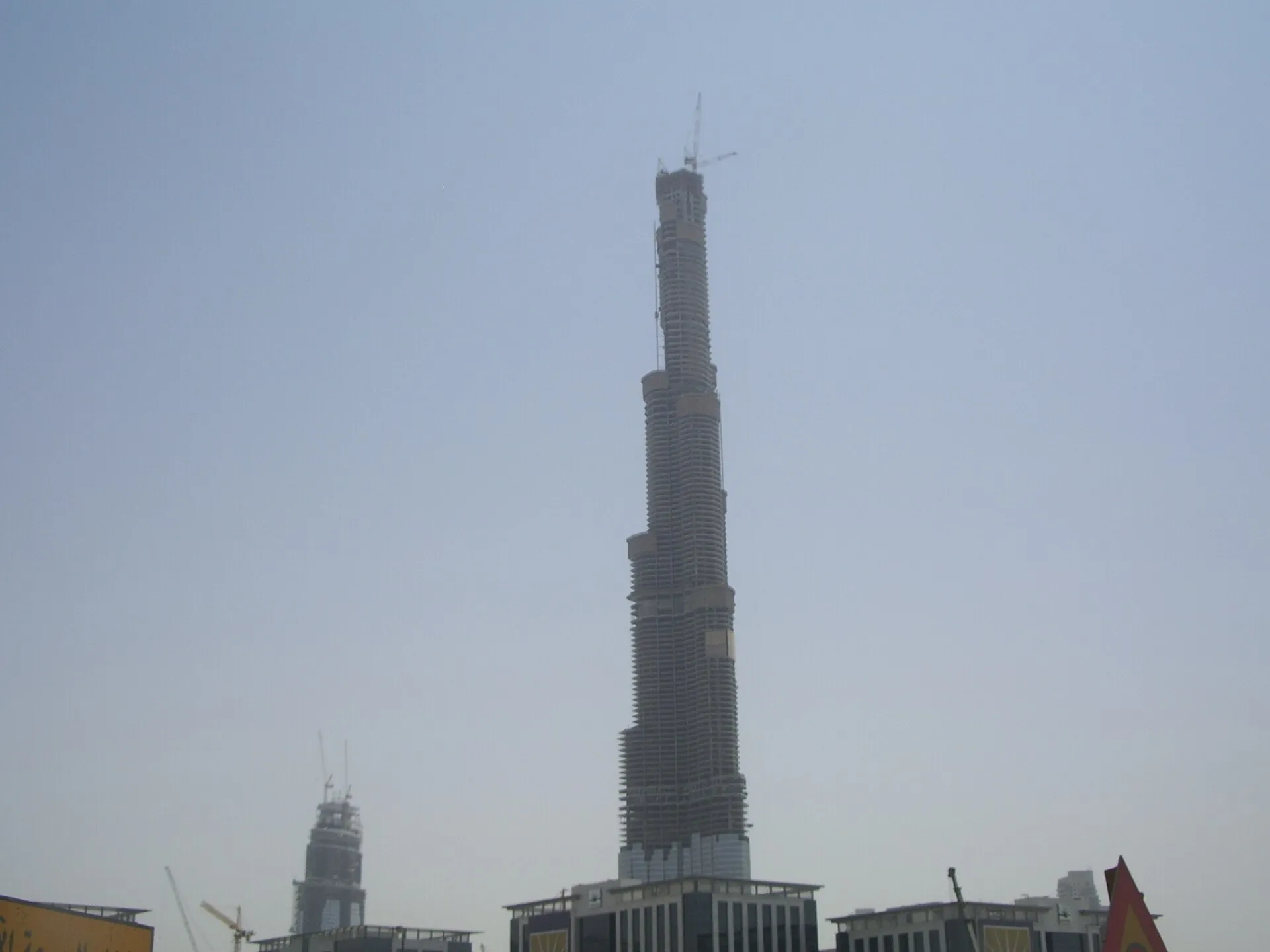
Engineering Facts
The Y-shaped buttressed core channels wind forces around the tower rather than letting them build against a flat face, holding the sway at the summit to under 2 metres even in strong storms. The structure rests on 192 piles driven about 50 metres into the ground and carries a total weight of roughly 500,000 tonnes. The stepped profile is the other half of the wind strategy: the tower sets back 27 times as it rises, so no single wind vortex can organise itself along the full height — a technique known as "confusing the wind".
The high-speed elevators travel at 10 metres per second, among the fastest in the world, reaching the observation decks in under a minute. The exterior carries more than 26,000 individually fitted glass panels engineered to reflect the desert heat while admitting daylight. A condensation-recovery system harvests roughly 15 million gallons of water a year from the building's air-conditioning units and reuses it to irrigate the surrounding landscaping — a meaningful figure in a city with little natural freshwater.
Observation Points
The Level 124/125 deck pairs an indoor gallery with an open-air terrace, free high-powered telescopes trained on landmarks such as the Palm Jumeirah, the World Islands and the Arabian Gulf coast, and an outdoor rail at 452 metres where you can feel the desert wind. It sits closest to the Dubai Fountain and is the best vantage for watching the show choreographed in the lake below.
Level 148 is the highest public point, a calmer indoor lounge with seating and complimentary refreshments and a viewing angle 100 metres above the standard deck. From here the sunset drops behind the dune horizon while the grid of Dubai ignites below. On the way up, interactive exhibits walk through the 6-year build, including time-lapse footage of the tower rising floor by floor, so the ascent itself doubles as a short museum of how the structure was made.
Getting There
The simplest arrival is the Dubai Metro Red Line to the Burj Khalifa/Dubai Mall station, from which an air-conditioned covered link bridge runs into the lower level of the Dubai Mall — a roughly 10-15 minute indoor walk that keeps you out of the heat. Inside the mall, follow the signs to the "At the Top" entrance on the lower-ground floor. A free mall shuttle and travelators shorten the final stretch at peak times.
Taxis and ride-hail apps drop directly at the tower's dedicated entrance, which is the easier option for an early slot, heavy camera kit or anyone travelling with reduced mobility. Drivers can use the Dubai Mall car parks and walk through on the same indoor route. If you are combining the ascent with the heritage side of the city — the Gold Souk and Dubai Creek — the Red Line continues north toward the older districts, while evening desert safari operators collect guests from Downtown Dubai hotels nearby.
When to Visit
The observation decks open 9:00 AM - 11:00 PM daily, with last entry at 10:30 PM. The standout window is sunset, roughly 5:00-7:00 PM, when the desert light turns gold and the city switches from daylight to a carpet of lights in a single visit — book this as a "prime" slot. If clear long-range views matter more than the light show, an early-morning weekday slot between 9:00 and 11:00 AM is both quieter and usually haze-free in winter.
Time your visit around the Dubai Fountain, which performs every 30 minutes from 6:00 PM in the lake directly below and is best watched from the deck looking straight down. Because sunset and public-holiday slots sell out, reserve 2-4 weeks ahead; same-day tickets, when available, are sold at a premium. The clearest months for distant visibility are November to February, which is why the winter ratings on this page sit higher than the hazy summer window.
Admission and Costs
At The Top (Levels 124/125) costs AED 149 (~$40) in non-prime hours and AED 244 (~$66) during prime sunset hours, a surcharge most visitors find worth it for the day-to-night transition. At The Top SKY (Level 148) costs AED 394 (~$107), reaching the highest public deck at 555 metres with lounge access, refreshments and noticeably thinner crowds than the lower levels.
VIP experiences with dedicated lounge access start at AED 769+ (~$209+). Independent licensed guides cost AED 450-700 (~$122-190) per person and usually bundle fast-track entry so you skip the main queue, while a private guide for a group of up to six runs AED 1,500-2,500 (~$408-680). Booking directly through the official channel or a reputable guide avoids the inflated resale prices common on third-party marketplaces.
The Case for a Guide
The observation decks are spectacular on their own, but the engineering superlatives that make this building genuinely extraordinary — and the 70-year urban story visible from 555 metres — only come into focus when someone with specific knowledge orients you to what you are seeing.
- Construction feats made legible: The 192 foundation piles, the 10-metres-per-second elevators and the 27 stepped setbacks that break up the wind are abstract statistics on a brochure; a guide ties each one to a physical detail or sensation you can notice on the way up, so the engineering stops being a number and becomes something you can point at.
- Choosing the right deck: Level 148 is quieter, seated and 100 metres higher than Levels 124/125, but it is also pricier and more intimate rather than open-air — a guide explains which tier fits your priorities and helps navigate the official booking system to the right slot.
- Photography by compass direction: The northern view toward Dubai Creek and the historic quarter shifts completely between backlit sunset and fully illuminated blue hour, so a guide advises which direction to shoot first based on your arrival time and where to stand for the fountain show below.
- Reading the panorama: From the top you can trace the whole arc of the city's growth — from the Creek trading port and the Gold Souk district, through the 1990s highway sprawl, out to the Palm Jumeirah and the receding desert where safari camps sit — and a guide narrates that transformation as one compressed view.
- The deliberate sway: The summit moves up to two metres in high wind by design, not by fault; a guide explains the tuned damping, what the movement feels like on a breezy day, and why the Y-shaped plan was chosen specifically to tame wind-induced oscillation.
Tips for Visitors
Book 2-4 weeks ahead for sunset slots, which sell out fastest on weekends and public holidays, and arrive 30 minutes early to clear security and the elevator queue without rushing. The prime-hour surcharge buys the dramatic day-to-night transition and is usually worth it; if you are on a budget, a non-prime morning slot delivers the same views at a lower price.
Level 148 is the upgrade to consider — far less crowded than Levels 124/125, with lounge seating and refreshments included. Tripods are not permitted, so bring a phone or camera that handles low light well for the evening shots. Plan 1.5-2 hours for the full visit. Because the decks connect to the Dubai Mall via an underground walkway, it is easy to fold the ascent into a half-day that ends with the fountain show or dinner in Downtown Dubai.
Frequently Asked Questions
When is the best season for visiting the Burj Khalifa?
November through February gives the clearest visibility from the observation decks: cooler desert air and less atmospheric haze can stretch views roughly 95 kilometres across the Arabian Gulf on exceptional days, which is why those months carry the highest ratings on this page. From June through August the heat haze that builds over the desert significantly softens long-range visibility from the upper floors, and the open-air sections — Level 125 and the SKY terrace on Level 148 — become uncomfortable when afternoon temperatures pass 45°C. If you are travelling in summer, book a late-evening slot after the worst of the heat has gone.
Can visitors go up the Burj Khalifa in the evening?
Yes. The observation decks run daily from 9:00 AM to 11:00 PM, with the last entry at 10:30 PM, so the tower stays open well after dark. The most sought-after window is the roughly 5:00–7:00 PM sunset-to-blue-hour transition, when the desert sun drops behind the dunes and Downtown Dubai lights up beneath you; those slots are priced as "prime" and sell out first. For the shortest queues, aim for a weekday morning between 9:00 and 11:00 AM. The choreographed Dubai Fountain show runs every 30 minutes from 6:00 PM in the lake directly below, so an evening visit lets you watch it from above.
How much does it cost to go up the Burj Khalifa?
At The Top on Levels 124/125 costs about AED 149 ($40) in non-prime hours and AED 244 ($66) during prime sunset hours. At The Top SKY, the higher deck on Level 148 (555 metres), costs around AED 394 ($107) and includes lounge access with refreshments while staying noticeably less crowded. VIP packages begin near AED 769 ($209). A licensed Dubai guide who meets you with fast-track entry typically runs AED 450–700 ($122–190) per person, and a private guide for a small group costs AED 1,500–2,500 ($408–680).
How do I reach the Burj Khalifa on the Dubai Metro?
Take the Red Line to the Burj Khalifa/Dubai Mall station, then follow the air-conditioned covered link bridge into the lower level of the Dubai Mall — roughly a 10–15 minute indoor walk that keeps you out of the heat. The observation-deck entrance, "At the Top", is signposted inside the mall on the lower-ground floor. Allow extra time on weekend evenings when the mall and fountain draw large crowds. A taxi or ride-hail to the dedicated drop-off saves the walk if you have an early time slot or are travelling with reduced mobility.
How long should I plan for a visit, and what is worth booking ahead?
Budget about 1.5 to 2 hours for the full experience, including security screening, the elevator ride and time to linger on the decks. Book sunset slots two to four weeks ahead because the prime evening windows sell out quickly, especially on weekends. Arrive 30 minutes before your slot to clear screening without rushing. If photography matters to you, the Level 148 SKY deck is the calmer choice, while Levels 124/125 put you closest to the open-air rail and the Dubai Fountain show below.