
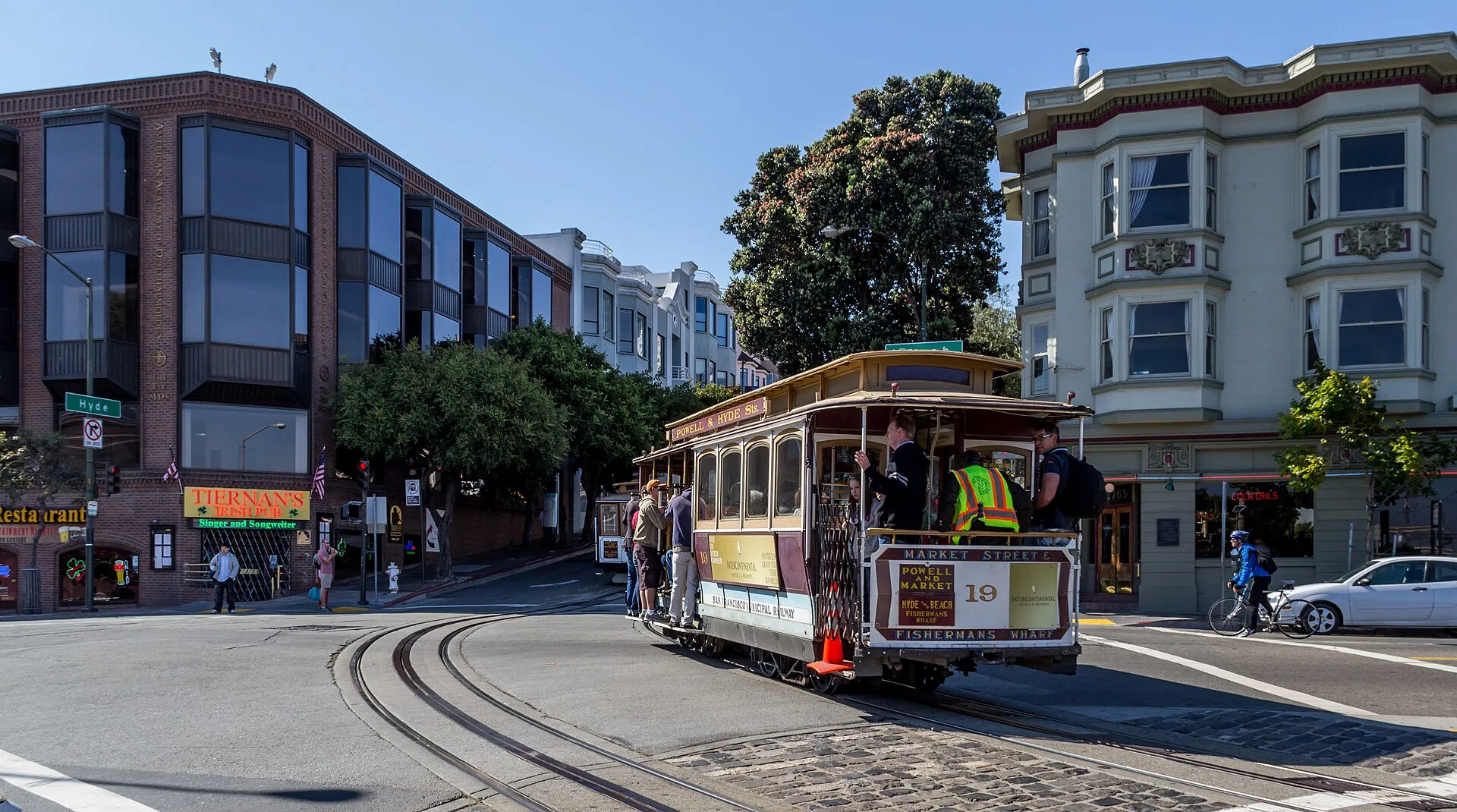
Observation Points
Powell-Hyde crest at Russian Hill: the most dramatic moment on any line, when the car tips over the summit and the bay, Alcatraz, and the Hyde Street descent open up all at once — have the camera ready before the top. California Street line: the quieter, grander ride, crossing Nob Hill between the Fairmont and the Mark Hopkins with long views down to the Financial District.
Cable Car Museum (Washington and Mason Streets, free): the working powerhouse where you stand above the giant sheaves that reel every cable in the system through the street. Powell Street turntable: watch the crew heave the 15,000-pound single-ended car around by hand at the Market Street end — the California line's double-ended cars never need it. The running board: standing on the outside step, one hand on the pole and the hill falling away beneath you, is the ride everyone remembers.
Engineering Facts
Andrew Hallidie launched the first cable car down Clay Street in 1873, solving the problem of horse-drawn cars that could not safely climb San Francisco's hills. Each car carries no motor: the gripman pulls a lever that clamps a set of jaws onto a looped steel cable running at a steady 9.5 miles per hour through a slot in the roadway, then releases it to coast or brake. Every cable in the city is driven from a single powerhouse — the Cable Car Museum at Washington and Mason, where you can watch the winding wheels turn for free.
The two Powell lines use single-ended cars that must be spun on a turntable at each terminus, which is why a crowd always gathers to watch the crew push the 15,000-pound car around by hand at Powell and Market; the California Street line uses double-ended cars with a grip at both ends, so they simply reverse. Three routes are all that remain of the 23 lines that once laced the city. In 1947 a citizens' campaign led by Friedel Klussmann beat back a plan to tear the system out, and a roughly $60 million rebuild in the early 1980s closed the lines for nearly two years before they reopened in 1984.
When to Visit
The two Powell Street lines run the longest hours, roughly 6:30 AM to just past midnight, while the California Street line keeps shorter hours and thins out through the evening. Cars leave the turntables about every 5-10 minutes at peak. The quietest boardings are on weekday mornings before 9:00 AM and after the dinner rush; the worst queue builds at the Powell and Market turntable on weekend afternoons, where the wait to board the first available car often runs 45-90 minutes. You skip almost all of it by walking a few blocks uphill and boarding at an intermediate stop, where cars still arrive with standing room.
Admission and Costs
Single ride: $8 per person, each way — there are no transfers, so every boarding is a fresh fare. You can pay the conductor in cash on board, but operators carry only limited change, so bring small bills or tap a Clipper card or the MuniMobile app. A 1-Day Muni Passport ($13) covers unlimited cable car rides plus every Muni bus and Metro line and pays for itself after two cable car trips; 3-day ($31) and 7-day ($45) passports suit longer stays. The Cable Car Museum at Washington and Mason Streets is free. A guided half-day that works the cable cars into a Nob Hill and waterfront walk typically runs $45-75 per person in a small group, or $200-350 for a private guide covering all three lines.
The Case for a Guide
First-time riders almost all make the same mistake: they join the long line at the Powell Street turntable when the real trick is to board somewhere else entirely. A local guide turns that frustrating wait into the best half-hour of the trip.
- Beating the queue: Guides know the intermediate stops on all three lines where cars pull up half-empty, sparing you the 45-90 minute turntable wait that defeats most visitors on a busy afternoon.
- The gripman's craft: They explain how the grip lever clamps a set of jaws onto a cable moving at a constant 9.5 miles per hour beneath the slot in the street, why the car lurches at every start and stop, and how the brakeman drops a wooden block onto the rail on the steepest descents.
- Choosing the right line: Powell-Hyde delivers the sudden bay view as you crest Russian Hill above Lombard Street; California Street is the calm, elegant ride across Nob Hill with far shorter waits. Guides match the route to your time and interests.
- The 1947 rescue: When the city tried to scrap the system, Friedel Klussmann's Citizens' Committee to Save the Cable Cars beat the plan at the ballot box — a story guides tell on the ride, tying it to the $60 million rebuild of the 1980s.
- Onward connections: From the end of the line a guide can carry you straight into Fisherman's Wharf, the free Cable Car Museum, or down the hill into Chinatown, stitching the ride into a coherent day.
Tips for Visitors
- Board mid-route, not at the turntable: walk a few blocks uphill from Powell and Market and board at an intermediate stop, where cars arrive with room and no queue.
- Have the fare ready: it is $8 each way with no transfers; conductors take cash but carry little change, so bring small bills or a Clipper card.
- Hold on tight: the car jerks hard every time the gripman takes or drops the cable, especially on the steep pitches — keep a hand on the pole.
- Ride the California line to escape crowds: it is almost never full and crosses Nob Hill past the historic hotels.
- Dress in layers: the open sides are breezy and often cold near the water, even in summer, thanks to the city's famous fog.
- For the classic photo, stand at the downhill end of the car and shoot back up the track as it climbs toward the sky.
Frequently Asked Questions
Is there a best season for riding San Francisco's cable cars?
September through November brings San Francisco's warmest and clearest weather, making open-air cable car rides through the hills most enjoyable. The famous summer fog from June through August can make rides chilly and damp, so bring layers even in July. Spring and autumn also mean shorter queues at the Powell Street turntable than the peak-summer afternoons when waits can push past an hour.
What are the daily service hours for San Francisco's cable cars?
The two Powell Street lines (Powell-Hyde and Powell-Mason) run the longest hours, roughly 6:30 AM until just past midnight. The California Street line keeps shorter hours and quietens in the evening. Cars leave the turntables about every 5-10 minutes at peak, and the shortest waits are on weekday mornings before 9:00 AM or late in the evening once the dinner crowds thin.
How can visitors skip the Powell Street cable car turntable queue?
Walk a few blocks uphill from the Powell Street turntable and board at an intermediate stop, where cars arrive with standing room instead of a line. The turntable queue at Powell and Market can run 45-90 minutes on a weekend afternoon, but almost nobody waits at the stops in between. Riding the California Street line rather than the Powell lines also avoids the crush, and weekday mornings before 9:00 AM are quietest everywhere. Load your fare onto a Clipper card or the MuniMobile app ahead of time so you are not fumbling for change as the car arrives.
What practical tips help when riding the cable cars?
Board at an intermediate stop a few blocks from the Powell turntable to skip the queue. The fare is $8 each way with no transfers, and conductors carry little change, so have small bills or a Clipper card ready. Hold the pole firmly — the car lurches whenever the gripman grabs or releases the cable, especially on the steep pitches. Dress in layers, since the open sides get cold and foggy near the waterfront, and ride the quieter California Street line if the Powell queues look long.