
Architecture
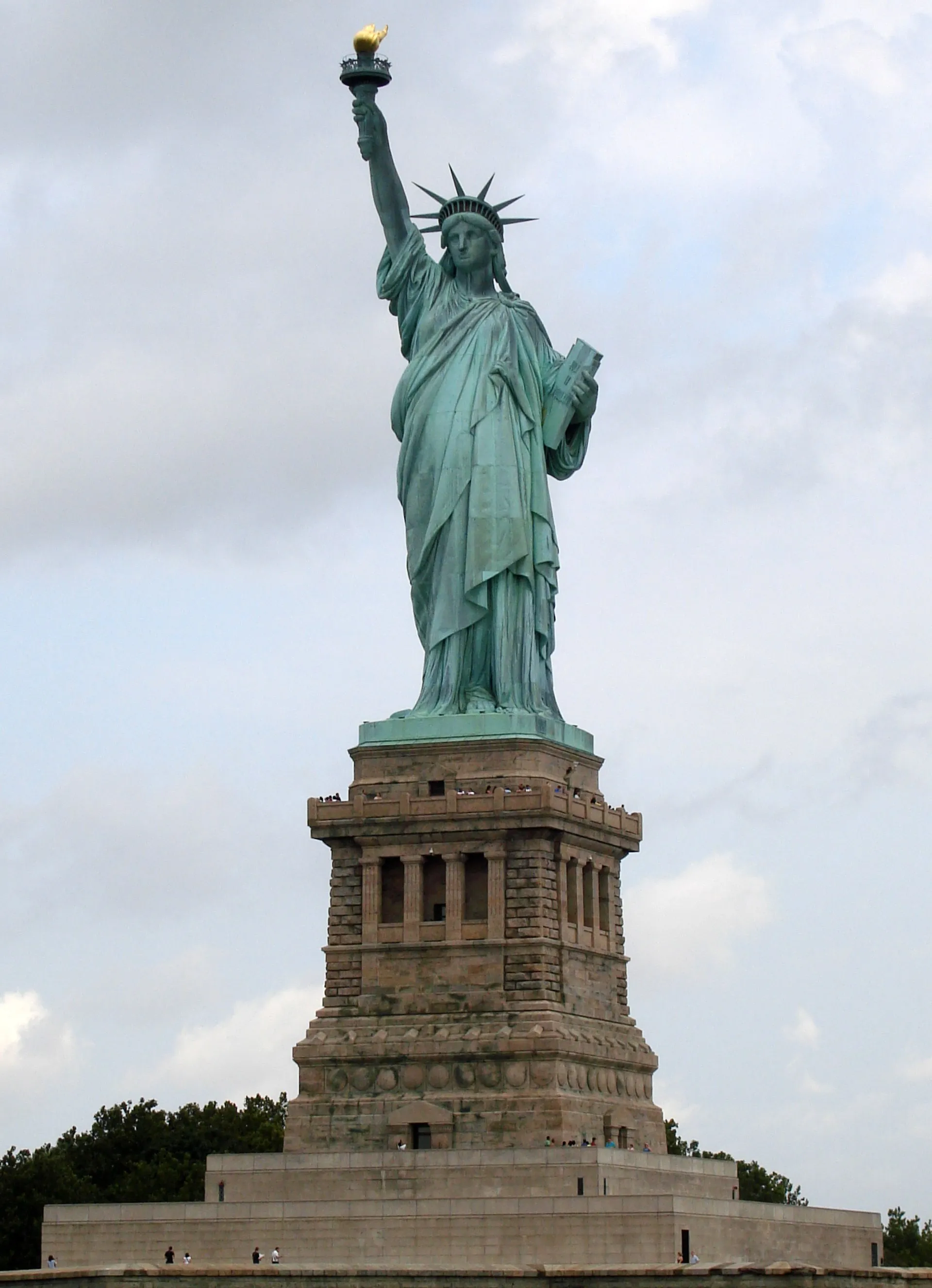
Bartholdi built Liberty not by casting but by repoussé: roughly 300 copper sheets, each only 3/32 of an inch thick — about the width of two stacked pennies — were hammered over full-size wooden molds and riveted into a skin that weighs some 31 tons yet would buckle under its own weight without support. That support is Gustave Eiffel's hidden masterpiece: a central iron pylon carrying a flexible lattice of secondary framing, linked to the skin by hundreds of iron "saddles" that let the copper expand, contract, and sway several inches in a storm without cracking. The bright copper oxidized to its familiar green patina within about thirty years of the 1886 unveiling.
Every exterior detail is deliberate iconography. The seven rays of the crown stand for the seven seas and continents; the tablet in her left hand reads JULY IV MDCCLXXVI — July 4, 1776 — and a broken chain and shackle lie half-hidden at her feet to mark the end of slavery and tyranny. The figure rises from a granite pedestal designed by American architect Richard Morris Hunt, set inside the eleven-pointed star of Fort Wood, a War of 1812 battery. During the 1984–1986 restoration the corroded original torch was removed and replaced with a copper flame sheathed in 24-karat gold leaf; Bartholdi's 1886 torch is now the centerpiece of the Statue of Liberty Museum, which opened on the island in 2019.
Historical Significance
The monument began as an idea at a Paris gathering around 1865, when the French jurist and abolitionist Édouard de Laboulaye proposed a gift celebrating the Union's victory, the end of slavery, and the century-old friendship between the two republics. France funded the statue by public subscription while the United States was responsible for the pedestal — a fundraising struggle rescued in part by Joseph Pulitzer's newspaper campaign and by Emma Lazarus, whose 1883 sonnet The New Colossus ("Give me your tired, your poor, your huddled masses yearning to breathe free") was cast on a bronze plaque inside the pedestal in 1903 and permanently fused the statue with the immigrant experience.
That meaning only deepened over the following century. The islands became the Statue of Liberty National Monument in 1924, Ellis Island was folded into the monument in 1965, and UNESCO inscribed the site as a World Heritage landmark in 1984 — two years before the grand centennial rededication of July 1986. The statue remains a working civic symbol as much as a relic: it closed after the September 11 attacks and did not reopen the crown until 2009, and went dark again after Hurricane Sandy before reopening on July 4, 2013. Grasping that layered history is what separates a quick photo stop from a visit that resonates.
When to Visit
Liberty Island opens daily at 9:00 AM, the last Statue City Cruises ferry leaves Battery Park around 3:30 PM, and the islands clear by 5:00 PM. Aim for the very first sailing: it reaches the pedestal before the day's tour groups and delivers the calmest crown climb and cleanest photographs, whereas the 11:00 AM–2:00 PM window brings the heaviest crowds, longest security lines, and busiest ferries — worst of all on summer weekends. Set aside 4–6 hours for the full loop so you can explore both Liberty Island and the Ellis Island Immigration Museum without racing the return boat. Late spring and early fall bring the kindest weather on the open water.
Admission and Costs
Every option begins with a Statue City Cruises ferry ticket, the only boat authorized to land on the islands; it runs about $24 for adults and $12 for children and already bundles grounds access, a self-guided audio tour, and entry to the Ellis Island Immigration Museum. Pedestal access costs the same fare but is capped and must be reserved in advance — book 2–3 months ahead in peak season. Crown access adds only a few cents (around $24.30) yet is the hardest to secure: a few hundred people a day climb the 354 steps and slots vanish 3–4 months out. Expect $60–80 per person for a shared guided tour with priority boarding and live narration, or roughly $300–500 for a private guide handling a group of up to six.
The Case for a Guide
The ferry ride to Liberty Island takes 15 minutes; without a guide, most visitors spend those minutes looking at their phones instead of learning that virtually every element of the statue encodes a specific political and historical message that Frédéric Auguste Bartholdi and his collaborators deliberately chose.
- Bartholdi's face inspiration: The face of Lady Liberty was modeled on Bartholdi's own mother, Charlotte — a detail guides share while pointing out the stern, matronly expression that becomes far more recognizable once you know who she was.
- Ferry timing and positioning secrets: Guides know which deck of the outbound ferry to board for the best Manhattan-receding-behind-Liberty shot, and which return-trip position frames the statue against the Brooklyn Bridge — knowledge that transforms routine transit into prime photography.
- Crown vs. pedestal views explained: The crown's 354-step climb provides a unique oblique view down Lady Liberty's nose and across the harbor to Manhattan; the pedestal's glass ceiling looks straight up into the hollow copper interior — guides help you decide which is worth the advance booking based on your priorities.
- Immigration history at Ellis Island: On Ellis Island, guides walk the Great Hall where 12 million immigrants underwent the legal and medical inspections that determined whether they could stay in America — transforming the museum's statistics into individual human stories with genuine emotional weight.
- Symbolism in every detail: The broken chains at Liberty's feet (abolition), the seven rays of her crown (seven continents and seas), the July 4, 1776 date on her tablet — guides decode the entire iconographic program that makes this statue a compressed manifesto of Enlightenment ideals.
Tips for Visitors
Reserve the ferry online at least 2–4 weeks ahead, and far earlier if you want the pedestal or crown. Everyone passes airport-style security before boarding, so travel light — large bags are not allowed on the ferry or inside the statue — and build in extra time for the screening. The crown climb is a tight, 354-step double-helix stair with no elevator and little airflow; skip it if you have claustrophobia, heart or mobility concerns, or young children in tow. Food on the islands is limited and overpriced, so eat beforehand or pack snacks and water. The harbor is windy and markedly colder than Manhattan, so dress in layers even in summer, and reserve 2–3 hours for Ellis Island, where the restored Great Hall and the American Family Immigration History Center reward an unhurried walk.
Frequently Asked Questions
When is the best season to visit the Statue of Liberty?
May through June and September through October strike the best balance of pleasant ferry weather, manageable crowds, and comfortable conditions for climbing the pedestal or crown. Summer months draw the heaviest visitor volumes and pedestal tickets sell out months in advance. Winter crossings can be frigid and windy on the open harbor, but the dramatically reduced crowds mean a more contemplative experience at the monument itself.
What are the Statue of Liberty opening hours and when should I go?
Liberty Island opens daily at 9:00 AM, and the last Statue City Cruises ferry leaves Battery Park around 3:30 PM, with the islands clearing by 5:00 PM. The first 9:00 AM sailing reaches the pedestal before the tour groups and gives the calmest crown climb; the 11:00 AM to 2:00 PM window is the busiest, especially on summer weekends. Budget four to six hours so you can take in both Liberty Island and Ellis Island without racing the return boat.
How much does it cost to visit the Statue of Liberty?
Everything starts with a Statue City Cruises ferry ticket, the only boat authorized to land on the islands, at roughly $24 for adults and $12 for children. That fare already includes grounds access, a self-guided audio tour, and the Ellis Island Immigration Museum. Pedestal access is reserved at the same price (book two to three months ahead), while crown access adds a few cents and sells out three to four months out. Shared guided tours run about $60 to $80 per person.
What practical tips should visitors know before visiting the Statue of Liberty?
Reserve the ferry two to four weeks ahead, and far earlier for pedestal or crown tickets. Everyone passes airport-style security before boarding, so travel light and allow extra time. The crown is a tight 354-step climb with no elevator, so skip it if you have claustrophobia or heart, mobility or young-child concerns. Dress in layers even in summer because the harbor runs windy and cold, and leave two to three hours for Ellis Island.