
Manneken Pis timeline
-
First documented fountain
City records describe a small stone fountain-figure supplying drinking water at this corner, making Manneken Pis one of Brussels' oldest civic fixtures.
-
Duquesnoy casts the bronze
Sculptor Hiëronymus Duquesnoy the Elder casts the bronze figure that fixed the statue's enduring form.
-
Earliest recorded costume
Governor Maximilian Emanuel of Bavaria is traditionally credited with first dressing the statue, the earliest documented outfit.
-
Carried off by soldiers
English soldiers steal the statue during the War of the Austrian Succession; it is recovered and returned to its niche.
-
Louis XV's gilded apology
After French grenadiers seize the figure, King Louis XV defuses the insult by gifting a gold-embroidered court costume and a knighthood — the flourish usually cited as the origin of the dressing tradition.
-
Shattered and recast
An escaped convict breaks the statue into pieces; the recovered fragments are used to recast the bronze.
-
Original retired indoors
The restored original moves to the Brussels City Museum for safekeeping and a faithful replica takes its place on the street fountain.
-
GardeRobe wardrobe museum opens
A dedicated museum on Rue du Chêne opens to display the ever-growing costume collection, rotating about a hundred outfits at a time.
Architecture
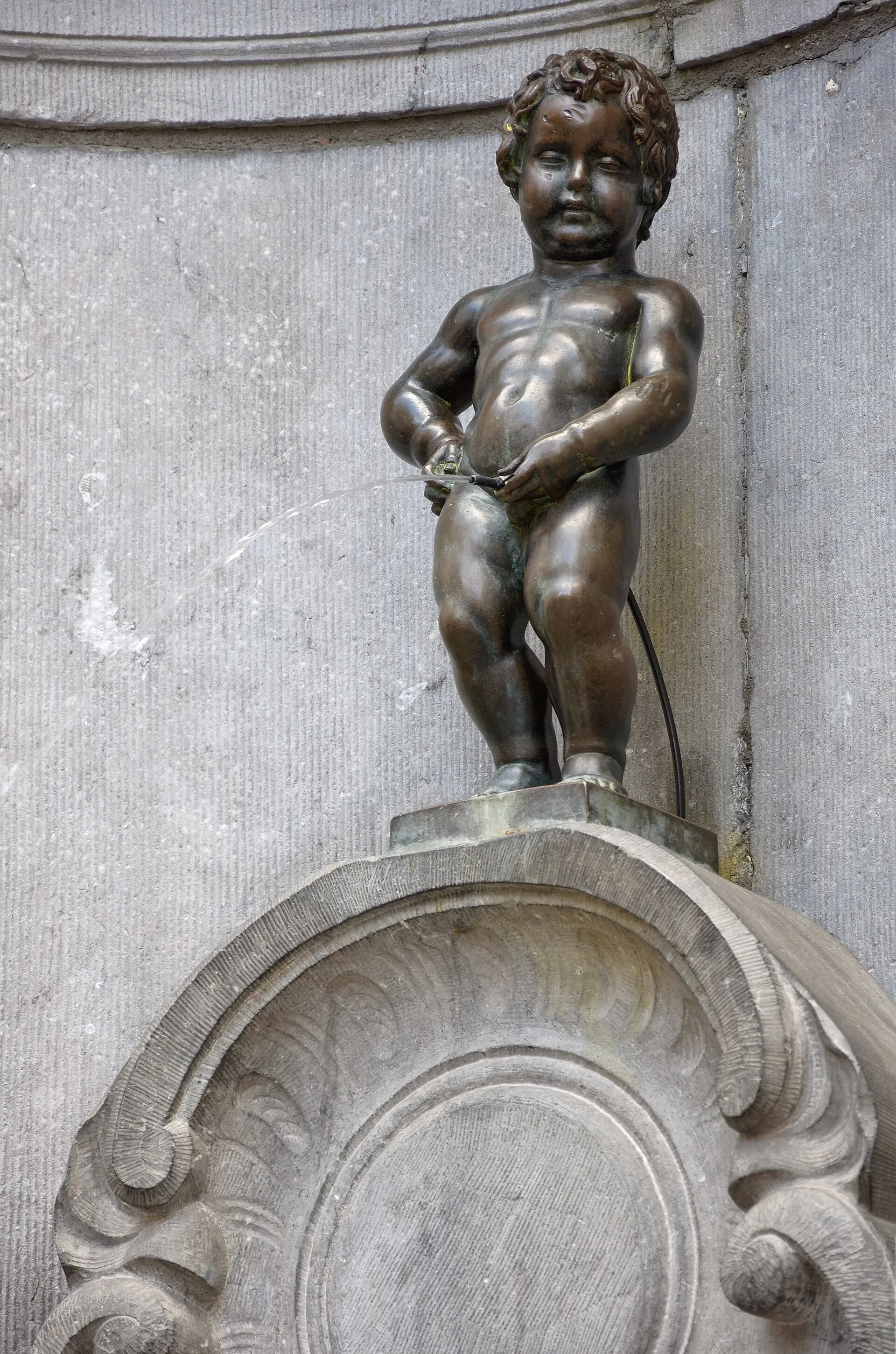
Manneken Pis rewards a little strategy rather than a quick snap. The bronze sits in an ornate grey-stone niche framed by a wrought-iron grille, and when he is dressed the city's costume team fits the outfit so he keeps "performing" through the fabric.
- Photo angles. The lane is narrow, so a wide shot is impossible up close. Step back 10–15 meters along Rue de l'Étuve for the niche and corner in context, or move in for a tight portrait of the figure alone. Early light and the after-dark floodlighting both clear the worst of the crowds.
- Costume days. On 100-plus dressing days a year he appears in full regalia — a Mozart period suit, full samurai armor, a football kit, an Elvis jumpsuit. Costumed days give the best photographs and draw festive local crowds.
- The wardrobe. The growing collection lives two minutes away at the GardeRobe MannekenPis on Rue du Chêne, which opened in 2017 and rotates roughly a hundred outfits at a time; older ceremonial costumes and the 1619 original statue are held at the Brussels City Museum (Maison du Roi) on the Grand Place.
- The siblings. Brussels later gave him company: Jeanneke Pis, a squatting girl unveiled in 1985 down the Impasse de la Fidélité, and Zinneke Pis, a leg-cocking dog from 1998 on Rue des Chartreux. Tracking down all three is a favorite local scavenger hunt.
- Chocolate detour. The surrounding lanes hide some of Brussels' better chocolatiers — Planète Chocolat, Mary, and others — a far better stop than the candy-piled tourist windows beside the fountain.
Historical Significance
The fountain predates its famous bronze by centuries: city accounts describe a stone Manneken Pis supplying drinking water here from at least the mid-15th century, making it one of Brussels' oldest surviving civic fixtures. Hiëronymus Duquesnoy the Elder cast the current bronze form in 1619, and from there the statue's biography reads like a catalogue of European turbulence. English soldiers made off with him during the War of the Austrian Succession in 1745; French grenadiers seized him again in 1747, an insult so keenly felt that King Louis XV defused it by dressing the figure in a gold-embroidered court costume and making him a knight of the Order of Saint Louis — the flourish most often cited as the origin of the dressing tradition, though governor Maximilian Emanuel of Bavaria is said to have costumed him as early as 1698. In 1817 an escaped convict shattered the statue into pieces; the fragments were used to recast it, and in 1965 the restored original was retired indoors to the Maison du Roi while the replica you see today took its place on the fountain.
More than the dates, the statue captures Brussels' zwanze — the irreverent local humor of a city that chose a urinating toddler as its emblem, dresses him in diplomatic gifts from heads of state, and celebrates the whole affair with genuine civic pride. That self-deprecation is a deliberate counterpoint to the grandeur of neighboring France and the tidy order of the Netherlands, and it runs through everything from Belgium's surrealist painters to its comic-strip walls.
When to Visit
Access. Manneken Pis is an open-air street fountain, so he is always visible, free, and never ticketed. What varies is the crowd and the costume:
- Costume changes fall on 100-plus days a year for holidays, commemorations, and visiting delegations; the outfit is usually fitted mid-morning by a City of Brussels team. Check the official City of Brussels dressing schedule before you set out.
- Quietest light. Come 7–8 AM or after 9 PM, when the lane empties and the fountain is floodlit. Midday in summer clogs the narrow surrounding streets with tour groups.
- How long. Honestly 2–5 minutes to photograph — treat him as a waypoint and fold the visit into a Grand Place and chocolate-lane loop rather than a destination in itself.
Admission and Costs
Seeing the statue costs nothing — it is a public fountain. The spending happens around it:
- GardeRobe MannekenPis wardrobe museum — around €5 (about $5.50) to see a rotating selection of the 1,000-plus costumes on Rue du Chêne.
- Brussels City Museum (Maison du Roi) — €10 (about $11) on the Grand Place, home to the 1619 original statue and older ceremonial outfits.
- Guided walking tours taking in Manneken Pis — roughly €15–25 ($16–27) for group departures, €150–200 ($165–220) for a private guide who unpacks Brussels' humor tradition.
- Chocolate — budget €10–30 ($11–33) for pralines from the serious chocolatiers hidden in the surrounding lanes.
The Case for a Guide
On his own, Manneken Pis is a two-minute photo that leaves many visitors underwhelmed — the single most common reaction is surprise at how small he is. A guide is what converts that anticlimax into the best kind of travel story. Standing at the corner, a good guide explains why a wealthy European capital chose a urinating toddler as its mascot, decodes the zwanze humor behind it, and reads the layers of the statue's biography — the wartime thefts, Louis XV's apology in costume, the 1965 switch to a replica.
- Context over spectacle — the meaning, not the monument, is the payoff here, and it does not survive on a plaque.
- A smarter route — guides thread Manneken Pis between the Grand Place, the wardrobe museum, and the Sablon, so the stop becomes part of a circuit rather than a detour.
- The good chocolate — locals steer you to the serious chocolatiers a few doors away instead of the tourist-trap windows.
- Wider Brussels — the same walk can carry on to the Magritte Museum or the Royal Museums of Fine Arts, tying the city's humor to its surrealist art.
Tips for Visitors
- Manage expectations. He is 61 cm (24 inches) tall; many visitors are briefly deflated. Lean into the absurdity — that reaction is the experience.
- Skip the fountain-side restaurants. The immediate corner trades on confused tourists. Walk three minutes toward the Grand Place or into the Îlot Sacré for better food.
- Time it with a costume day. The City of Brussels publishes the annual dressing calendar; costumed days are more photogenic and draw a local crowd.
- Route him, don't target him. Slot the statue between the Grand Place and the Sablon antiques district, pausing for pralines at a proper chocolatier.
- Go at night. After dark the fountain is lit, the crowds thin, and you can finally see the figure without elbowing through tour groups.
- Collect the set. Hunt down Jeanneke Pis and Zinneke Pis nearby to turn one small statue into a genuinely fun mini-tour.
Frequently Asked Questions
Does the time of year affect a visit to Manneken Pis?
As an outdoor street fountain, Manneken Pis is accessible year-round, but April through September offers the most comfortable conditions for the surrounding chocolate shop circuit and Grand Place exploration that complete the visit. Costume days — over 100 per year — are scattered throughout the calendar and draw more festive local crowds than ordinary days, so checking the City of Brussels dressing schedule matters more than the season itself.
When can visitors see Manneken Pis, and when is he in costume?
Manneken Pis is an open-air fountain on a public street corner, so he can be seen free of charge at any hour, day or night. What changes is whether he is dressed: the City of Brussels puts him in costume on more than 100 days a year for holidays, commemorations, and visiting delegations, usually fitting the outfit mid-morning. Because the schedule is irregular, it is worth checking the City of Brussels dressing calendar before you go — a costume day is more rewarding, and better lit for photos, than an ordinary one.
How much does it cost to visit Manneken Pis?
Viewing the statue is completely free, since it is a public fountain. Costs only appear if you extend the visit: the GardeRobe MannekenPis wardrobe museum on Rue du Chêne charges around €5 to display a rotating selection of his 1,000-plus costumes, while the Brussels City Museum on the Grand Place (€10) holds the original 1619 bronze and older ceremonial outfits. Guided walking tours that include the statue run about €15–25 for group departures and €150–200 for a private guide.
Why is Manneken Pis so small, and is it worth visiting?
At just 61 centimeters (24 inches) tall, Manneken Pis routinely surprises first-time visitors, and mild disappointment is the most common reaction. The trick is to treat the scale as the joke rather than a letdown: Brussels deliberately celebrates a tiny urinating boy as its civic emblem, an expression of the self-deprecating zwanze humor that defines the city. Seen that way — ideally with a guide, on a costume day, and as one stop on a short circuit with the Grand Place — it is genuinely worth the three-minute detour.
Where can I see the Manneken Pis costume collection?
The bulk of the wardrobe is displayed at the GardeRobe MannekenPis, a dedicated museum that opened in 2017 on Rue du Chêne, a two-minute walk from the fountain; it rotates roughly a hundred of the 1,000-plus outfits at a time. Older ceremonial costumes, along with the original 1619 statue itself, are kept at the Brussels City Museum (Maison du Roi) on the Grand Place. On costume days you can also simply catch the statue wearing one of the outfits out in the street.
What else is near Manneken Pis?
Manneken Pis sits at the center of Brussels' most walkable cluster of sights. The Grand Place, with its baroque guildhalls, is three minutes north; the chocolate lanes and the GardeRobe wardrobe museum are right beside it; and the Mont des Arts — home to the Magritte Museum and the Royal Museums of Fine Arts — is a short uphill walk. His two lesser-known siblings, Jeanneke Pis and Zinneke Pis, are both within a few blocks, making a quick statue-hunt easy to fold in.