
Abu Simbel timeline
- c. 1264 BC
Great Temple begun
Ramesses II ordered the temple cut straight into the Nubian sandstone to mark his reign and face pharaonic power toward the frontier with Nubia.
- c. 1244 BC
Both temples completed
About two decades of carving finished the Great Temple and the neighbouring Temple of Nefertari before Ramesses' Nubian campaigns wound down.
- c. 27 BC
Earthquake topples a colossus
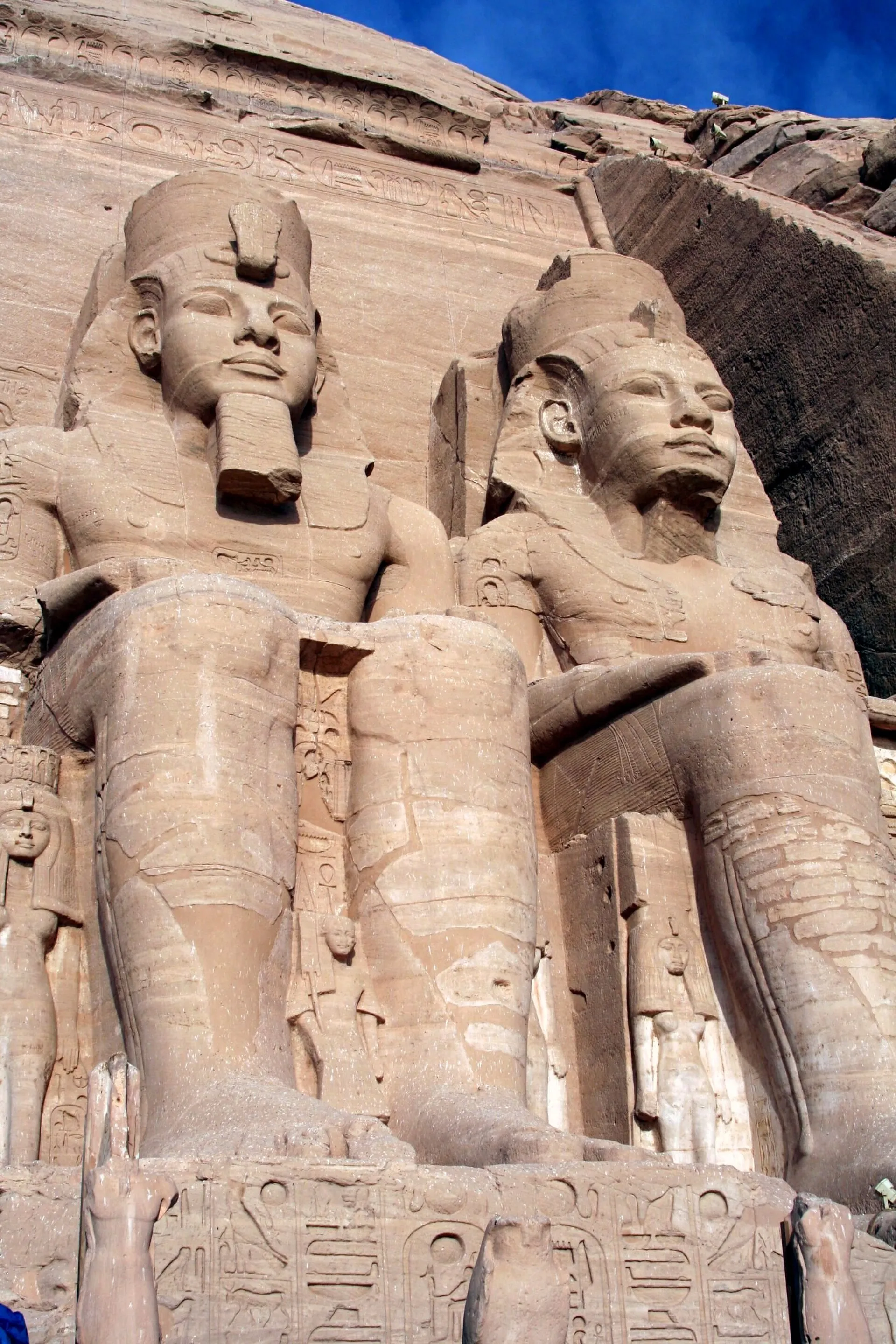
A tremor cracked the seated giants and sent the upper body of the second colossus to the ground, where the fallen head and torso still lie today.
-
Burckhardt sights the facade
The Swiss traveller Johann Ludwig Burckhardt spotted the sand-buried heads of the colossi while journeying south along the Nile.
-
Belzoni clears the entrance
Giovanni Belzoni dug out the choked doorway and became the first European of the modern era to step inside the buried sanctuary.
- 1964-1968
UNESCO relocation
An international team cut both temples into more than a thousand blocks and rebuilt them 65 metres higher, above the rising waters of Lake Nasser.
-
Listed by UNESCO
Abu Simbel joined the World Heritage list within the Nubian Monuments from Abu Simbel to Philae.
Excavation History
When the Aswan High Dam was being constructed in the 1960s, rising waters from the new Lake Nasser threatened to submerge these temples forever. What followed was one of the most ambitious archaeological rescue missions in human history. Between 1964 and 1968, UNESCO coordinated an international salvage campaign involving specialists from over fifty countries. Engineers faced an unprecedented challenge: how do you move a mountain without destroying what makes it sacred? The solution was audacious. Workers cut both temples into more than 1,000 blocks, some weighing up to 30 tonnes, and reassembled them 65 meters higher and 200 meters back from the original cliff face. To replicate the natural landscape, construction crews built an artificial hill using a reinforced concrete dome hidden beneath a carefully sculpted exterior. The operation cost $40 million at the time, equivalent to roughly $360 million in today's currency. Standing inside the temples today, you would never know they were moved unless someone told you. The precision required to maintain the original solar alignment—accurate to within millimeters—represents engineering that rivals the original construction by Ramesses' architects.
Key Artifacts
Passing between the four colossi, you enter a hypostyle hall cut 60 meters into the living sandstone. Eight Osiride pillars line the central aisle, each showing Ramesses merged with the mummiform god of the afterlife, and their painted reliefs still hold traces of ochre and blue after more than three thousand years. The northern wall carries the longest pictorial account of a single battle in Egyptian art -- the clash with the Hittites at Kadesh -- with massed chariots, a besieged fortress on the Orontes, and the pharaoh loosing arrows from a speeding chariot. Egyptologists read the whole composition as royal propaganda, since the historical engagement ended nearer a stalemate than the sweeping triumph the walls proclaim.
Deeper in, the ceilings drop and the corridors narrow until they reach the sanctuary, where four seated gods -- Amun-Ra, Ra-Horakhty, the deified Ramesses II, and Ptah -- wait in near-total darkness. Twice a year, at dawn on February 22 and October 22, sunlight travels the full length of the axis and lights three of the figures while Ptah, tied to the underworld, stays in shadow -- an alignment the builders calculated on purpose. Next door, the Temple of Nefertari breaks with convention: its six standing colossi show the queen at the same 10-meter height as the king, where royal wives were normally carved no taller than the pharaoh's knee. An inscription dedicates the temple "for the great royal wife Nefertari, for whom the sun shines," and inside, delicate reliefs show her before Hathor, goddess of love and music, in some of the finest painted carving in Egypt.
When to Visit
The comfortable season runs November through February, when daytime temperatures settle around 25-30 degrees Celsius and the low morning sun rakes across the facade. Heat builds fast from March, and between June and August the surrounding Western Desert regularly tops 45 degrees, making a midday visit punishing. Whatever the month, aim for the first hour after opening: the rising sun strikes the eastward-facing colossi head-on and picks out the deep relief that the flat overhead light of noon erases.
Two dates fill the site to capacity. On February 22 and October 22, thousands gather before dawn for the sun festival, when the aligned rays reach the inner sanctuary -- reserve transport and rooms months ahead for either. How you arrive shapes the whole day. The road convoy leaves Aswan under police escort between 3 and 4 AM and crosses about three hours of desert to reach the temples at sunrise, while EgyptAir's morning flights cover the same 280 kilometers in roughly 45 minutes each way. Most day trips allow two to three hours on site before the return -- enough to walk both temples unhurried, though not to wait out the softer afternoon light.
Admission and Costs
Admission to both temples is EGP 600 (about $12) per person, bought at the visitor centre above the site. A permit to photograph the interiors adds EGP 300, and flash is banned throughout to protect the pigments -- a rule the guards enforce closely. Around the February 22 and October 22 sun festivals, transport and accommodation prices commonly double or triple as demand spikes.
Your biggest cost decision is convoy versus flight. The shared desert convoy from Aswan is the budget route, whereas EgyptAir's return flight costs considerably more but removes six hours of driving and frees the rest of the day for other Aswan sights such as Philae Temple and the Unfinished Obelisk. A private Egyptologist guide arranged through an Aswan agency runs $60-120 for a group of up to six, separate from entry and transport. If you plan to overnight, the two lakeside hotels near the temples -- Seti Abu Simbel and Nefertari Hotel -- price modest rooms well above their Aswan equivalents, a premium you pay for the setting and for sunrise access ahead of the day-trip crowds.
The Case for a Guide
Abu Simbel's colossi are impossible to miss, but the engineering miracle behind the entire mountain being moved, the precise solar astronomy encoded in the inner sanctuary, and the displaced Nubian history that rarely appears in any signage all require a guide to surface.
- The 1960s UNESCO relocation engineering: Between 1964 and 1968, the entire temple complex was cut into 1,036 blocks weighing up to 30 tonnes each and reassembled 65 meters higher and 200 meters further from the original location; a guide explains the jointing technique that made the stones invisible, and points to the artificial dome constructed to simulate the original rock mass above the temples.
- Twice-yearly solar alignment: On February 22 and October 22, sunlight penetrates 63 meters into the inner sanctuary and illuminates the statues of Ramesses II, Ra-Horakhty, and Amun while leaving the fourth figure — Ptah, god of darkness — unlit; a guide explains how the UNESCO engineers preserved this alignment exactly despite the relocation and why these dates correspond to Ramesses' coronation and birthday.
- Rock-cut engineering without mortar: The entire original temple was carved directly into sandstone cliff; a guide explains the ancient quarrying technique using copper chisels and wooden wedges soaked in water, and why rock-cut construction made this temple more durable than any built structure of its era.
- Nubian history and displaced villages: The rising waters of Lake Nasser displaced over 100,000 Nubian people from dozens of villages; a guide explains that this human cost was largely absent from the international celebration of the rescue operation, and identifies the relocated Nubian communities now living in the Aswan area whose ancestors farmed this valley for millennia.
- The artificial hill's hidden structure: The concrete dome above the temples is camouflaged with sand and rock to appear natural; a guide explains the structural engineering challenge of creating a dome large enough to house the original cliff formation while keeping it invisible from the approach path.
Tips for Visitors
The single biggest upgrade to a visit is staying the night. An overnight at one of the lakeside hotels lets you see the temples at both sunset and the following sunrise, long after the convoy crowds from Aswan have gone and while Lake Nasser turns gold behind the colossi. Day-trippers see none of this, arriving and leaving inside the same brief window. Whichever you choose, carry more water than feels necessary, wear a hat and sturdy shoes for the exposed stone terrace, and count on almost no shade between the two temples.
Hire an Egyptologist rather than reading the wall panels alone. The Battle of Kadesh relief is stunning but cryptic without narration; a good guide walks you through the chariot charge, the Hittite ambush, and the way the scene turns a costly draw into a monument-sized victory. Ask, too, about the relocation's one quiet imperfection: rebuilding the temple nudged the solar alignment a single day off Ramesses' original calendar, so today's sun festivals fall just after the dawns the ancient architects intended -- a reminder that even a flawless rescue could not perfectly reset three thousand years of celestial timing.
Frequently Asked Questions
When is the best time of year to visit Abu Simbel?
November through February is the prime window, when desert temperatures drop to a tolerable 25-30 degrees Celsius and the golden morning light on the colossal facade is at its most photogenic. The sun festivals on February 22 and October 22, when dawn rays illuminate the inner sanctuary statues, draw the largest crowds and require months-advance booking. Avoid June through August entirely, as temperatures regularly exceed 45 degrees in this remote stretch of the Western Desert.
What time of day is best for touring Abu Simbel?
The road convoy departs from Aswan between 3 and 4 AM, ensuring arrival at sunrise when golden light strikes the facade most dramatically. Most day trips allow two to three hours at the site. The sun festivals on February 22 and October 22 draw thousands, so book months in advance for those dates.
What is the entrance fee for Abu Simbel?
Entry costs EGP 600 (approximately $12) per person. Photography permits for the interior cost an additional EGP 300, though flash is strictly prohibited. A private guide arranged through Aswan agencies typically costs $60-120 for up to six people.
How do you get to Abu Simbel from Aswan?
Two routes cover the 280 kilometres. Most visitors travel overland by car or minibus across the Western Desert, a drive of roughly three to three and a half hours each way that leaves Aswan before dawn to reach the temples at sunrise. The faster alternative is an EgyptAir flight into the small Abu Simbel Airport a few minutes from the site, about 45 minutes in the air, which turns the visit into a half-day and leaves time for Philae Temple or the Unfinished Obelisk back in Aswan.
Is a guide recommended for visiting Abu Simbel?
A guide transforms what might feel like distant history into vivid drama. Without narration, the Battle of Kadesh reliefs remain beautiful but cryptic. With a guide, you witness chariot charges, divine interventions, and scholarly debates about royal propaganda versus historical reality.