
Philae Temple timeline
- c. 380 BC
Nectanebo I begins the sanctuary
The oldest surviving structures on Philae -- a colonnaded vestibule and the first shrine to Isis -- were raised by Nectanebo I, one of the last native pharaohs.
- 3rd-1st c. BC
Ptolemaic Temple of Isis
The Ptolemies built the main temple, its two great pylons, the birth house, and the hypostyle hall, making Philae the leading centre of the Isis cult.
- 1st c. AD
Roman additions
Augustus, Tiberius, and Trajan added gateways and the fourteen-column pavilion now known as Trajan's Kiosk, the temple's most photographed structure.
-
Last hieroglyphic inscription
The graffito of Esmet-Akhom, cut on the Gate of Hadrian, is the last securely dated hieroglyphic inscription known anywhere in the world.
-
Justinian closes the temple
Emperor Justinian ordered the sanctuary shut and its cult statues removed, ending the last active worship of the old Egyptian gods.
-
Low Dam floods the island
The first Aswan Dam submerged Philae for much of each year; heightenings in 1907 and 1934 left the temple standing in water for months at a time.
- 1972-1980
UNESCO relocation to Agilkia
An international campaign enclosed the island in a cofferdam and moved 40,000 tonnes of stone to higher Agilkia Island, safe above the High Dam reservoir.
Key Artifacts
The reliefs of Philae retell one of antiquity's most influential myths. When the god Set murdered his brother Osiris and scattered the body across Egypt, Isis gathered the pieces and, through her magic, revived him long enough to conceive their son Horus. This story of death, resurrection, and divine motherhood travelled far: shrines to Isis rose in Rome, Pompeii, and as far as Roman Britain, and some scholars trace the imagery of the Virgin Mary nursing the infant Jesus to Ptolemaic scenes of Isis suckling the young Horus.
The island reads as a sequence of set-pieces, each worth seeking out:
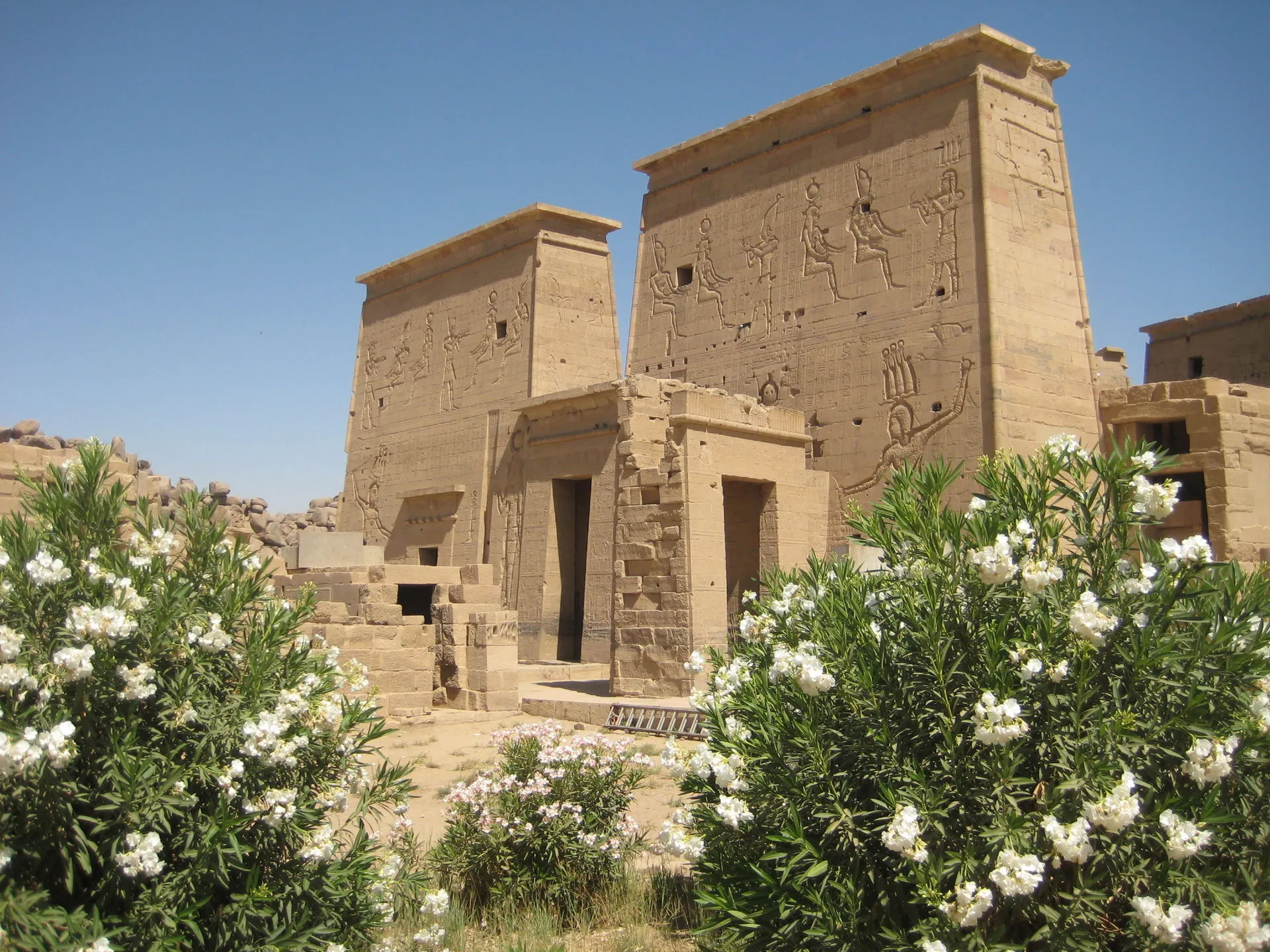
- The First Pylon — an 18-metre gateway carved with Ptolemy XII smiting his enemies before Isis and Horus.
- The mammisi (birth house) — where reliefs of Isis nursing Horus in the marshes celebrated the divine birth each year.
- The hypostyle hall — its columns crowned with Hathor-head and papyrus capitals that still hold flecks of ancient pigment.
- Trajan's Kiosk — the elegant fourteen-column pavilion on the eastern shore that became the temple's postcard image.
- The Gate of Hadrian — whose walls carry that final hieroglyphic graffito and a rare scene of the Nile-god Hapy pouring the flood from a cave.
For ancient pilgrims, reaching the sanctuary meant sailing up the Nile to Aswan's first cataract and crossing to the sacred island; priests in white linen met arrivals at the western quay for oracles, healing rites, and initiation into the goddess's mysteries. Even after Egypt turned to Christianity, the desert Blemmyes and Nobadae were granted the right to keep worshipping here and to carry the cult statue of Isis south in procession — a concession Justinian finally revoked when he ordered the temple closed.
Excavation History
Philae's present home is not its original one. For over two thousand years the temple stood on Philae Island, a short way upstream, but the completion of Aswan's Low Dam in 1902 began a slow drowning: each year the rising reservoir swallowed the temple for months, and visitors rowed between half-submerged columns, peering down through green water at reliefs never meant to be seen that way. Raising the dam twice, in 1907 and 1934, only deepened the flooding.
The much larger High Dam, planned in the 1960s, threatened permanent submersion. UNESCO's answer, carried out between 1972 and 1980, was among the boldest rescues in archaeology:
- A steel and rock-filled cofferdam was thrown around Philae Island and the water pumped out.
- Surveyors mapped and photographed every surface before 40,000 tonnes of stone were cut into numbered blocks.
- Nearby Agilkia Island was reshaped with explosives and fill to match Philae's original topography.
- The blocks were ferried across and reassembled stone for stone, so the plan matches the original almost exactly.
Funded by contributions from fifty countries, the operation succeeded so completely that visitors now experience the temple much as Ptolemaic pilgrims did, safely above any flood. Look across the water and the original Philae Island is still visible as a low, bare mound between the dams — the threat and the rescue in a single view. Traces of a later life survive too: in the sixth century part of the hypostyle hall was converted into a church of Saint Stephen, and Coptic crosses are still cut beside the pharaonic gods. Like the rock-cut temples at Abu Simbel further south, Philae owes its survival to that international campaign, and the two sites anchor the UNESCO Nubian Monuments listing together.
When to Visit
Every visit to Philae begins at the Shellal marina, where motorboats wait to ferry visitors across the reservoir. The crossing takes ten to fifteen minutes each way, passing between granite outcrops and the submerged foundations of ancient quarries. Shared boats, which depart when full, cost EGP 200-300 per vessel; private boats cost more but let you control your timing and avoid the constraint of scheduled returns. The boat ride itself is part of the experience — as you approach, the temple emerges from the horizon much as it did for ancient pilgrims, its colonnade and pylons growing larger against the sky. A calm half-day tends to unfold in a predictable order:
- 7 AM — the island opens; the first boat lands you before the tour groups.
- 9 AM — coaches from Aswan arrive and the courtyards fill quickly.
- 3:30 PM — the last boat back leaves during winter months, so plan your return accordingly.
Tipping the boat captain EGP 20-50 is customary. After dark, Philae transforms into a theatrical stage. The Sound and Light Show guides visitors through the complex as coloured floodlights illuminate successive structures and a narrated soundtrack recounts the mythology of Isis and Osiris. It begins at the ancient quay, where you first step onto the island much as pilgrims did two thousand years ago; as you walk through colonnades bathed in shifting reds, blues, and golds, recorded voices speak the parts of gods and pharaohs, telling of betrayal, murder, resurrection, and eternal love. The climax projects onto the temple facade and its reflection in the surrounding water, doubling the visual impact. Two performances run most evenings, with schedules rotating between languages — check locally for English showtimes.
Admission and Costs
Entry to the temple costs EGP 450 (approximately $9). Shared boats from the Shellal marina, which depart when full, cost EGP 200-300 per vessel; private boats cost more but let you control your timing. Tipping the boat captain EGP 20-50 is customary. Group guided tours running two to three hours, including boat transfer, cost $25-45 per person, while private guides charge $80-150 for up to six people, exclusive of boat and entry fees. Many visitors combine Philae with the nearby Unfinished Obelisk and the High Dam in a single morning itinerary — an efficient way to see three of Aswan's major sights before lunch. Wear sturdy shoes for the uneven stone pathways, bring water and sun protection, and resist the urge to touch the ancient reliefs, since oils from skin accelerate erosion of the soft sandstone. The Sound and Light Show costs EGP 400-500 per person and includes boat transfer from Shellal; tickets are sold at the marina ticket office. The show runs regardless of weather, though wind can blur the water reflections. Long-exposure photography during the performance produces some of Philae's most dramatic images, capturing the interplay of ancient stone and modern light.
The Case for a Guide
Philae rewards a guide more than most Egyptian sites, because its meaning is layered — pharaonic myth, Ptolemaic politics, Roman ambition, and a modern rescue — and almost none of it is explained on the island itself.
- Reading the Isis myth on the walls: a guide walks you through the Osiris cycle relief by relief, from Set's murder to the miraculous birth of Horus in the mammisi, so the carvings become a story rather than decoration.
- The Greek-and-Egyptian blend: Philae's pharaohs wear the double crown but often carry the softer features of Greek sculpture; a guide shows where Ptolemaic and Roman hands reworked traditional forms.
- The last of the hieroglyphs: only a guide will find the 394 AD graffito on the Gate of Hadrian and explain why the writing system died here, on this island, long after the rest of Egypt had moved on.
- The 1970s relocation: standing on Agilkia, a guide explains the cofferdam, the numbered blocks, and the reshaping of the island — then points out the original Philae as a mound across the water.
- Timing the boats and the show: guides handle the Shellal crossing, secure an early departure ahead of the group crush, and know which evening the Sound and Light Show runs in English.
Tips for Visitors
Unlike many Egyptian temples with roots in the distant pharaonic past, Philae's surviving structures date primarily from the Ptolemaic dynasty (305-30 BC) and the subsequent Roman period. This relatively late construction means the carvings blend traditional Egyptian religious imagery with Hellenistic style. Pharaohs wear the double crown of Upper and Lower Egypt, but their faces often show the softer, more naturalistic modelling favoured by Greek sculptors. Roman emperors including Augustus, Tiberius, and Trajan added their own reliefs and structures, proclaiming their legitimacy as heirs to pharaonic tradition. The main Temple of Isis follows a traditional Egyptian plan — a massive first pylon leads to a colonnaded forecourt, then a second pylon, a hypostyle hall, and finally the sacred sanctuary where the cult statue once stood — yet beside it rises Trajan's Kiosk, clearly Roman in its proportions. Smaller shrines to Hathor, to Horus, and to the Nubian gods, plus a nilometer for gauging flood levels, accumulated over centuries as successive rulers honoured the mother goddess. Practical footnotes: wear sturdy shoes for the uneven stone, carry water and sun protection on the shadeless island, and never touch the reliefs, whose soft sandstone has already survived twenty-three centuries of Nile humidity.
Frequently Asked Questions
What season should visitors choose for Philae Temple?
November through February offers the most pleasant conditions for the open-air temple on Agilkia Island, with daytime temperatures around 25 degrees and the low winter sun casting long shadows across the colonnades that accentuate the carved reliefs. The evening Sound and Light Show is particularly atmospheric during cool winter nights. Summer visits from June through August face extreme heat exceeding 40 degrees on the exposed island with no shade between structures.
What time of day is best for touring Philae Temple?
Early morning on the first boat after the 7 AM opening, when the island is nearly empty before group tours begin flooding in around 9 AM. The Sound and Light Show runs most evenings, offering a dramatically different experience after dark.
What is the entrance fee for Philae Temple?
Entry costs EGP 450 (approximately $9). Shared boats from Shellal marina cost EGP 200-300 per vessel. The Sound and Light Show costs EGP 400-500 per person including boat transfer. Group guided tours run $25-45 per person; private guides charge $80-150 for up to six people.
Is a guide recommended for visiting Philae Temple?
A guide is highly recommended. They decode the Isis mythology carved into every wall, explain the blending of Egyptian, Greek, and Roman artistic styles, and recount how UNESCO dismantled and relocated 40,000 tonnes of stone to save the temple from permanent submersion.
How do you get to Philae Temple from Aswan?
The temple stands on an island, so every visit involves a short boat ride. From central Aswan it is a 20-30 minute taxi to the Shellal marina, just south of the Old Dam, where motorboats cross to Agilkia Island in about ten to fifteen minutes. Shared boats leave when full for EGP 200-300 per vessel; a private boat costs more but lets you set your own return time rather than wait for a full load.
What makes Philae Temple historically important?
Philae was the last stronghold of ancient Egyptian religion. Its priests kept the cult of Isis alive for centuries after the rest of Egypt had turned to Christianity, and the world's last securely dated hieroglyphic inscription was carved on the island in 394 AD. Emperor Justinian ordered the temple closed around 537 AD, ending more than three thousand years of pharaonic worship.
Is Philae Temple accessible for visitors with limited mobility?
Access is challenging. Reaching the island means stepping down into a small boat and up onto the quay, and the temple grounds are paved with uneven ancient stone, steps, and thresholds with no ramps. Visitors with limited mobility should travel with a companion, choose a private boat for an unhurried transfer, and hire a guide who can plan the flattest route through the complex.