
Spiritual Significance
For Rovinj, St Euphemia is far more than a historical curiosity enshrined in a hilltop church — she is the town's patron and protector, and her presence is woven into local identity in ways that go beyond ordinary tourist interest. The saint herself, a young Christian woman from Chalcedon (in present-day Turkey), was martyred in 304 CE during the persecutions under Emperor Diocletian, one of the early Church's most famous virgin martyrs. Her cult spread widely across the Adriatic in the centuries that followed, but it found a particularly durable home in Rovinj after the arrival of her relics.
The town's founding legend — that her sarcophagus floated unaided across the sea and could only be moved uphill by a boy and two oxen after every adult effort failed — is retold to children in Rovinj much as any origin myth would be, and it appears in local art, souvenirs, and civic imagery throughout the old town. The feast day on 16 September remains a genuine community event rather than a staged spectacle for visitors, with Mass, a procession bearing relics through the streets, and gatherings that draw people back to Rovinj from wherever they have since moved. Fishermen historically timed their departures and returns around observances connected to her protection, reflecting how deeply the maritime town's survival was bound up with faith in a patron believed to watch over those at sea. Even secular visitors tend to sense, standing before the sarcophagus, that this is a living devotional site rather than simply a stop on a heritage trail.
Visitor Etiquette
As an active parish church, St Euphemia expects the same quiet respect any working place of worship does: modest dress covering shoulders and knees is appreciated, voices should stay low, and photography — while generally tolerated in the nave — should pause during any Mass or private prayer taking place near the altar or the saint's sarcophagus. Flash photography directed at the altar area is best avoided out of courtesy to worshippers rather than any strict rule. If a service is in progress when you arrive, it is polite to wait outside or observe quietly from the rear rather than treating the space purely as a sightseeing stop.
The bell-tower climb has its own etiquette born of practicality: the stairwell is narrow and largely one-way in spirit even where two-way traffic is technically possible, so give way to descending visitors rather than forcing a squeeze past on the tight spiral. Groups should keep the pace moving rather than lingering on the stairs themselves, saving photographs for the viewing platform at the top, where there is room to pause without blocking others. Because the tower is unheated and exposed, dress for wind even on a warm day at street level — the platform can feel noticeably cooler and breezier than the piazza below. Finally, remember that the piazza in front of the church is a genuine public square used by residents as well as visitors; enjoying it as a photo backdrop is fine, but treating it with the same everyday respect you would show any town square goes a long way in a place this small.
When to Visit
The church is generally open to visitors daily, typically from around 10 AM until early evening, with shorter hours outside the summer season and occasional closures during Mass — check current notices posted at the door, as times shift seasonally and around religious holidays. The bell tower climb usually operates on a similar schedule but may close in poor weather, since the exposed viewing platform offers little shelter from wind or rain. Early morning or the hour before closing are the quietest windows to visit, especially in July and August when cruise-ship groups and day-trippers cluster around midday. Evenings are lovely for the approach up Grisia Street, even if the tower itself has closed, since the facade catches the last light beautifully.
Admission and Costs
Entry to the church nave is typically free, in keeping with its status as an active parish church. Climbing the bell tower usually carries a small fee, in the region of a few euros per person, collected at a ticket point near the base of the stairs — exact pricing varies by season, so treat any figure as an estimate and confirm on arrival. There is no charge to view the exterior or to sit in the piazza in front of the church, which is itself one of the best vantage points for photographing the facade. Guided walking tours of the old town that include the church and tower as a stop typically run somewhere in the range of a modest per-person fee for a small group, though private guides charge more for a dedicated, in-depth visit.
Tips for Visitors
Wear comfortable shoes with good grip: both the climb up Grisia Street and the narrow spiral stairs inside the tower are steep, and the stone steps can be slippery when wet. Visit the tower on a clear day if possible — the view over the Rovinj archipelago and the old town's terracotta roofs is the entire point of the climb, and haze or rain will blunt it considerably. Combine the visit with a wander through Rovinj Old Town below, since the church sits at the natural high point of any walking route through the peninsula's lanes. If you are in town on 16 September, plan around the feast-day procession, which draws crowds but offers a rare glimpse of the church's living religious role. Photographers should note that the golden hour before sunset lights the tower beautifully from the harbour side, while a midday visit is best for the interior, when light through the windows is strongest.
Frequently Asked Questions
Why is the Church of St. Euphemia important to Rovinj?
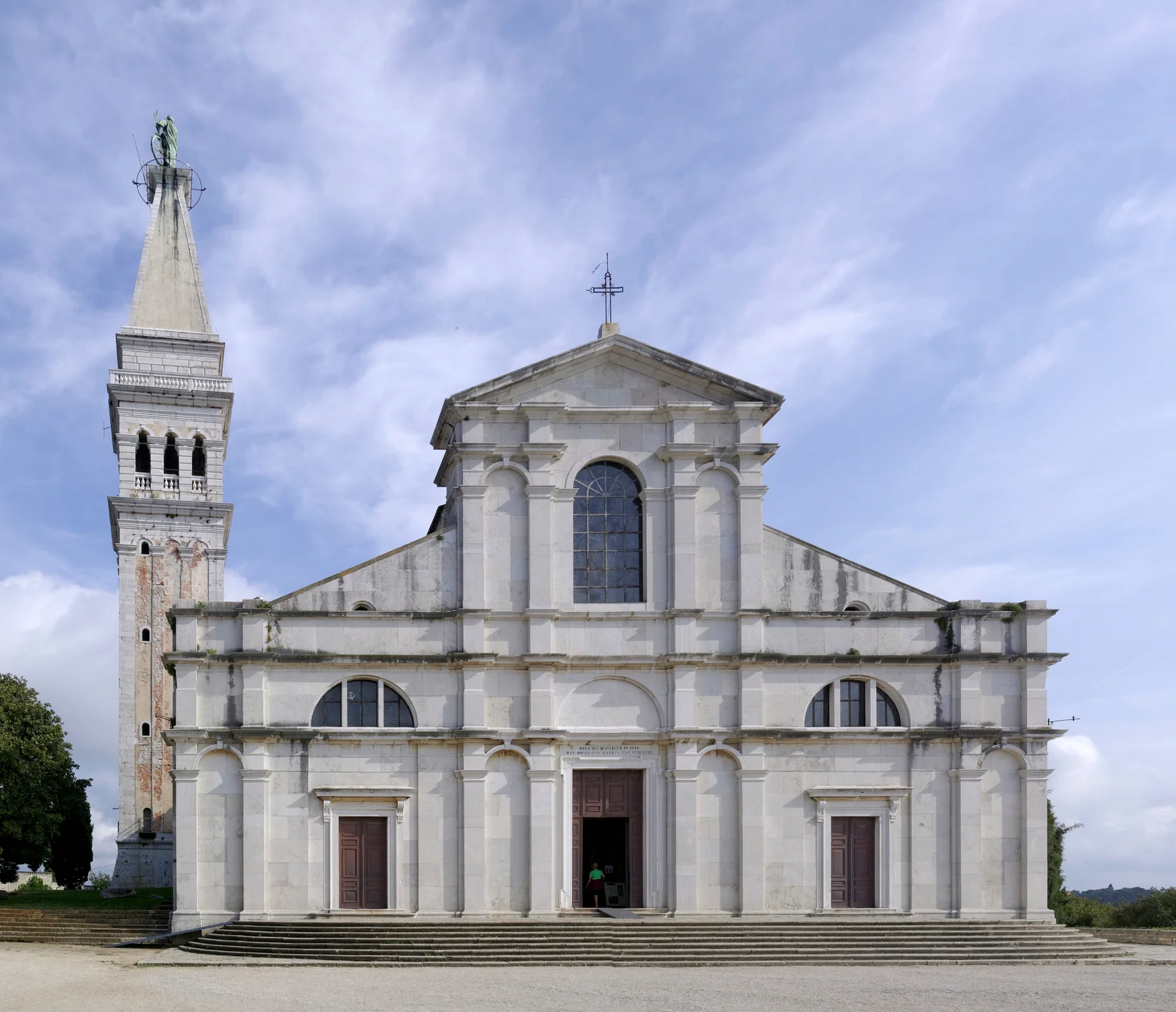
It is the spiritual and visual anchor of the town, standing on the highest point of the old-town peninsula and holding the sarcophagus of St Euphemia, Rovinj's patron saint. According to local tradition, the sixth-century stone coffin containing her remains washed ashore near the town around 800 CE and could not be moved until a boy with two oxen miraculously hauled it up the hill to where the church now stands. Rovinj has venerated her ever since, and the town's identity is bound up with the silhouette of the church visible from every approach by sea or land.
How tall is the bell tower and can visitors climb it?
The campanile rises to roughly 60 metres, making it the tallest bell tower in Istria and a clear echo of St Mark's Campanile in Venice, which directly inspired its design. A narrow staircase of around 190 steps climbs to a viewing platform beneath the belfry, and the reward is a sweeping panorama over the terracotta roofs of Rovinj, the harbour, and the wooded islets of the Rovinj archipelago. The climb is steep and the stairwell tight, so it is not ideal for anyone with mobility difficulties or a fear of confined heights.
What is the significance of the statue on top of the tower?
A gilded copper statue of St Euphemia stands at the very top of the spire, holding a palm frond in one hand — the traditional symbol of a Christian martyr — while her other hand rests on a wheel, an emblem tied to the torture she is said to have endured before her execution. The statue is mounted to pivot with the wind, so it functions as the town's weather vane as well as its guardian figure, and Rovinj's fishermen have long read the direction it faces before heading out to sea.
Is St Euphemia's Day still celebrated in Rovinj?
Yes. Every 16 September, the town marks the saint's feast day with a procession, church services, and civic celebrations that draw residents from across the peninsula and the surrounding countryside. It remains one of the few days when the church's role as an active parish, rather than simply a landmark for visitors, is on full public display, and the piazza in front of the church fills with stalls and music into the evening.