
Walking Routes
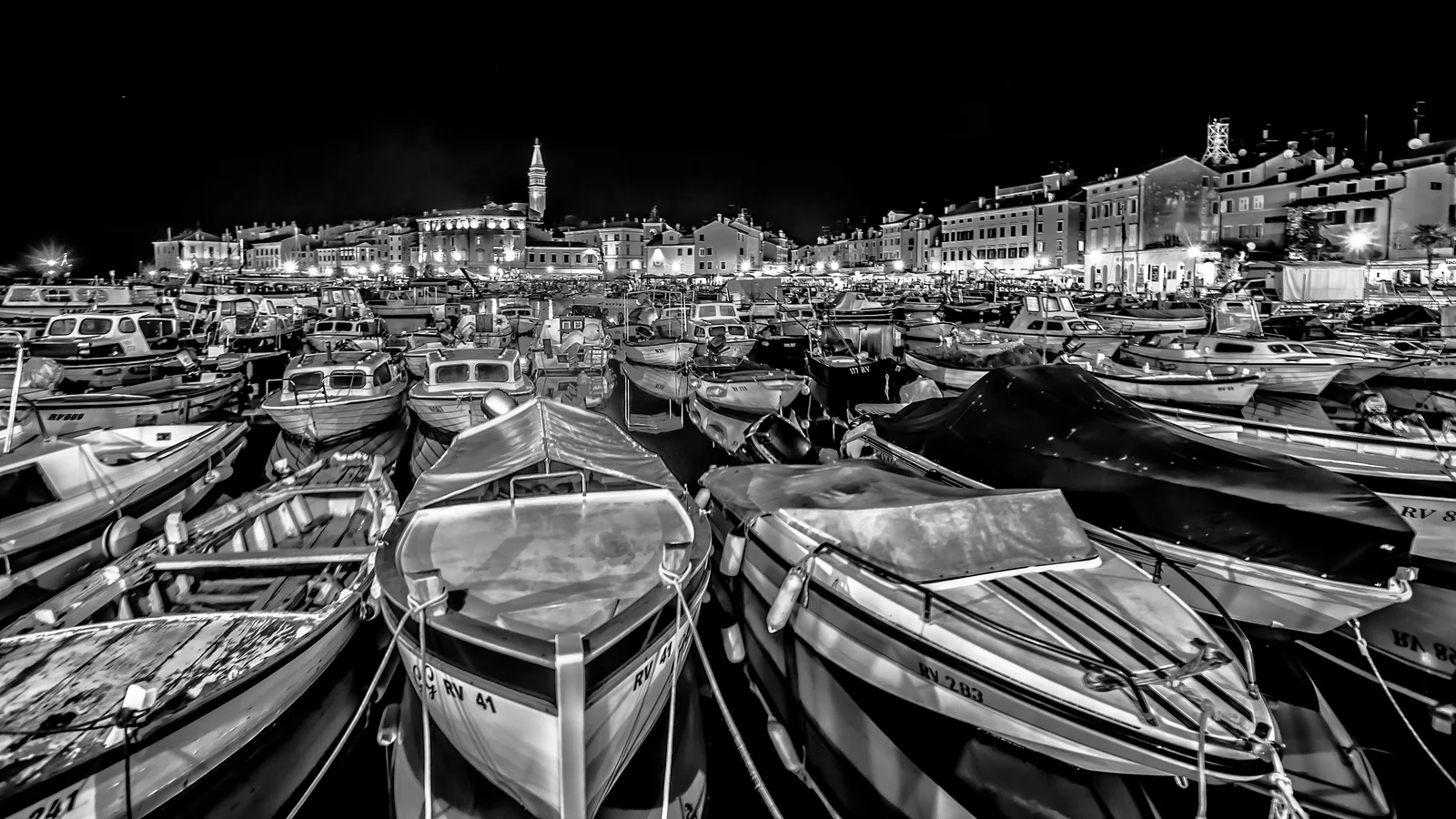
A satisfying loop starts under the Balbi Arch on Trg maršala Tita, climbs Grisia all the way to the Church of St Euphemia and its viewpoint, then descends by any of the side lanes toward the western rocks — the best sunset vantage over the water. From there, follow the Obala Pina Budicina promenade back around the harbour, passing the fishing houses with their sea steps and the Batana Eco-Museum, to return to the square. The whole circuit is under two kilometres but easily fills a half-day with stops. For a longer walk, continue south from the harbour along the shore into the Golden Cape Forest Park (Zlatni rt / Punta Corrente), a wooded coastal park of holm oak, cypress, and cedar laid out in the 1890s by the industrialist Georg Hütterott, with swimming coves and shaded paths.
Local Life
For all its beauty, Rovinj is still a lived-in town rather than an open-air museum. Laundry hangs between shuttered windows on the upper alleys, cats doze in doorways, and locals do their shopping at the small morning market near the harbour. The fishing tradition survives in the working corner of the port and in the batana boats kept afloat by a dedicated community association — you may see them rowed out on summer evenings, sometimes accompanied by the call-and-response bitinada singing. The town's Italian heritage is genuinely bilingual: street signs appear in both Croatian and Italian, and the older residents' first language is often the local Istro-Venetian dialect. Eating where the fishing families eat — a simple konoba serving the morning's catch rather than a promenade tourist menu — is the surest way to touch that everyday Rovinj.
When to Visit
The old town is an open, roofless place you can wander at any hour, and the light is what matters most. Early morning, before the day-trippers and any cruise passengers arrive, is quietest and coolest, and the fishing corner of the harbour is at its most active around 7–9 AM. The golden hour before sunset is the classic window — the low sun sets the pastel walls and the campanile alight from the seaward side, which is why painters and photographers cluster on the western rocks then. Midday in July and August is the one time to avoid: the alleys funnel heat and crowds, and Grisia can be shoulder-to-shoulder. May, June, September, and October give you the same townscape with room to breathe. The individual museums and the church tower keep seasonal hours, so save interiors for opening times and use the streets themselves for the edges of the day.
Admission and Costs
Wandering the old town costs nothing — the lanes, squares, promenade, and the Balbi Arch are all free to explore at any time. Individual sights carry modest charges: the Batana Eco-Museum entry is a few euros, and climbing the St Euphemia bell tower a similar small fee. A guided old-town walking tour typically runs €80–130 for a private small group of up to six, covering the street history, the Balbi Arch, Grisia, and the sea-step houses, and often folding in a stop for olive oil or a malvazija wine tasting in one of the cellar konoba. Free tip-based walking tours appear occasionally in peak summer but are far less reliable here than in Croatia's larger cities. Treat all figures as estimates and confirm current prices, which drift with the season.
The Case for a Guide
A knowledgeable local guide turns Rovinj's maze from a pretty backdrop into a legible story. Because there is no logic to the street plan, a guide is the fastest way to understand why — the island origin, the 1763 infill, the concentric rings shaped by a vanished shoreline — and to find the sea-step houses, the best sunset rocks, and the studios on Grisia without wasting an afternoon backtracking. Guides who work the food-and-culture angle connect the harbour to the Istrian interior, arranging malvazija and teran tastings in old-town cellars or truffle experiences in the forests inland, and they know which konoba still cook for locals rather than for the promenade. In a town this compact, the difference a guide makes is not distance covered but depth — the difference between photographing Rovinj and understanding it.
Tips for Visitors
Wear shoes with real grip: the cobbles and the polished stone of Grisia are genuinely slippery when wet, and the climb to the church is steeper than it looks. Deliberately get lost in the morning while the light is good and the streets empty, then use the church at the top and the harbour at the bottom as your two fixed reference points. Bring a little cash for the small museums and for the studios on Grisia, some of which are one-artist affairs. Photographers should shoot the sea-step houses from the western rocks near the Rovinj Archipelago boat jetties at sunset, and the alleys themselves in the flat morning light when the colours are truest. If you visit on the second Sunday of August, plan around the Grisia art exhibition — it is a highlight, but the street will be packed.
Frequently Asked Questions
How do I find my way around Rovinj's old town?
You mostly don't — and that is the point. Because Rovinj was an island until 1763, its streets were never laid out on a grid; they spiral outward in concentric rings from the hilltop Church of St Euphemia, following the shape of the former shoreline. The reliable trick is vertical: whenever you are lost, climb, and you will eventually reach the church and the panorama at the top; to leave, keep descending toward the sound of the harbour. The main artery is Grisia, the cobbled lane that runs from the central square up to the church, and almost every other alley branches off it. Give yourself permission to take wrong turns — the dead ends that open suddenly onto the sea are the best part.
What is the Balbi Arch?
The Balbi Arch (Balbijev luk) is the grand Baroque gateway that marks the entrance to the old town from the main square, Trg maršala Tita. It was built in 1679–1680 on the site of the town's original inner gate, and it carries a Venetian lion of St Mark on its outward face and a Turk's head and a Venetian's head carved on either side. Passing beneath it is the traditional start of any walk into the peninsula, and it makes the cleanest orientation point in a town with almost no straight lines.
Why do some houses have steps going straight into the sea?
Rovinj's seaward houses were built by fishing families right at the water's edge, and many still have private stone stairs — the morske stube, or sea steps — descending from a door or terrace directly into the Adriatic, where a small boat could be moored or nets hauled in. They are one of the most photographed details of the old town and a reminder that this was a working fishing settlement long before it became a resort. The Batana Eco-Museum (Kuća o batani) on the harbour documents the flat-bottomed batana boats these families used, a tradition inscribed on UNESCO's list of intangible cultural heritage in 2016.