
Observation Spots
Formation
The Everglades is young rock on old bones — a wetland only about 5,000 years old spread across limestone laid down over millions. The bedrock is porous Miami Limestone and the Fort Thompson Formation, a reef-and-shell platform that also forms the Biscayne Aquifer supplying the region's drinking water. As the last Ice Age ended and sea-level rise finally slowed, summer rains and the seasonal overflow of Lake Okeechobee began spreading a thin film of freshwater southward across this nearly flat shelf, which tilts only about two inches per mile. That almost non-existent gradient is why the water moves as a sheet rather than a channel — the defining fact of the whole ecosystem.
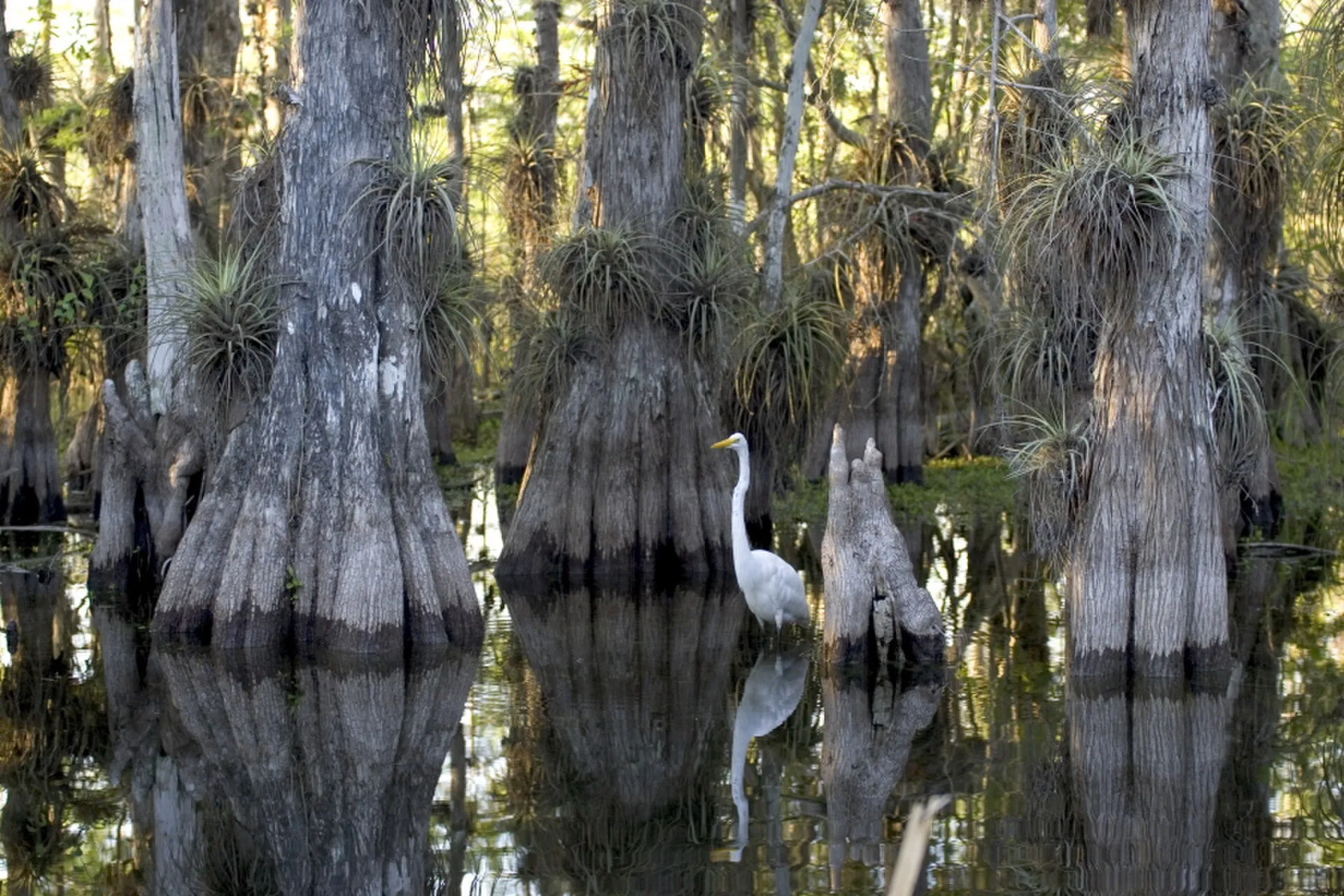
Over the millennia the standing water built the landscape's texture. Decaying sawgrass laid down peat in the deeper sloughs; thinner marl settled on the prairies; and where slightly acidic water dissolved pockets in the limestone, cypress domes and tree islands (tropical hardwood hammocks) rose just inches above the marsh — enough to keep their roots dry. Oolitic limestone ridges carry the fire-dependent pine rockland. The result is a system where a difference of a few inches in elevation or water depth produces an entirely different habitat within yards. A century of drainage canals cut that living flow to a fraction of its original volume, which is why the multi-billion-dollar Comprehensive Everglades Restoration Plan now works to send clean freshwater south again.
Trails
Anhinga Trail is the park's signature walk: a flat 0.8-mile paved loop and boardwalk at Royal Palm where, in winter, alligators, anhingas, herons and turtles gather so close the railing feels unnecessary. From the same car park the shaded Gumbo Limbo Trail winds through a tropical hardwood hammock of strangler figs and red-barked gumbo-limbo trees. Further along the main road, the short boardwalk to Pa-hay-okee Overlook climbs to a platform with the definitive view across the river of grass, and Mahogany Hammock loops past the largest mahogany tree in the United States.
At the park's other entrance, the Shark Valley loop is a 15-mile paved circuit ridden by tram or rental bike out to the spiralling 65-foot observation tower and its 360-degree sawgrass panorama. For water routes, the Nine Mile Pond canoe trail threads 5.2 miles of mangrove tunnels and open marsh, while the road's end at Flamingo opens Florida Bay to kayakers and backcountry boat tours. Wherever you walk, start early: wildlife is most active, and the light most forgiving, in the first hours after dawn.
Wildlife
The Everglades is a wildlife spectacle precisely because it is a crossroads of freshwater and sea. It is the only place on Earth where American alligators and American crocodiles coexist — alligators patrol the freshwater marshes of Shark Valley and the Anhinga Trail, while the rarer, salt-tolerant crocodile keeps to the brackish bays around Flamingo. Those same southern waters shelter gentle West Indian manatees through the cooler months and flashes of pink from feeding roseate spoonbills.
Birds are the headline act: more than 360 species have been recorded, from endangered wood storks and the snail-eating Everglades snail kite to great egrets, white ibis and herons that mass by the hundred at dry-season rookeries. Overhead and underfoot the list runs long — river otters, bottlenose dolphins in Florida Bay, and the critically endangered Florida panther, of which only a couple of hundred survive in the wild. The park also fronts the modern battle against invasive Burmese pythons, which have reshaped the food web and are now the focus of intensive removal programs. A guide who knows the seasons and the gator holes turns a landscape that can look monotonous into a safari.
Everglades National Park timeline
- ~5,000 yrs ago
The wetland forms
As post-glacial sea-level rise slowed, rainfall and Lake Okeechobee's overflow began spreading a thin sheet of freshwater south across the gently tilting limestone shelf, laying down the peat and marl that became the modern Everglades.
-
Park dedicated; "River of Grass" published
President Truman dedicated the national park in December, the same year Marjory Stoneman Douglas published her landmark book reframing the "worthless swamp" as a living river that had to be saved.
-
International Biosphere Reserve
UNESCO's Man and the Biosphere programme recognised the park as a reserve of global ecological importance.
-
UNESCO World Heritage Site
Inscribed for its exceptional wetland biodiversity, the park is one of only a handful of sites listed for natural, biosphere and wetland significance at once.
-
Wetland of International Importance
Designated under the Ramsar Convention, cementing the Everglades as one of the planet's most important wetlands.
-
Comprehensive Everglades Restoration Plan
Congress authorised CERP, the largest ecosystem-restoration effort ever attempted, to undo a century of drainage canals and return clean freshwater flow to the park.
When to Visit
Park access: Everglades National Park is open 24 hours a day, 365 days a year, though the Shark Valley loop road has staffed gate hours. Visitor centers (Ernest F. Coe at the main entrance, Shark Valley, Flamingo and Gulf Coast) generally open 9 AM to 5 PM, with reduced hours in the summer off-season.
Dry season (December through April) is the time to come: receding water concentrates wildlife around shrinking pools, mosquitoes retreat, and animal sightings become almost guaranteed. Wet season (May through November) brings 90°F-plus heat, daily afternoon thunderstorms and legendary mosquitoes, but also floods the sawgrass into its full flowing glory. Whatever the season, dawn and dusk are when the park comes alive — early-morning bike rides at Shark Valley and sunset paddles are the most rewarding, and the cooler hours spare you both the heat and the worst of the bugs.
Admission and Costs
Park entry is a single pass covering seven consecutive days: $30 per private vehicle, $25 per motorcycle, or $15 per person on foot or by bike. An annual Everglades pass is $55, and the national America the Beautiful pass ($80) covers entry to every US national park. Children aged 15 and under are free.
Activities inside the park: the Shark Valley tram tour runs about $32 per adult (reserve ahead in winter) or you can rent a bike for roughly $25 a day to ride the loop yourself. Ranger-led canoe and kayak programs are free but require advance reservation; boat tours from Flamingo into Florida Bay and the backcountry run about $40 per adult. Commercial airboat rides operate on private land along the Tamiami Trail outside the park and typically cost $25-50 for a 30-60 minute ride. A full-day guided natural-history tour from Miami, transport included, generally runs $120-200 per person.
The Case for a Guide
- Finding what hides in plain sight — a naturalist spots the alligator you mistook for a log, picks the roseate spoonbill out of the tree line, and knows which gator hole is holding manatees this week, turning seemingly empty sawgrass into a theatre of constant activity
- Choosing the right entrance — Shark Valley, Royal Palm and Flamingo are three unconnected worlds; a guide matches the entrance, tide and season to the time you have so you don't waste half a day driving between them
- Reading the river of grass — guides explain how a two-inch drop in the limestone shelf creates a whole new habitat, why alligators and crocodiles meet here and nowhere else, and what the restoration canals are trying to repair
- Telling the human story — the Miccosukee and Seminole peoples have lived within this landscape for generations, and a guide connects the place names and the dugout-canoe history to the marsh you are standing in
- Staying safe and comfortable — guides know which trails flood after rain, where the mosquitoes are tolerable, how far to keep from an alligator, and how to carry enough water for a park with almost no shade and few services
Tips for Visitors
Bug spray is not optional: Everglades mosquitoes are legendary, especially in the wet season — bring DEET-based repellent and, from May to October, a head net. Sun protection matters just as much: there is almost no shade in the sawgrass prairies, so pack a wide-brimmed hat, long sleeves and high-SPF sunscreen, and carry far more water than you think you need, because services inside the park are minimal.
Pick one entrance per visit — they do not connect inside the boundary. Shark Valley on US-41 (45 minutes from downtown) suits a half-day; the Ernest F. Coe entrance near Homestead (1 hour south) opens the full road to Flamingo and needs a day. A classic pairing is a morning in the sawgrass followed by an afternoon at Vizcaya Museum and Gardens, a satisfying swing from untamed wilderness to formal European gardens. Keep at least 15 feet from any alligator — they look sluggish but lunge fast — and never feed wildlife.
Frequently Asked Questions
Which Everglades entrance should you use from Miami?
The park has three separate entrances that do not connect to each other inside the boundary, so pick one per trip. Shark Valley on the Tamiami Trail (US-41), about 45 minutes west of downtown, is the quick half-day option — a 15-mile paved loop you ride by tram or rental bike to the observation tower. The Ernest F. Coe entrance near Homestead, roughly an hour south, opens the main road past the Anhinga Trail, Pa-hay-okee and Mahogany Hammock all the way to Flamingo on Florida Bay, and needs a full day. The remote Gulf Coast entrance at Everglades City is the gateway to the mangrove islands of the Ten Thousand Islands by boat or kayak.
Can you take an airboat ride inside Everglades National Park?
Not inside the park proper. The National Park Service does not run airboats, and only a handful of grandfathered operators are permitted within the boundary; the loud commercial airboat rides most visitors book operate on private land along the Tamiami Trail just outside the park. Inside, the quieter ways to get onto the water are the guided tram at Shark Valley, rental bikes, ranger-led canoe and kayak trips, and the boat tours that leave from Flamingo into Florida Bay and the backcountry.
When is the best season to visit the Everglades?
The dry season from December through April is by far the best window. As the summer floodwater recedes, fish and wildlife crowd into the remaining gator holes and pools, so alligators, wading birds and otters concentrate in spots you can actually see from the boardwalks — and the mosquitoes and afternoon thunderstorms of the wet season have eased. The wet season (May to November) floods the sawgrass into its full river-of-grass form but brings ferocious mosquitoes, heat above 90°F and daily storms.
Can you really see both alligators and crocodiles here?
Yes — the Everglades is the only place on Earth where American alligators and American crocodiles live side by side, because the park spans the meeting point of freshwater marsh and brackish coastal estuary. Alligators are common and easy to spot along the Anhinga Trail and Shark Valley in freshwater. The shyer, lighter-coloured, narrow-snouted American crocodile favours the salt and brackish water around Flamingo and Florida Bay, where manatees also gather in the warmer months.
Is the Everglades a good day trip from Miami?
It makes an excellent day trip. Shark Valley works as a half-day and pairs naturally with an afternoon back in the city — many visitors follow a morning in the sawgrass with the manicured European gardens of Vizcaya Museum and Gardens or a late lunch in Little Havana. To reach Flamingo and the full main road, budget a complete day from the Homestead entrance and leave the city early.