
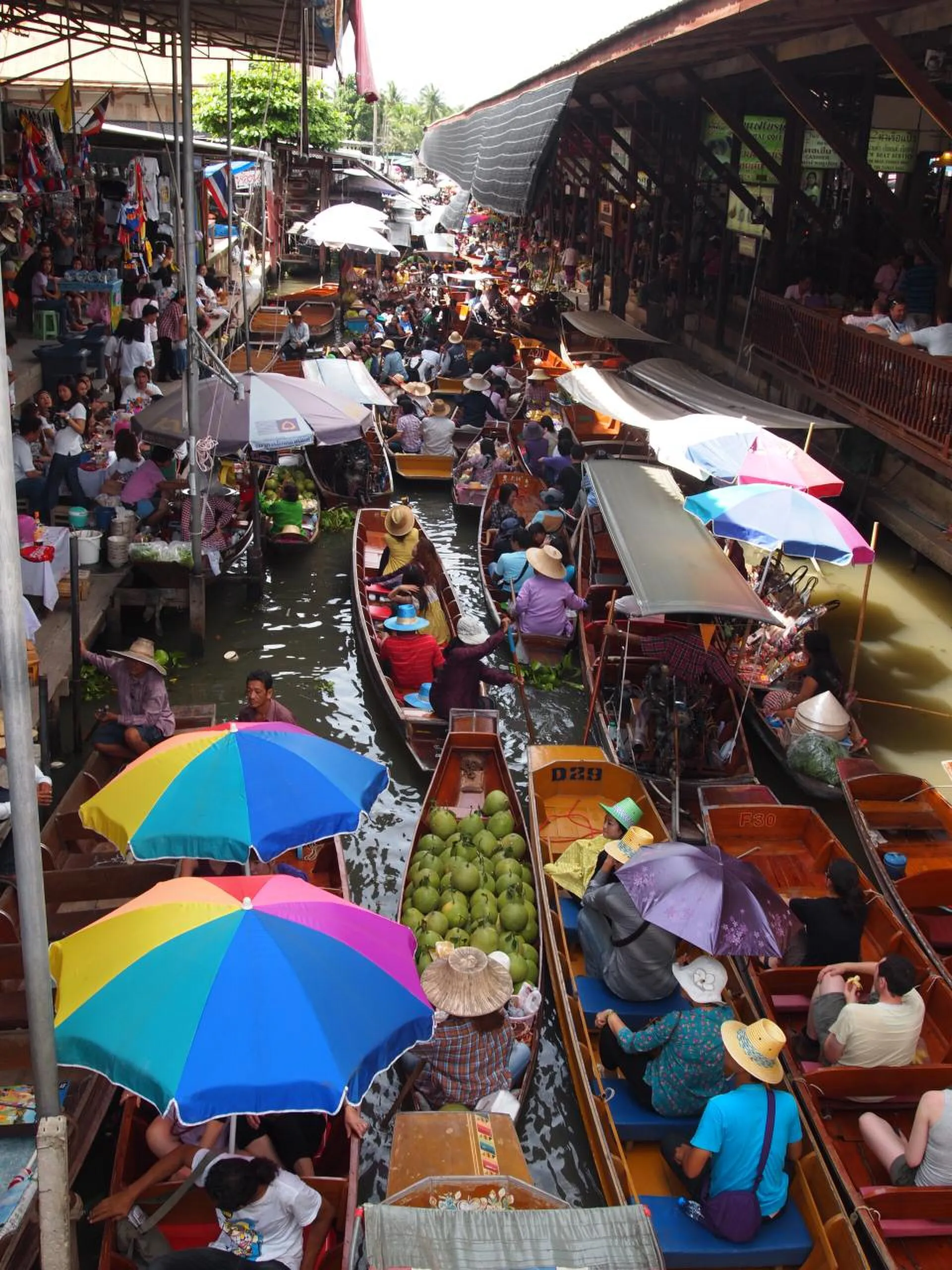
Food Stalls
The real reason to come is to eat from the water. At every market the boats double as floating kitchens, and the signature dish is boat noodles (kuaytiaw ruea) — a dark, intense pork or beef broth served in small bowls, historically sized so a vendor could pass them across the water without spilling. They are cheap and meant to be eaten in quick succession, so order two or three rather than one.
Beyond the noodles, seek out:
- Grilled river prawns and seafood, splayed over charcoal on boat platforms — the star of Amphawa's evening market, where whole prawns arrive with a fiery seafood dip.
- Coconut ice cream (i-tim kati), scooped into a half-coconut shell or a soft bun and topped with peanuts and sweet sticky rice.
- Khanom krok, coconut-rice pancakes cooked in a dimpled cast-iron pan and served warm and custardy in the middle.
- Mango sticky rice (khao niao mamuang) in season, with freshly pressed sugarcane or young-coconut juice to cut the tropical heat.
Damnoen Saduak leans toward quick snacks eaten straight from the boat; Amphawa and the in-city markets have more sit-down space along the canal, so save a proper seafood meal for a riverside table there.
What To Buy
Floating markets are as much a spectacle as a shopping trip, and the most memorable "purchases" are the scenes themselves.
- Fresh tropical fruit — rambutan, mangosteen, pomelo, rose apple, and mango — sold straight from laden sampans by vendors in conical ngob hats.
- Boat-to-boat commerce: produce, cash, and cooked food change hands entirely on the water, the living remnant of the canal trade that earned Bangkok its "Venice of the East" nickname.
- Stilt houses and canal life lining the khlongs, where families still bathe, do laundry, and sell from their front porches.
- Handicrafts and souvenirs — carved wood, coconut-shell bowls, woven hats, and hand-dyed cotton — most authentic and best-priced at the in-city Taling Chan and Khlong Lat Mayom markets rather than tourist-focused Damnoen Saduak.
- Firefly boat tours at Amphawa, where after dark the lamphu trees along the Mae Klong flicker with thousands of fireflies — a distinctly Thai experience with no equivalent at the daytime markets.
Many tours combine the canals with the nearby Maeklong Railway Market, where vendors fold back their awnings as a train inches through the stalls several times a day — one of the region's most photographed sights.
Bangkok Floating Markets timeline
-
King Rama I founds Bangkok on the Chao Phraya
The new capital is laid out around a dense network of *khlongs* (canals). Vendors paddle boats of fruit, rice, and curries door to door, and the city earns its nickname as the "Venice of the East."
- 1866-1868
The Damnoen Saduak canal is dug
King Rama IV orders a roughly 32 km canal linking the Mae Klong and Tha Chin rivers southwest of Bangkok; its grid of side canals will later host Thailand's most famous floating market.
- 1900s
Canals give way to roads
Through the 20th century many of Bangkok's central *khlongs* are filled in for streets, and waterborne commerce fades from the city core, surviving mainly in the surrounding provinces.
-
Taling Chan Floating Market opens
A weekend market starts on Khlong Chak Phra inside Bangkok, giving locals a nearby alternative to the long trip out to Damnoen Saduak.
-
Amphawa is revived as an evening market
The Friday-Sunday afternoon market at Amphawa in Samut Songkhram takes off, drawing Thai visitors for riverside seafood and after-dark firefly boat tours; Khlong Lat Mayom opens the same year.
- Today
Four markets keep the tradition afloat
Damnoen Saduak, Amphawa, Taling Chan, and Khlong Lat Mayom each strike a different balance of spectacle and authenticity for visitors based in Bangkok.
When to Visit
Bangkok's four floating markets keep very different schedules, and matching the market to the hour is what separates a memorable morning on the water from an overpriced scrum.
- Damnoen Saduak (Ratchaburi): daily, roughly 7:00 AM – 11:00 AM, with the boats thickest and the light best between 8 and 9 AM. By late morning the canals clog with longtails and the tour buses arrive, so treat it strictly as an early start — allow 90 minutes to two hours' drive each way from central Bangkok.
- Amphawa (Samut Songkhram): Friday to Sunday only, from around 11:00 AM until 8:00–9:00 PM. It peaks in the late afternoon and after dark, when the riverside grills fire up and the firefly boat tours set out along the Mae Klong at dusk (roughly 6:30–8:00 PM).
- Taling Chan: Saturday and Sunday, about 8:00 AM – 5:00 PM. The closest market to the centre — 30 minutes across the river in Thonburi — with a floating raft restaurant where you point at grilled fish and eat cross-legged over the canal.
- Khlong Lat Mayom: Saturday and Sunday, roughly 8:00 AM – 5:00 PM. A relaxed neighbourhood market with orchard-and-canal longtail tours and an almost entirely Thai crowd.
If you have a single weekend morning, you can pair the in-city Taling Chan canals with an afternoon run out to Amphawa; if you are set on Damnoen Saduak's classic photographs, sacrifice the lie-in and be at the pier by 8 AM.
Admission and Costs
Entry to the markets themselves is free — you pay only for the boat and what you eat. Bring small notes, because vendors on the water rarely change a 1,000-baht bill.
- Paddle-boat (sampan) ride: 200–400 THB ($5.50–11) per person for 30–60 minutes, best negotiated before you step aboard.
- Longtail boat charter: 600–1,000 THB ($17–28) for the whole boat (4–6 people) at Damnoen Saduak; Amphawa's evening firefly tours run about 60–80 THB ($1.75–2.25) per person on a shared boat.
- Food and drink from the boats: 40–100 THB ($1–3) a dish — boat noodles, grilled prawns, coconut ice cream, and fresh fruit all sit in this range.
- Group day tour from Bangkok: 1,200–2,000 THB ($34–56) per person, usually bundling transport, a boat ride, and often the Maeklong Railway Market.
- Private tour: 3,500–5,500 THB ($98–155) for up to four people across a full day and several markets.
The Case for a Guide
Bangkok's floating markets punish the unprepared: pick the wrong market or the wrong hour and you get an overpriced longtail ride through a tourist bottleneck instead of the canal culture you came for. A local guide earns the 1,200-2,000 THB group tour fee by handling the decisions that actually shape the day:
- Matching the market to your goal — Damnoen Saduak for photography, Amphawa for evening food and fireflies, Taling Chan or Khlong Lat Mayom for an authentic morning close to the city.
- Timing the 90-minute drive so you reach the canals in the 7-9 AM window before the tour buses and the heat arrive.
- Negotiating boat fares with trusted captains rather than paying the inflated 600-1,000 THB tourist rate.
- Steering you toward freshly cooked boat-noodle and grilled-seafood vendors and away from stalls where food has been sitting out.
- Explaining the canal way of life — stilt houses, the khlong network, and the vendors' daily routine — that most visitors glide straight past.
Combine the market with the rest of Bangkok, from Wat Pho to the Grand Palace, so a half-day on the water fits a wider Thailand itinerary.
Tips for Visitors
- Arrive early or embrace the evening. Damnoen Saduak and the weekend in-city markets are best in the 7–9 AM window before the tour groups and heat; Amphawa is an afternoon-and-evening market, so time it for the firefly boats at dusk.
- Agree the boat fare first. Settle the price and the route before boarding — tourist longtails at Damnoen Saduak quote 600–1,000 THB and expect to be talked down.
- Carry small cash. Bring 20, 50, and 100-baht notes; boat vendors are cash-only and rarely have change for large bills.
- Sun and splash protection. There is no shade on the water — pack a hat, sunglasses, and high-SPF sunscreen, and keep your phone or camera in a waterproof pouch, as splashing is constant.
- Pick the market that matches your goal. Damnoen Saduak for photographs, Amphawa for evening seafood and fireflies, and Taling Chan or Khlong Lat Mayom for an unhurried, local morning close to the city.
- Build a wider day. A half-day on the canals pairs naturally with Bangkok's riverside temples — Wat Arun, Wat Pho, and the Grand Palace — or the vast weekend Chatuchak Market back in town.
Frequently Asked Questions
When is the best time to shop at Bangkok Floating Markets?
For the classic floating-market spectacle, reach Damnoen Saduak between 7 and 9 AM, before the tour buses and the midday heat. Amphawa works the opposite way - it runs Friday to Sunday afternoons and peaks after 3 PM, when the seafood grills open and the firefly boats set out at dusk. Taling Chan and Khlong Lat Mayom are relaxed weekend-morning markets inside the city.
What prices should visitors expect at Bangkok Floating Markets?
Entry is free; you pay for the boat and the food. A shared paddle-boat ride runs about 200-400 THB ($5.50-11) per person, while a private longtail charter is 600-1,000 THB ($17-28) for the whole boat. Dishes from the floating kitchens cost 40-100 THB ($1-3), and a guided day tour from Bangkok is typically 1,200-2,000 THB ($34-56) per person.
What practical tips help when visiting Bangkok Floating Markets?
Come early to beat the crowds and heat, agree your boat fare before stepping aboard, and carry small baht notes since vendors rarely have change for large bills. There is no shade on the water, so pack a hat, sunscreen, and a waterproof pouch for your phone, then match the market to your goal: Damnoen Saduak for photos, Amphawa for evening seafood and fireflies.