
Visitor Etiquette
While no longer an active monastery, San Juan de los Reyes asks visitors to maintain a quiet, respectful atmosphere inside the church and cloister. Dress code is observed: covered shoulders and knees are expected. Large backpacks larger than a daypack may need to be left at the entrance. Photography without flash is permitted throughout the cloister and church. Do not touch the carved stonework, iron chains on the facade, or heraldic medallions. The narrow cloister passageways can become congested during peak hours -- move slowly and let others pass rather than stopping to photograph in doorways.
Spiritual Significance
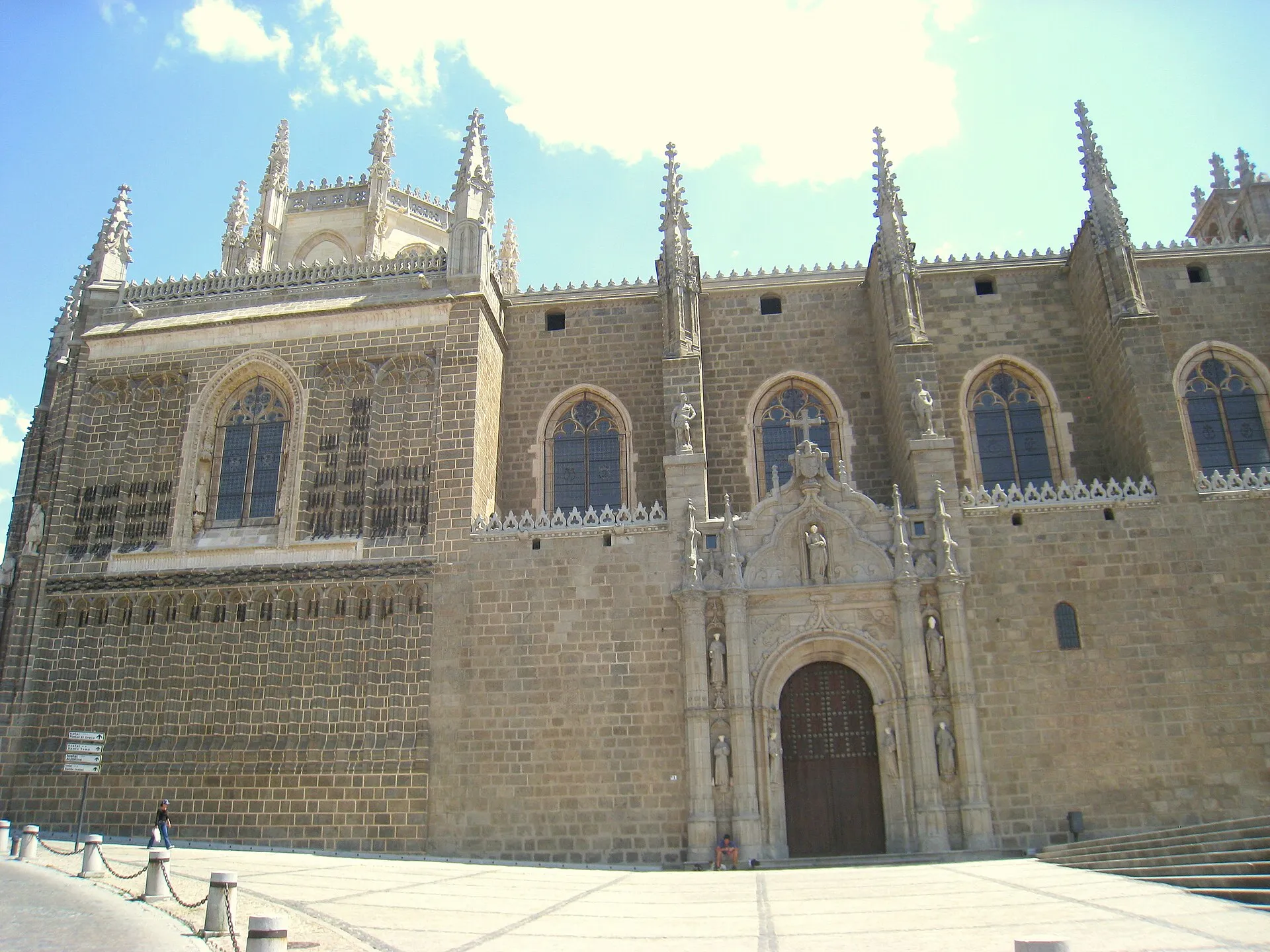
Ferdinand and Isabella commissioned San Juan de los Reyes within months of the Battle of Toro (1476), framing the victory as divine intervention on behalf of their claim to Castile's throne — the monastery was the ex-voto, the votive offering given to God in thanksgiving for answered prayer. The Franciscan order they chose to occupy the monastery was not accidental: the Franciscans were associated with poverty, humility, and mendicant service, and placing austere friars inside one of the most lavishly decorated buildings in Spain expressed the theological paradox at the heart of the Reconquista project — royal magnificence in service of evangelical simplicity. The iron chains hanging across the exterior facade were brought from the prisons of Málaga, Almería, and Baeza as Christian captives were freed during Reconquista campaigns; each chain is simultaneously a war trophy, a thanksgiving offering, and a material prayer — visible proof that God had liberated Christian souls from Muslim captivity and that the Catholic Monarchs were His instruments. The pervasive yoke-and-arrows heraldry carved into the stone was not mere vanity but a theological claim: the yoke (yugo) of Ferdinand and the arrows (flechas) of Isabella, joined together, symbolized not just their dynastic union but a providential destiny to complete the Christianization of Iberia that the Reconquista represented. The fact that they ultimately chose to be buried in Granada's Royal Chapel rather than here does not diminish San Juan de los Reyes — it confirms that Toledo was a station on a larger sacred journey whose destination was the completion of Christian Spain.
When to Visit
Every day: 10:00 AM - 6:45 PM (summer hours may extend to 7:00 PM). Best time to visit: Late afternoon, when low-angle sunlight floods the upper cloister gallery. Least crowded: Weekday mornings outside of Spanish school holiday periods. Allow: 45 minutes to 1.5 hours, depending on your pace through the cloister and church
Admission and Costs
General admission: €3 (church and cloister). Pulsera Turística: Multi-monument bracelet that bundles entry to San Juan de los Reyes with other Toledo landmarks at a reduced total price. Guided group tour: €10-€12 per person (approximately 1 hour, includes monastery entry). Private guided tour: €12-€15 per person for an in-depth visit with a local art historian
The Case for a Guide
San Juan de los Reyes rewards visitors who can read its surfaces as a political and theological program — without that context, the profusion of carved symbols and hanging chains registers as impressive decoration without meaning.
- Decoding royal heraldry: Every surface carries the yoke-and-arrows emblem of Ferdinand and Isabella; a guide explains the political dynastic symbolism and distinguishes the Castilian and Aragonese elements in the building's decorative program
- The Reconquista chains explained: The iron shackles on the facade are meaningless without historical context; a guide explains which specific campaigns freed Christian prisoners from which Moorish territories, and why hanging their chains here was both a political statement and a religious act
- Isabelline Gothic as a Spanish phenomenon: This architectural style is unique to late 15th-century Castile and has no exact parallel in France or England; a guide explains how it blends Mudéjar geometric precision with Gothic structural ambition
- Cloister geometry: The interplay of Gothic tracery arches in the lower gallery and Mudéjar-accented carved ceilings in the upper gallery requires a trained eye to appreciate fully — a guide draws attention to the subtle transitions between the two traditions
- Context of the Catholic Monarchs: Guides connect San Juan de los Reyes to the wider story of the fall of Granada, the expulsion of the Jews, and Christopher Columbus's first voyage — all events in which Ferdinand and Isabella were simultaneously involved while this building was under construction
Tips for Visitors
Pair with the Jewish Quarter: San Juan de los Reyes sits at the edge of Toledo's historic Jewish Quarter; combine both for a rich half-day walk. Photography: The cloister is one of the most photogenic spaces in Toledo -- a wide-angle lens captures the full arched galleries. Comfortable footwear: The streets leading to the monastery are steep and uneven cobblestones. Chain the big three: Starting here and walking east toward the Toledo Cathedral and on to the hilltop Alcázar traces a natural route uphill through the old town. Late afternoon light: Low-angle sun floods the upper cloister gallery in the final hours before closing.
Frequently Asked Questions
Which months are ideal for visiting San Juan de los Reyes?
April through June and September through October offer the most rewarding visits, when afternoon sunlight streams through the upper cloister gallery creating stunning light and shadow patterns on the Gothic stonework. The monastery's two-level cloister garden is at its best in spring when citrus trees are in bloom. Winter visits are quieter and still worthwhile since most of the experience is sheltered, though the open cloister corridors can feel brisk on cold Castilian mornings.
When should visitors plan to arrive at San Juan de los Reyes?
Every day: 10:00 AM - 6:45 PM (summer hours may extend to 7:00 PM). Best time to visit: Late afternoon, when low-angle sunlight floods the upper cloister gallery. Least crowded: Weekday mornings outside of Spanish school holiday periods.
How does a guide enhance a visit to San Juan de los Reyes?
A guide decodes the dense heraldic program -- the yoke-and-arrows emblem, royal eagles, and Latin mottoes that cover every surface -- and explains why the iron chains on the facade hang there, which Reconquista campaigns freed the captives they once bound, and how the two-storey cloister sets Gothic tracery below against a Mudéjar coffered ceiling above.
What should visitors know before visiting San Juan de los Reyes?
The monastery sits at the western edge of Toledo's historic Jewish Quarter, so pair it with a walk through those lanes for a rich half-day. Admission is €3 and the church and two-level cloister take about 45 minutes to an hour; the approach is steep cobblestone, so wear sturdy shoes, and aim for late afternoon when low sun floods the upper gallery.