
Walking Route
Walking Routes
The classic circuit runs north–south along the old Jewish street and takes about 90 minutes at a browsing pace. Begin at the Puerta de Almodóvar, the sole surviving gate of Córdoba's medieval wall, where a statue of the Córdoba-born Roman philosopher Seneca marks the threshold into the quarter.
Walk down Calle de los Judíos to the Synagogue of 1315, one of only three medieval synagogues left in Spain, and step inside to read the Hebrew psalm verses worked into its stucco and climb to the women's gallery. A few doors on, the Casa de Sefarad fills five rooms of a restored medieval house with Sephardic artefacts, music, and reconstructions of domestic and ritual life.
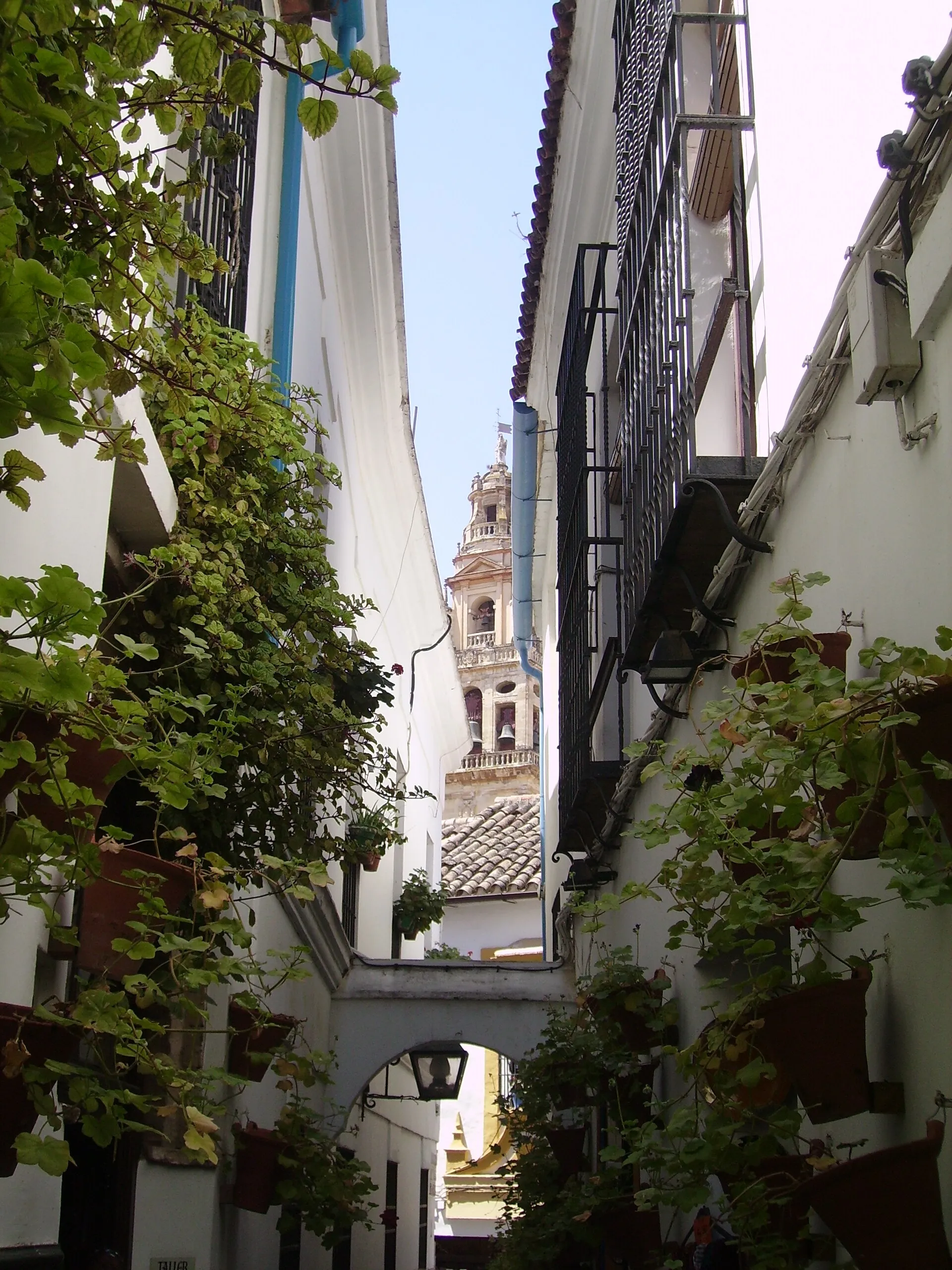
Beside it, the Zoco Municipal craft market occupies a Mudéjar-style courtyard where silversmiths and leather-workers sell from the arcades. Pause at the Plaza de Tiberíades to sit beside the bronze Maimonides and rub his foot, then thread the lanes east toward the Calleja de las Flores, the narrow flower-hung alley whose dead end frames the Mezquita's bell tower — the most photographed view in the city. Finish with a glass of wine in one of the centuries-old tabernas tucked into the surrounding plazas.
Local Life
The Judería is a working residential district, not a gated site, and that is its quiet pleasure. Early in the morning, before the first tour groups arrive, you share the lanes with residents walking dogs and shopkeepers hosing down their stretch of cobbles; by late evening, when the day-trippers have gone and lanterns pick out the whitewash, the quarter belongs to Córdoba again.
Courtyard culture is the thread that holds it together: behind almost every studded door is a patio tiled in azulejos and overflowing with geraniums, and for the first two weeks of May the Festival de los Patios — recognised by UNESCO in 2012 — opens dozens of these private courtyards to the public for free, a tradition unique to Córdoba.
A good local guide can point out the handful occasionally accessible outside the festival and explain the social customs — the competitive pride, the shared watering rituals — that keep the practice alive. Residents live here year-round, so the unwritten rule is simple: keep voices low in the narrow residential stretches, especially early and late.
Jewish Quarter (Judería) of Córdoba timeline
-
Caliphate of Córdoba proclaimed
Under Abd al-Rahman III, Córdoba becomes the capital of a western caliphate and one of the largest cities on earth; the Jewish courtier-physician Hasdai ibn Shaprut serves at the caliphal court and makes the city a centre of Sephardic learning.
-
Maimonides born in the Judería
Moses ben Maimon, the pre-eminent Jewish philosopher and physician of the medieval world, is born on these streets before his family flees Almohad persecution.
-
Ferdinand III takes Córdoba
The Christian conquest ends caliphal rule, yet the Jewish community continues under the crown, clustered in the walled quarter beside the former Great Mosque.
-
The Synagogue is built
A small Mudéjar synagogue rises on Calle de los Judíos, its walls covered in stucco tracery and Hebrew psalm inscriptions.
-
Pogroms devastate the aljama
Anti-Jewish riots sweeping Castile reach Córdoba, shattering the community and driving many conversions a century before the final expulsion.
-
Expulsion of Spain's Jews
The Alhambra Decree expels practising Jews from Spain; the Synagogue is converted to Christian use, which is why it survives to this day.
-
Synagogue declared a national monument
Rediscovered and protected, the building becomes one of only three medieval synagogues preserved in Spain.
-
UNESCO inscribes the historic centre
The Judería is listed as part of the Historic Centre of Córdoba, later extended in 1994.
When to Visit
Neighbourhood streets: open 24 hours — the Judería is a living district, not a gated site, so you can wander freely at any hour. Synagogue (Calle de los Judíos): Tuesday–Sunday, roughly 9:00 AM – 3:00 PM, closed Monday; free for EU citizens, a nominal fee for others. Casa de Sefarad: daily 10:00 AM – 6:00 PM, extended toward 7:00 PM in summer.
Best time to walk: early morning before the tour groups arrive from the Mezquita, or the evening when lanterns light the alleys. Market: the artisan stalls of the Zoco Municipal and the shops around Plaza de Tiberíades are busiest on weekends. Because posted hours shift with season and public holidays, confirm them on the day before building a tight schedule around a specific entry.
Admission and Costs
Walking the quarter: completely free — no ticket is required for the streets, plazas, or the Calleja de las Flores. Synagogue entry: free for EU citizens; a nominal charge (around €0.30–0.75, ~$0.35–0.85) for non-EU visitors, cash only. Casa de Sefarad: about €5 ($5.50) general admission. Guided walking tour: €15–25 ($16–27) per person for a two to two-and-a-half-hour circuit covering the Synagogue, Maimonides, and the hidden courtyards.
Private guide: €100–160 ($110–175) for up to six people, with the route and pace tailored to your interests. Many visitors fold the Judería into a half-day that also takes in the Mezquita-Cathedral and the riverside Alcázar de los Reyes Cristianos, all within a ten-minute walk.
The Case for a Guide
The Judería rewards context more than almost any neighbourhood in Spain, because so much of its meaning is invisible on the surface. A guide trained in Sephardic history earns their fee on three fronts:
- The stones that look ordinary — Without explanation the lanes read as a charming cluster of white walls and flower pots. A guide shows why the Synagogue's stucco mimics the patterns of the Alhambra, which doorways still bear faint Hebrew inscriptions, and how the street plan preserves the shape of the medieval aljama.
- The people who made it matter — The quarter's significance rests on specific lives: Hasdai ibn Shaprut at the caliphal court, Averroes reconciling Aristotle with faith, and Maimonides, whose medical and philosophical writings shaped European universities for centuries. A guide connects each figure to the places they lived and worked.
- The courtyards behind the doors — Córdoba's patio culture is largely hidden from the street. A local can point out the courtyards occasionally open outside the May festival and explain the traditions behind them, turning a pleasant stroll into a reading of how the city actually lives.
Tips for Visitors
Wear flat shoes: the cobblestones are uneven and some lanes slope steeply, so trainers or sandals with grip beat anything smooth-soled. Walk morning or evening: midday in summer pushes past 40 °C with almost no shade in the narrow streets, so plan the quarter for the cooler ends of the day. Combine with the Mezquita: the Judería wraps the Mezquita-Cathedral's western and northern sides, so seeing both in one morning is effortless, with the Alcázar de los Reyes Cristianos a short walk south.
Visit in early May for the patios: the Festival de los Patios opens dozens of private courtyards, but book accommodation months ahead. Carry cash: the Synagogue and some small artisan shops accept coins and notes only. Keep voices low: residents live here year-round, so the narrow residential stretches ask for quiet, especially early and late.
Frequently Asked Questions
What are the opening hours and admission for the Judería's main sights?
The streets themselves are an open, lived-in district with no gate or ticket — you can walk them 24 hours a day. The paid sights keep their own hours. The medieval Synagogue on Calle de los Judíos opens Tuesday–Sunday, roughly 9 AM–3 PM, and closes Mondays; it is free for EU citizens and charges a nominal fee (around €0.30–0.75) for other visitors, so carry a little cash.
The privately run Casa de Sefarad museum opens daily, about 10 AM–6 PM (later in summer), for roughly €5. Because hours shift with season and public holidays, confirm them on the day before planning around a specific entry.
When is the best time of year to visit Córdoba's Jewish Quarter?
Early May is the spectacle: the Festival de los Patios — a UNESCO Intangible Cultural Heritage tradition since 2012 — throws open dozens of private courtyards for free, and the Cruces de Mayo fills the plazas with flower-decked crosses. Book accommodation months ahead for those two weeks. October is the calmer choice, with mild afternoons and thinner crowds. Avoid July and August if you can: Córdoba is one of the hottest cities in Europe and regularly tops 40 °C, turning the shadeless stone lanes into an oven by midday.
What makes the Synagogue of Córdoba so significant?
Built around 1314–1315 in the Mudéjar style, it is one of only three medieval synagogues still standing in all of Spain — the other two are both in Toledo. It survived because, after the 1492 expulsion of Spain's Jews, it was repurposed rather than demolished: first as a hospital, then as the chapel of the city's shoemakers' guild, before being declared a national monument in 1885.
Its single small prayer hall is lined with delicate stucco tracery and Hebrew psalm inscriptions, with a raised women's gallery — a rare, intact window onto Sephardic worship in medieval Al-Andalus.
Who was Maimonides and where is his statue?
Moses ben Maimon — known as Maimonides or the Rambam — was born in the Judería in 1138 and became the most influential Jewish philosopher and physician of the Middle Ages, author of the Mishneh Torah and the Guide for the Perplexed. His family fled Almohad persecution when he was young, and he died in Egypt in 1204, but Córdoba claims him as its own. A seated bronze statue of him by Amadeo Ruiz Olmos (1964) sits in the small Plaza de Tiberíades; visitors rub his well-polished foot for luck and wisdom.
Is the Jewish Quarter worth a guided walking tour?
For many visitors, yes. Without context the Judería reads as a pretty but anonymous cluster of white walls and flower pots. A guide versed in Sephardic history explains why the Synagogue's stucco echoes the Alhambra, how Maimonides' medicine shaped European universities, and which doorways still carry faint Hebrew inscriptions. Group walking tours typically run €15–25 per person for two to two-and-a-half hours; a private guide is roughly €100–160 for up to six people.
How do I reach the Judería and find the Calleja de las Flores?
The quarter wraps the western and northern flanks of the Mezquita-Cathedral, so most visitors simply walk out of the monument and into the lanes. Coming from farther out, enter through the 14th-century Puerta de Almodóvar, the last surviving gate of the medieval city wall. The much photographed Calleja de las Flores is a short dead-end alley off Calle Velázquez Bosco, a two-minute walk north of the Mezquita; follow it to the small fountain-plaza at its end, where the hanging flower pots frame the cathedral's bell tower.