
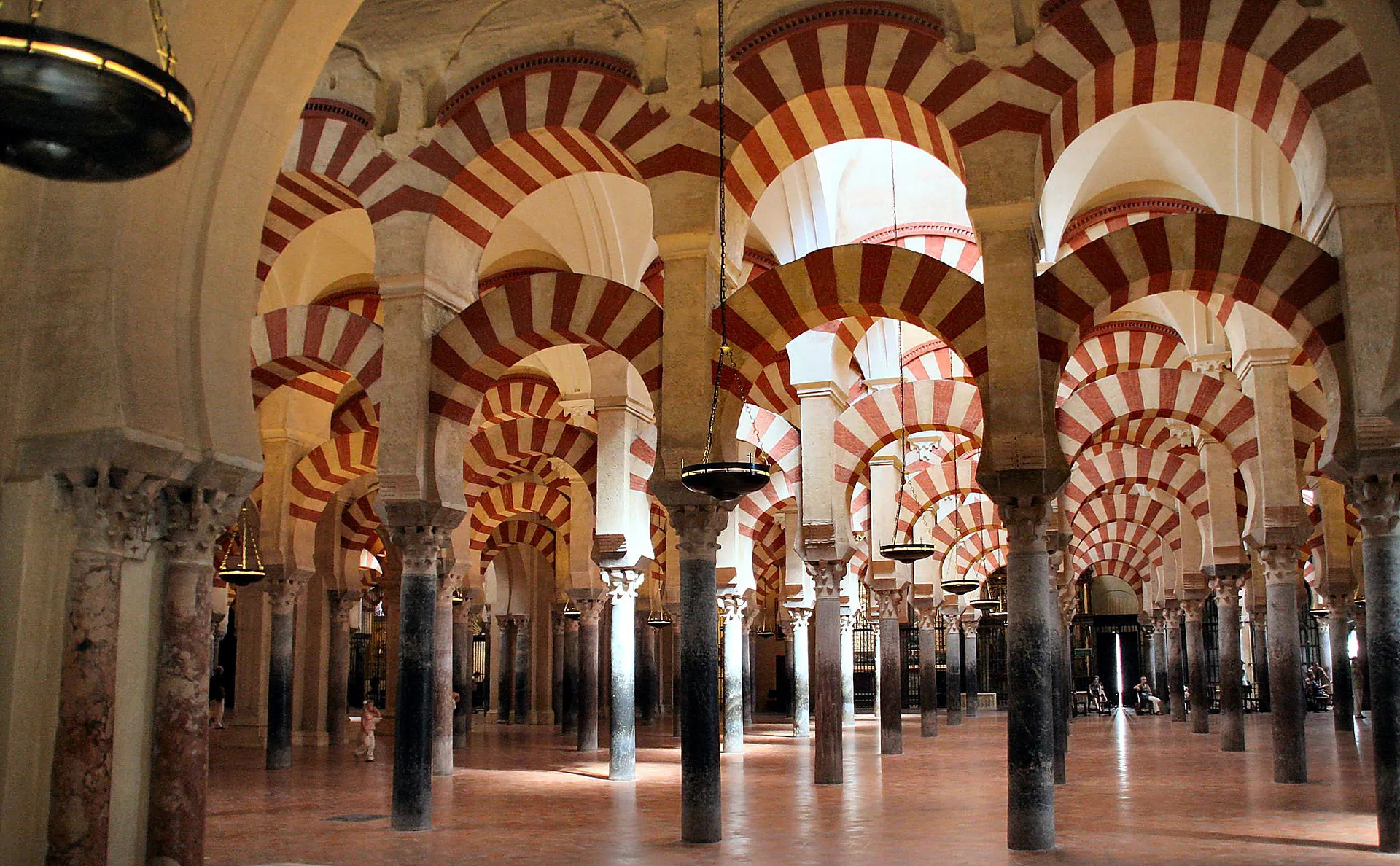
Visitor Etiquette
The Mezquita-Cathedral is an active Catholic cathedral where Mass is celebrated regularly, typically before 10:00 AM on weekdays, after which the building opens to tourists. During services, access to the cathedral nave is restricted, though the surrounding Moorish columns generally stay accessible. A short checklist keeps a visit smooth and respectful:
- Dress code is enforced: shoulders and knees must be covered for all visitors, and security staff will turn away those who do not comply.
- Photography is permitted without flash; tripods require advance permission from the cathedral administration.
- Keep voices low: raised voices echo noticeably in the column forest and carry clearly to the cathedral nave.
- Do not touch the carved capitals, the mihrab mosaics, or any decorated surfaces.
- Bags may be checked at security screening on entry, so travel light.
The Patio de los Naranjos (Orange Tree Courtyard) has a more relaxed atmosphere and is freely accessible during opening hours — a good place to regroup before or after the prayer hall.
Spiritual Significance
At its peak in the 10th century, the Mezquita was one of the most sacred spaces in the Islamic world — second in prestige only to Mecca and Medina in the consciousness of the western Umayyad Caliphate. The mihrab was not merely a prayer niche but a divine focal point: the Byzantine emperor sent craftsmen and roughly 1,600 kg of gold tesserae as a diplomatic gift for its decoration, acknowledging that Córdoba under Abd al-Rahman III rivalled Constantinople as a civilisational centre. For Muslims across North Africa, the Iberian Peninsula, and the western Mediterranean, praying toward this mihrab carried the weight of praying toward the legitimate successor of the Prophet's own caliphate.
When the Christian forces of Ferdinand III conquered Córdoba in 1236, the decision to preserve the mosque rather than demolish it was partly practical and partly theological — the building was too magnificent to destroy, and its repurposing as a cathedral embodied Christianity's supersession of Islam in stone. For centuries the building operated under a strange spiritual duality: the columns that once oriented Muslim prayer toward the mihrab now framed a Catholic nave oriented toward a different altar. Today's Mezquita-Cathedral remains an active cathedral owned by the Church, which is why Muslim visitors wishing to pray toward their qibla are officially prohibited from doing so — a restriction the building's history makes at once understandable and layered with meaning. The same mosque-to-cathedral transformation defines the Seville Cathedral and Giralda downriver, though there the Almohad minaret survived as a bell tower rather than the prayer hall. Its standing as the heart of the Historic Centre of Córdoba has been recognised by UNESCO since 1984.
Mezquita-Cathedral of Córdoba timeline
-
Great Mosque begins
Abd al-Rahman I began the mosque on the site of the Visigothic church of San Vicente.
-
Mihrab expansion
Al-Hakam II added the lavish mihrab and one of the building's most celebrated decorative phases.
-
Cathedral consecration
Ferdinand III took Cordoba and converted the mosque into a cathedral while preserving its structure.
-
UNESCO listing
The Mezquita became the centerpiece of Cordoba's World Heritage recognition.
When to Visit
Monday–Saturday: 10:00 AM – 7:00 PM (last entry 6:30 PM). Sunday: 8:30 – 11:30 AM for tourism, after which Mass follows. Free entry runs Monday–Saturday 8:30 – 9:30 AM — no ticket required, first-come, first-served. Seasonal note: winter hours may close at 6:00 PM, so confirm on the official Cabildo website before visiting, as the schedule flexes around feast days and processions. Best window: arrive right at opening for the most atmospheric light and the smallest crowds in the prayer hall.
Admission and Costs
- General admission: €11 (~$12) — daytime visit to the mosque-cathedral prayer hall, courtyard, and cathedral nave.
- Bell tower climb: €4 (~$4) supplement — timed guided ascent of the campanario for panoramic views over the Patio de los Naranjos.
- Night visit "El Alma de Córdoba": €18 (~$19) — a seasonal sound-and-light experience through the darkened arcades.
- Guided group tour: €20–30 (~$22–32) per person — 1.5–2 hours, skip-the-line entry usually included.
- Private guide: €120–200 (~$130–215) for up to 6 people, with tickets purchased separately.
- Free entry: Monday–Saturday 8:30–9:30 AM — no ticket required, first-come, first-served.
- Children under 10: free with a paying adult.
Prices and timed slots are set by the Cabildo Catedral; verify the current tariff on the official website before you go.
The Case for a Guide
The Mezquita's forest of 856 columns is immediately overwhelming, but its structural logic, theological geography, and the audacious decision to thread a cathedral through its centre are all illegible without someone who has studied twelve centuries of construction politics. A licensed guide turns a beautiful blur into a legible argument in stone:
Mihrab orientation anomaly: the mihrab faces south rather than southeast toward Mecca — a deviation a guide explains as a deliberate nod to the Umayyad mosque in Damascus, asserting Córdoba's claim to be the legitimate heir of the Islamic caliphate. Its concave geometry also projects the imam's voice back through the hall in a way modern acoustic engineers have measured and admired.
Salvaged Roman and Visigothic capitals: Abd al-Rahman I recycled columns from ruins across southern Spain; a guide points out capitals where Christian crosses were partly carved away and explains the double-arch system invented to raise the effective ceiling when the salvaged shafts proved too short.
Córdoba as Europe's largest city: in the 10th century the caliphal capital held on the order of half a million people — larger than any city in contemporary Christian Europe — and a guide connects that wealth to both the mosque's expansions and the translation movement that preserved Greek science for the Renaissance.
The cathedral insertion: Bishop Alonso Manrique removed 63 columns to raise a full Gothic-Renaissance nave in 1523. A guide traces the exact footprint of what was demolished and recounts the emperor's famous regret:
You have built here what you or anyone might have built anywhere, but you have destroyed something that was unique in the world.
— words traditionally attributed to Charles V on seeing the finished nave.
The orange-tree courtyard: the Patio de los Naranjos is arranged in a grid whose trees align with the interior columns; a guide explains its role in ritual ablution before prayer and how its fountains drew on a Roman aqueduct the Umayyads repaired for the purpose.
Tips for Visitors
- The free slot fills fast: queue at the Puerta del Perdón by 8:15 AM, especially April through October, to claim the 8:30–9:30 AM free window.
- Dress respectfully: shoulders and knees must be covered, as the building remains an active place of worship — there are no loaner garments at the door.
- Photography is allowed: no flash and no tripods; the dim interior makes a wide-aperture lens or your phone's night mode genuinely useful.
- Best photo opportunities: the endless red-and-white arches from the western aisles, the golden mihrab, and the bell tower framed by orange trees in the Patio de los Naranjos.
- Look up at the maqsura: the three intersecting ribbed domes in front of the mihrab weave stone ribs into eight-pointed stars two centuries before Gothic Europe attempted anything similar — easy to walk under without noticing.
- Combine with the Judería: the narrow lanes of the Jewish Quarter begin steps from the Mezquita's western gate, and the riverside Alcázar de los Reyes Cristianos is a short walk south.
- Allow 1.5–2 hours, adding 30 minutes for the bell-tower climb or a longer pause in the courtyard.
- Hydration in summer: Córdoba regularly exceeds 40°C in July and August, so carry water and rest in the shaded courtyard.
Frequently Asked Questions
Which season is best for experiencing the Mezquita-Cathedral?
March–June and September–November offer the most comfortable visits, with moderate Córdoba temperatures that make the walk through the Patio de los Naranjos pleasant before you enter the cool forest of arches inside. As a largely indoor monument the Mezquita is visitable year-round, but the scorching July–August heat often tops 40°C — one of Europe's most extreme urban climates — and simply reaching the entrance becomes an ordeal. Winter mornings can feel surprisingly cold inside the cavernous stone interior, so a mid-morning slot suits the coldest months.
Do you need to book Mezquita tickets in advance, and where do you enter?
Daytime general admission is not usually timed, so a ticket bought online through the official Cabildo website or at the ticket office inside the Patio de los Naranjos will get you in the same day for most of the year. Booking ahead mainly saves queue time at Easter, long weekends, and the May Patios festival, and the bell-tower climb is timed and sells out, so reserve that slot separately. The free 8:30–9:30 AM window cannot be booked — it is on-site only. Everyone enters through the Puerta del Perdón beside the bell tower and passes through the courtyard before the prayer hall.
Why is it worth hiring a guide for the Mezquita?
The Mezquita rewards those who understand what they are seeing. Twelve centuries of construction, destruction, and reinvention have left layers that are easy to walk past without context — the reused Roman and Visigothic capitals, the mihrab's deliberate orientation, the seam where a Renaissance nave was threaded through an Umayyad prayer hall. A licensed guide reads those layers aloud, and can chain the visit to the neighbouring Jewish Quarter and Alcázar de los Reyes Cristianos into one coherent story of three cultures.
How do you get to the Mezquita, and can you combine it with the rest of Córdoba in a day?
Most visitors arrive by AVE high-speed train — roughly 1h45 from Madrid, 45 minutes from Seville, and about an hour from Málaga — then walk the 15–20 minutes (or take a short taxi) from Córdoba station into the historic centre. The monument sits in a pedestrianised old town by the Roman Bridge, so drivers should use a peripheral car park rather than aim for the door. A comfortable day pairs a morning at the Mezquita with the neighbouring Jewish Quarter and the riverside Alcázar de los Reyes Cristianos, all within a ten-minute walk.
Is the Mezquita a mosque or a cathedral?
Both, in sequence. It was built as the Great Mosque of Córdoba from 785 and served Islamic worship for over 400 years, until Ferdinand III consecrated it as a Catholic cathedral in 1236. It has functioned as a cathedral ever since — a Gothic-Renaissance nave was inserted into its centre in the 16th century — and it is owned and used by the Church today. That is why the building is properly called the Mezquita-Cathedral, and why it anchors the Historic Centre of Córdoba, a UNESCO World Heritage Site.