
Walking Routes
The main Bukchon circuit (approximately 90 minutes at a relaxed pace) typically follows:
- Anguk Station (Line 3) exit 2 → north along Bukchon-ro toward the Bukchon Museum
- Gahoe-dong → the core residential zone; Gahoe-dong 11-gil contains the famous rooftop view
- Samcheong-dong → the neighbourhood transitions into galleries, independent cafes, and boutiques; Samcheong-dong-gil is the main artery
- Gyeongbokgung northern approach → exit Bukchon westward and enter Gyeongbokgung through the eastern gate for the palace interior
The extended circuit adds:
- Changdeokgung approach via Wonseo-dong to the east of Gahoe-dong — quieter streets, more authentic residential atmosphere, fewer tourist visitors
- Jae-dong — the lower western section, overlooking Cheonggyecheon stream; less photographed but architecturally notable for the mix of period hanok and 1960s infill construction
A guide chooses routing based on time of day: the Gahoe-dong view is photographed best in early morning from the south; the Samcheong-dong transition is better in mid-morning when the cafe district opens.
Local Life
Bukchon navigates an ongoing tension between residential community and heritage tourism destination that defines many historically significant urban neighbourhoods worldwide. The yangban families of the Joseon period were replaced across the twentieth century by middle-class Seoul residents, and the 2001–2010 Bukchon preservation program — which provided municipal subsidies for hanok restoration — transformed property values and drove significant gentrification. Many original long-term residents were eventually displaced by the rising costs that conservation success created.
The households that remain navigate daily tourism in various ways:
- Some have adapted hanok into commercial uses: tea houses (dakjip, chamdaek) offer traditional Korean teas with hanji (mulberry paper) decor and floor seating; craft workshops sell hanji products, celadon, and Korean ink art
- Hanok-stay guesthouses allow visitors to sleep on traditional yo floor mattresses with ondol heating and experience the morning light in a madang courtyard
- Residents who still use the streets primarily as a neighbourhood maintain a legitimate position articulated through the quiet zone regulations — the community asked that visiting hours respect working and sleeping schedules
A guide interposes between tourist expectation and residential reality: knowing which tea house welcomes visitors versus which courtyard gate should remain closed, and framing the neighbourhood's gentrification story as part of its contemporary identity rather than a detail to be hidden.
When to Visit
Open: The public streets of Bukchon have no admission gate or formal opening hours. Quiet zone regulations: Visitors are asked to stay out of the deepest residential lanes after 5 PM when residents return. Most commercial hanok (tea houses, craft shops, small museums): generally open 10 AM – 6 PM, many closed on Mondays.
Best timing:
- 7–9 AM weekday mornings: Empty streets, optimal photography light, no quiet-zone enforcement needed as few visitors are present
- Mid-morning 10–11:30 AM: Tea houses open, comfortable temperature for walking, manageable crowds
- Avoid: Weekend afternoons (2–5 PM) attract peak visitor numbers — the Gahoe-dong alley becomes genuinely crowded
Visit duration: 1.5–2 hours for the main circuit; 3 hours with a guide covering architectural detail and tea house stops.
Admission and Costs
Street walking: Free — the public lanes require no admission.
Bukchon Museum: ₩3,000 ($2.25) — small exhibition on the neighbourhood's history and architectural conservation.
Traditional tea house: ₩8,000–15,000 ($6–11) per person for a pot of traditional tea (nokcha green tea, boricha barley tea, omija five-flavour berry tea) with seasonal rice cake (tteok) accompaniments.
Hanok-stay overnight: ₩80,000–200,000 ($59–148) per room depending on season and hanok quality — ranges from budget guesthouses to restored yangban manor properties.
Craft workshop experiences: ₩20,000–50,000 ($15–37) for hanji paper making, celadon painting, or Korean ink calligraphy sessions.
The Case for a Guide
Bukchon is walkable without a guide, but most independent visitors photograph the famous view and leave within 30 minutes, missing the neighbourhood's complexity entirely.
- Architectural reading: A guide identifies the specific hanok elements — the roof curve (gongpo) indicating the building's status, the courtyard orientation indicating the household hierarchy, the timber joinery techniques that predate nails — details invisible to the untrained eye
- Route selection: The guide chooses streets based on the time of day, current crowd patterns, and which commercial hanok are open and worth entering — the optimal route changes daily
- Tea house access: Some of the best traditional tea houses in Bukchon have no English signage and look, from the outside, indistinguishable from private residences; a guide knows which doors to open
- Gentrification context: The guide frames the neighbourhood's conservation success and displacement story honestly — connecting it to similar dynamics in Gamcheon Culture Village in Busan and to the broader Korean question of how to preserve heritage while respecting communities
- Photography guidance: Beyond the famous view, the guide knows a dozen lesser-photographed compositions within a five-minute walk that most visitors never discover
Tips for Visitors
Go early or go late: The famous alley view attracts significant crowds from about 10 AM onward on weekends. Arrive before 9 AM for empty lanes and morning light. On weekdays, late morning before noon is also manageable.
Respect the quiet zones: Signs request reduced voices and no lingering on private doorsteps — these apply to all visitors regardless of guided status. Noise complaints from residents have previously threatened to restrict visiting hours further.
Combine with Gyeongbokgung Palace: The palace is a 15-minute walk west from the core Gahoe-dong area — pair a morning palace visit (guard ceremony at 10 AM) with a Bukchon afternoon.
Hanbok rental: Several rental shops operate near Anguk Station — wearing hanbok while walking Bukchon's lanes creates natural photographs and connects visually with the neighbourhood's Joseon heritage.
Continue to Insadong: Walking south from Anguk Station through Gyeongbokgung's surrounding district leads directly to Insadong's gallery and antiques lane — a natural extension of a traditional culture day.
Frequently Asked Questions
What is a hanok and why is Bukchon significant?
A hanok is a traditional Korean wooden house constructed according to principles that evolved over centuries to suit the Korean climate and Confucian household organisation. The structures combine curved tiled roofs (giwa), exposed timber post-and-beam framing, ondol underfloor heating (heated by flue channels beneath stone floors), and an internal courtyard (madang) that organises space according to the gender and social hierarchy of the household. Bukchon — meaning "northern village" — was the residential district of the Joseon royal court's civil servant class, the yangban aristocracy, positioned between Gyeongbokgung and Changdeokgung palaces. Its significance is that it is a substantially intact residential neighbourhood from the Joseon period rather than a reconstructed museum site — the houses are real, most are occupied, and the street network has not been straightened or sanitised for tourism.
Where is the most famous viewpoint in Bukchon Hanok Village?
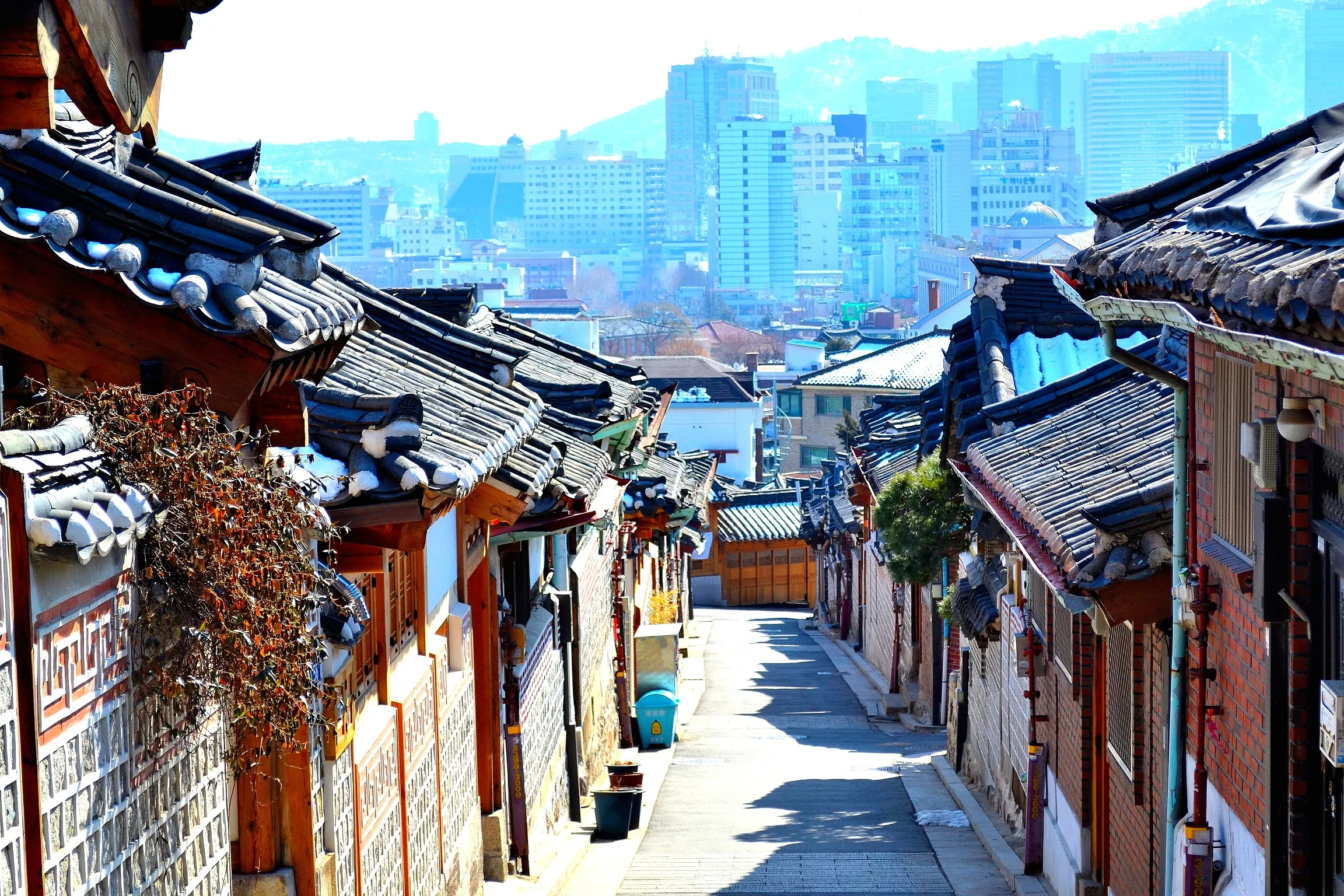
Gahoe-dong Alley No. 11 — commonly called "View 8" in tourist references — is a narrow lane in the Gahoe-dong section of Bukchon that frames a classic composition: tiled hanok rooftops cascading downhill in the foreground, Seoul's modern tower blocks rising behind them, with the sense of five centuries of urban history compressed into a single sightline. The view has been reproduced so widely that it has become Seoul's most internationally recognised image. The best light falls on the rooftops in the early morning from approximately 7 to 9 AM, before the daily tourist tide arrives. A guide knows the precise position and can also direct you to lesser-known viewpoints further into the neighbourhood that offer similar compositions without the crowds.
What are the resident noise restrictions in Bukchon?
Bukchon is a living neighbourhood — several hundred households still reside in the hanok buildings, many of whom have faced decades of increasing tourist foot traffic through their streets. After community complaints about noise and privacy violations, Seoul's Jongno district authority implemented quiet zone regulations: visitors are asked to speak at reduced volumes, refrain from sitting on private steps, and avoid visiting after 5 PM when residents return from work. Signs in multiple languages mark the quiet zones. The regulations are genuinely enforced and respected by guides — violating them is not simply poor etiquette but contributes to the ongoing pressure on a community that has legitimate claims on its own streets. Visiting with a guide ensures you understand and observe these boundaries as a guest rather than a consumer.