
Bergen timeline
-
Bergen founded
King Olav Kyrre established Bergen on a harbor that soon became Norway's main medieval trading city.
- 13th century
Harbour begins
Founded around 1070, it was Norway's largest city and busiest port, and in the 13th century the royal court sat on the Holmen headland at Bergenhus Fortress, where.
-
Hanseatic office opens
German merchants made Bryggen a northern European trading hub for stockfish and grain.
-
Power drifted east over the following centuries
Power drifted east over the following centuries: the union with Denmark from 1380 pulled administration toward Copenhagen, and when Norway rebuilt its institutions.
-
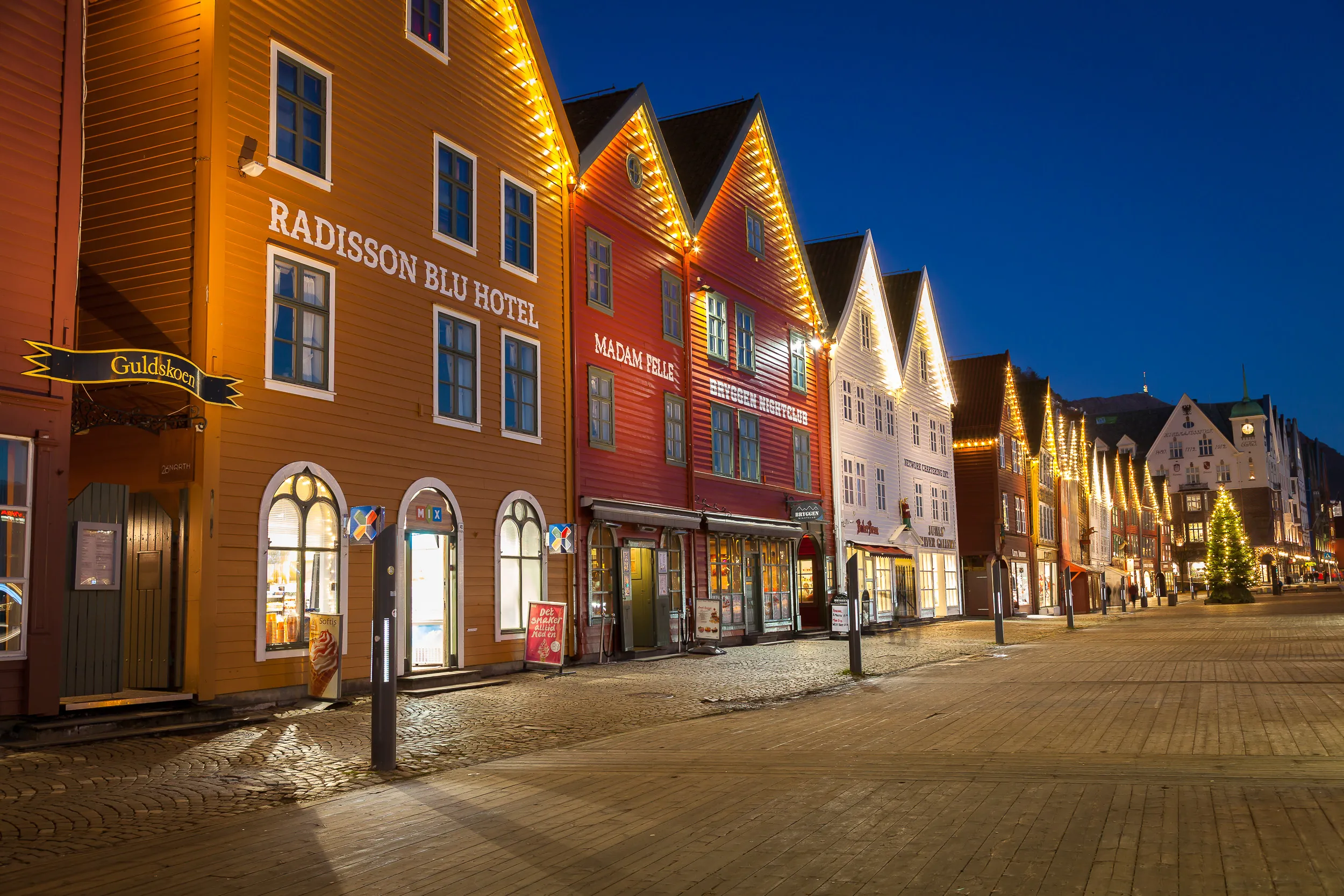
Great fire rebuilds Bryggen
Fire destroyed much of the waterfront, leading to the timber reconstruction visitors walk through today.
-
Christiania overtakes Bergen
Around this decade the capital Christiania (now Oslo) finally passed Bergen in size, ending Bergen's long run as Norway's largest city.
-
Bergen Railway completed
The line over the Hardangervidda plateau linked Bergen to Oslo by rail, cementing the city as the fjord country's gateway.
-
Bryggen listed by UNESCO
World Heritage status protected Bergen's merchant quarter as a rare surviving Hanseatic landscape.
Cited city facts
Key facts for visiting Bergen
Bryggen has been a trading hub on Bergen's waterfront since the 11th century
Originally established under King Øystein around 1070 CE, the wharf became a Hanseatic League trading post from the 14th century, when German merchants from Lübeck controlled the dried cod trade that made Bergen one of northern Europe's wealthiest cities. Despite multiple fires destroying the original buildings, merchants always rebuilt on the same footprint — the current structures largely date to after the 1702 fire
Bergen was Norway's largest city for over 700 years, from the 12th to the 19th century
Founded by King Olav Kyrre around 1070 CE and designated a royal residence, Bergen served as the de facto capital of Norway through the Viking Age's aftermath and into the medieval period, when its position as Europe's primary supplier of dried cod (klippfisk) made it wealthier than Oslo for centuries. Only around 1830 did the capital Christiania — today's Oslo — finally overtake it in population
Edvard Grieg composed most of his major works within 10 kilometres of Bergen
Norway's most celebrated composer spent his creative peak at Troldhaugen — his lakeside villa 8 km south of Bergen — where he composed much of Peer Gynt, the Piano Concerto in A minor, and dozens of his lyric pieces before his death in 1907. The house, now run as a museum by the KODE art institution, is one of Norway's most-visited composer homes
Mount Fløyen's funicular has carried passengers continuously since 1918
The Fløibanen, opened on 11 June 1918, rises 320 metres on a gradient reaching 26 degrees — equivalent to walking up a moderately steep ski slope. Now carrying well over a million passengers a year, it is Bergen's single most-visited attraction and one of the world's oldest urban cable railways still on its original line
Bergen is Norway's second-largest city, home to roughly 290,000 people
Only Oslo is larger. Spread around its harbour and up the slopes of seven mountains, Bergen anchors Vestland county and functions as the capital of Norway's fjord west — the commercial, academic, and cultural centre of the whole coast between Stavanger and Ålesund
The Bergen Railway, opened in 1909, crosses Europe's highest mountain plateau to reach Oslo
Bergensbanen climbs over the Hardangervidda to a summit of 1,237 metres at Finse before descending to the capital in about seven hours — an engineering feat that ended Bergen's isolation behind the mountains and made the city the natural western gateway for fjord travel from Oslo
Source: tour-guide.com — Free to cite with attribution
Things to see
What are the top attractions in Bergen?
- Bryggen Wharf — UNESCO-listed Hanseatic merchant quarter, rebuilt on its medieval footprint after fires, now galleries and restaurants
- Mount Fløyen & Funicular — Eight-minute funicular ride to 320 metres, with panoramic views of seven mountains and hiking trails beyond
- Bergenhus Fortress — The medieval royal compound on the harbour headland, with Gothic Håkon's Hall (c. 1261) and the Renaissance Rosenkrantz Tower
- Fisketorget — Bergen's famous open-air fish market on the waterfront, best visited before noon for the freshest seafood
- Troldhaugen — Edvard Grieg's lakeside villa and studio 8 km south of the city, now a museum and concert venue
- Bergen Kunstmuseum — The city's principal art gallery, with the finest collection of Munch outside Oslo and a strong Norwegian modernism wing
- Norway in a Nutshell — The classic Bergen-to-Bergen fjord circuit via Flåm Railway and Nærøyfjord, ideally done with a guide who contextualises the geology
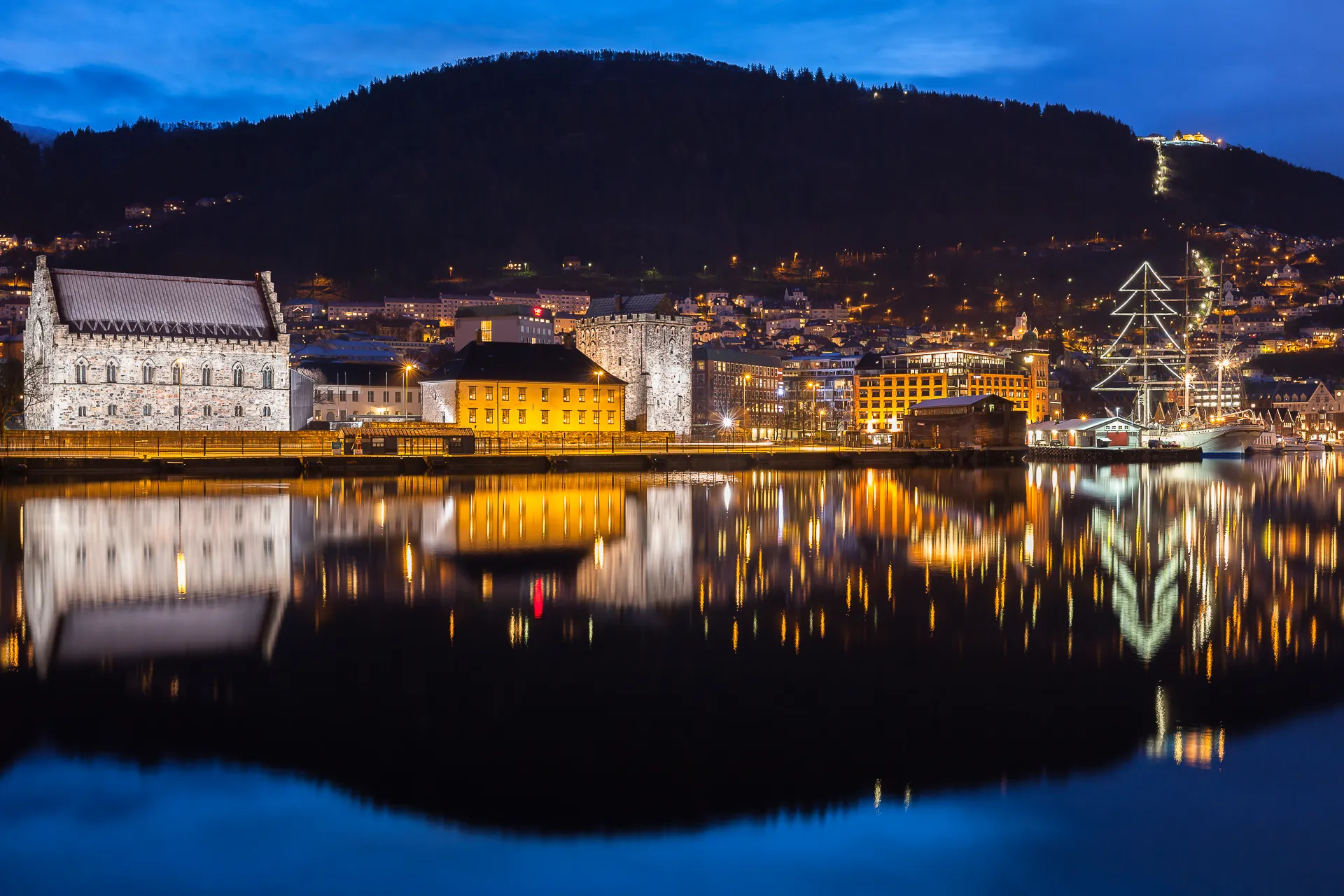
Bergenhus Fortress
Norway's medieval seat of power — a 13th-century royal hall and a Renaissance tower guarding the harbour mouth
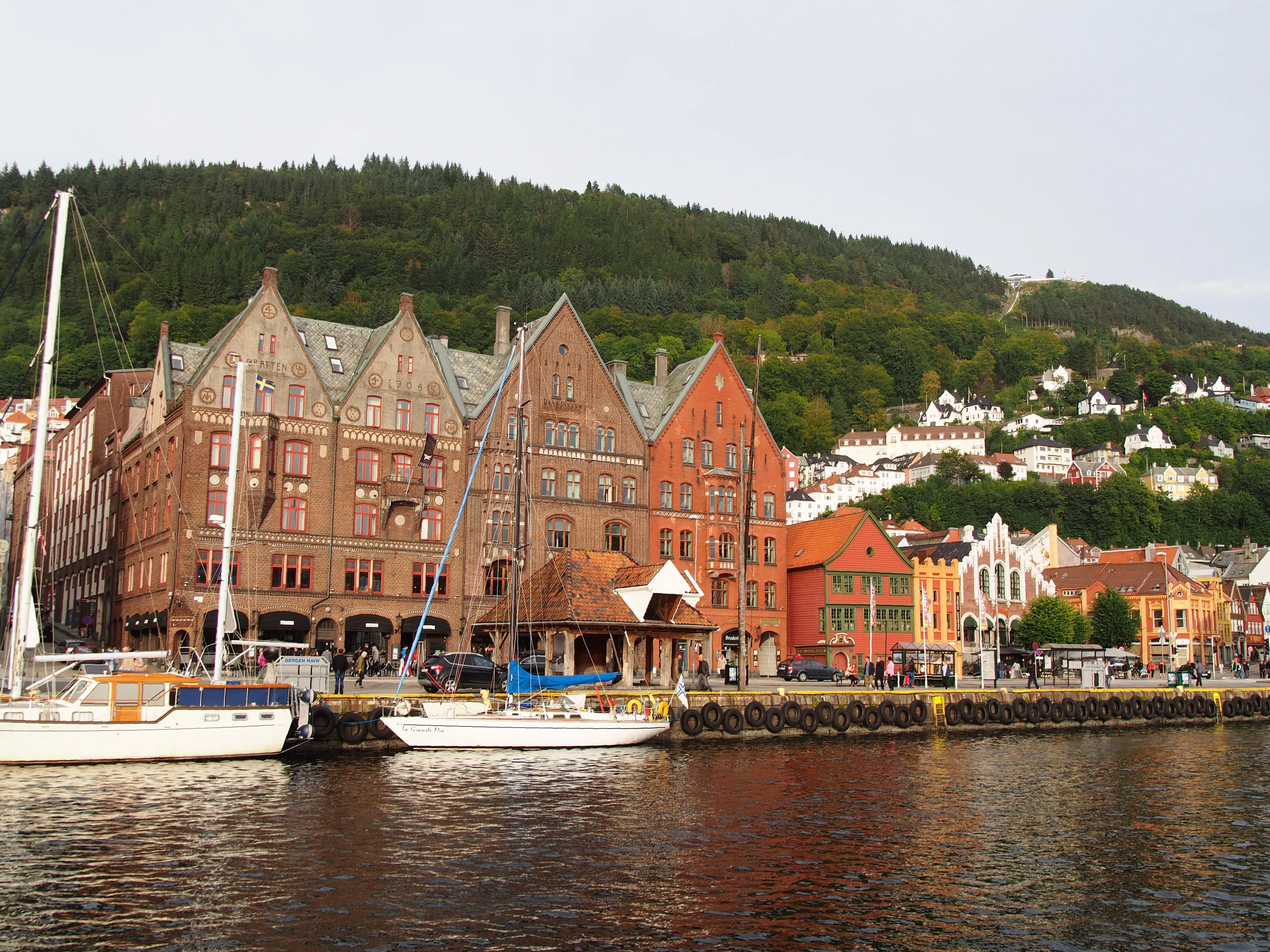
Bryggen Wharf
Bergen's UNESCO Hanseatic wharf — medieval wooden facades on the same footprint since the 14th century
Mount Fløyen & Funicular
Eight minutes above Bergen — seven mountains, a Hanseatic harbour, and fjords stretching to the horizon
Guide planning
How much does a tour guide cost in Bergen?
| Tour Type | Price | Details |
|---|---|---|
| Bryggen group walking tour (2 hrs) | NOK 250–400 per person | Licensed guide, UNESCO wharf history |
| Private city half-day (up to 6) | NOK 2,000–3,500 | Bryggen, Fløyen, Fisketorget |
| Norway in a Nutshell guided package | NOK 1,500–2,000 | Full-day fjord circuit from Bergen |
| Troldhaugen private visit + concert | NOK 200–500 per person | Museum entry + seasonal concerts |
| Bergen Card (24 hrs) | NOK 349 | Transport + Fløibanen + museums |
Book a Local Guide
The guides below are independent local businesses we recommend purely on editorial merit. We don't sell placement and we earn no commission when you book with them — see our booking and affiliate disclosure.
Season planner
When is the best time to visit Bergen?
- May–August — Best weather odds, longest days, fjord excursions running at full schedule
- Late May–early June — The Bergen International Festival (Festspillene i Bergen), Norway's largest performing-arts festival since 1953, fills Grieghallen, Troldhaugen, and Håkon's Hall with two weeks of concerts and theatre
- 17 May — Syttende mai, Norway's Constitution Day, brings flag-waving children's parades through the centre and one of the most festive days of the year to visit
- June and July — Peak summer: lively Fisketorget, ferry services at maximum frequency, and the outdoor Bergenfest music festival over four days in mid-June
- September — Crowds thin, autumn colours on the mountain slopes, fish market less hectic
- December — Bergen's Christmas market around Fisketorget is one of Norway's most atmospheric, despite the short days
- Rain at any time — Waterproofs are essential year-round; the city is fully functional regardless of weather
Spring
Mar-May
Summer
Jun-Aug
Autumn
Sep-Nov
Winter
Dec-Feb
Each score averages that season’s monthly ratings out of 5. The top-rated window is usually the peak season too, so read the guidance above for its trade-offs before you book.
On the ground
How do you get around Bergen?
- Walking — Bryggen, Fisketorget, Fløibanen, and the city centre cluster within 15 minutes of each other on foot; the old town is entirely walkable
- Bybanen light rail — Bergen's tram system connects the centre to the outer suburbs; Line 1 runs all the way to Flesland airport in about 45 minutes for a single fare of NOK 42, far cheaper than a taxi
- Arriving by train — Bergen station (Bergen stasjon) is the western terminus of the Bergen Railway from Oslo (about 7 hours) and sits a 10-minute walk from Bryggen and the harbour
- Fløibanen — Funicular from Vetrlidsallmenningen square to Fløyen summit; runs from 7:30 AM to midnight in summer
- Bergen Card — Covers Fløibanen, public transport, and entry to most city museums; available from the tourist office at Strandkaiterminalen
- Express boats & coastal ferries — Strandkaiterminalen runs fast boats to fjord villages and islands (essential for the Norway in a Nutshell route), and is a scheduled port for the Hurtigruten coastal line running north toward Ålesund and beyond
- Taxi — Fixed-rate taxis to Troldhaugen cost approximately NOK 250–300 each way from the city centre
Frequently Asked Questions
Does Bergen really rain as much as they say?
Yes — Bergen averages 231 rainy days per year, making it one of the wettest cities in Europe. The city sits in a bowl surrounded by seven mountains that trap Atlantic weather systems rolling in off the North Sea, and the Norse have a saying that Bergen has four seasons in a single day. The upside is extraordinary: the surrounding landscape is an almost supernatural shade of green, fjord waterfalls run at full strength even in summer, and Bergen's covered fish market (Fisketorget), café culture, and compact old town are designed for enjoyment in any weather. Pack a good waterproof, embrace the atmosphere, and you'll find the rain part of the city's character rather than an obstacle to it.
How do I get from Bergen to the fjords?
Bergen is the western terminus of the famous Norway in a Nutshell route — a classic circuit combining the mountain railway to Myrdal, the Flåm Railway descent (one of the world's steepest standard-gauge lines), a fjord ferry through Nærøyfjord (UNESCO World Heritage), and a bus return to Bergen. The full loop takes a full day and costs NOK 1,400–1,800 per person when booked as a package. Alternatively, express boats from Bergen's Strandkaiterminalen reach Voss in 2.5 hours and Flåm in 5.5 hours. For Geirangerfjord, most visitors fly or take the Hurtigruten coastal ferry north to Ålesund and approach from there.
What is the best way to reach the top of Mount Fløyen?
The Fløibanen funicular from the city centre climbs 320 metres in just 8 minutes, running every 15–30 minutes from 7:30 AM until midnight in summer. The return ticket costs NOK 100 for adults. Alternatively, a well-marked hiking trail through the forest takes 45–60 minutes on foot — many visitors ride up and walk down through the spruce and birch trees. From the summit, seven of Bergen's surrounding mountains are visible, along with the harbour, the archipelago of outer islands, and on clear days, fjords stretching to the horizon. A guide can point out the individual mountains by name and suggest hiking trails calibrated to your fitness level.
Why isn't Bergen the capital of Norway?
For much of the Middle Ages Bergen effectively was the kingdom's power centre. Founded around 1070, it was Norway's largest city and busiest port, and in the 13th century the royal court sat on the Holmen headland at Bergenhus Fortress, where Håkon's Hall (completed around 1261) hosted coronations, weddings, and the proclamation of King Magnus the Law-mender's national code. Power drifted east over the following centuries: the union with Denmark from 1380 pulled administration toward Copenhagen, and when Norway rebuilt its institutions around Christiania (today Oslo) in the 19th century, the eastern city became the formal capital. Bergen even remained Norway's largest city until roughly 1830, so locals will happily tell you they were the capital long before Oslo mattered — a civic pride you still hear in the Bergen dialect and the city's self-image as Norway's cultural heart.
How many days do you need in Bergen?
Two full days cover the essentials without rushing: one for the compact old town — Bryggen, the Fløibanen funicular, Fisketorget, and Bergenhus Fortress — and a second for Troldhaugen and the city's museums, or an easier fjord excursion by express boat. Add a third day if you want to run the full Norway in a Nutshell circuit, which takes a whole day from Bergen and back. Because Bergen is the western terminus of the Bergen Railway from Oslo and a hub for coastal ferries south to Stavanger and north toward Ålesund, many travellers use it as a two- or three-night base at one end of a longer fjord-country itinerary rather than a day stop.