
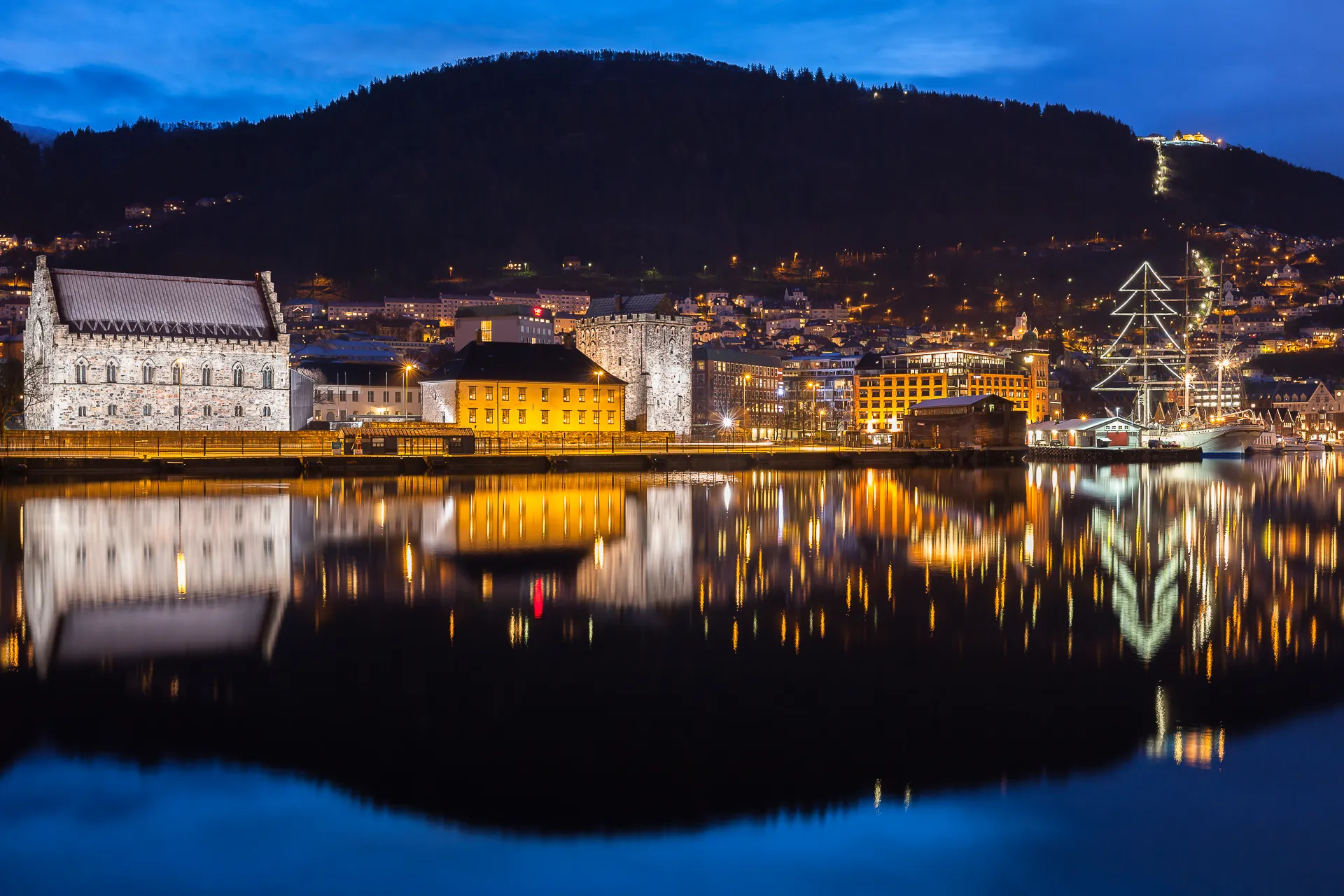
Fortification History
The Holmen headland was fortified from the 13th century, when it served as the royal residence of the Norwegian kings. The defensive character intensified under Danish-Norwegian rule: in the 1560s, governor Erik Rosenkrantz rebuilt the keep into a combined tower-house and gun platform, and successive governors added bastions, curtain walls, and powder magazines as artillery warfare evolved. The fortress saw real action — in 1665 its guns fired on an English fleet during the Battle of Vågen, when a Dutch treasure convoy sheltered in the harbour. Over the following centuries Bergenhus remained a working military installation, garrisoned through the 18th and 19th centuries and used by occupying German forces in the Second World War, before its medieval core was restored as a museum after the 1944 explosion.
Notable Rooms
The Great Hall of Håkon's Hall occupies the top floor — a soaring Gothic ceremonial space, reconstructed after 1944, where the medieval court feasted; its tall windows and timber roof recreate the setting of royal banquets. Beneath it, the undercroft and lower halls once stored provisions and housed the king's retainers. In the Rosenkrantz Tower, a tight spiral stair links a sequence of chambers: a grim dungeon at the base, a small chapel, the governor's private living quarters with their Renaissance fittings, and finally the rooftop battlements, where cannon once commanded the harbour mouth and where visitors today take in the panorama across the water toward Bryggen and the city beyond.
When to Visit
Håkon's Hall and the Rosenkrantz Tower are generally open daily in the summer season (mid-May to end of August), roughly 10 AM–4 PM, with extended access during the Bergen International Festival in late May. In the off-season the buildings keep reduced hours and are often open only on selected days — typically Sunday afternoons — so check current opening times before visiting in winter. The fortress grounds, ramparts, and lawns are open and free year-round, day and night, and make a fine walk in any weather. Best visited on a clear summer day: the tower rooftop and the seaward bastions are exposed to Bergen's frequent rain, and the harbour panorama is the highlight. Allow 1.5–2 hours for both buildings.
Admission and Costs
A combined ticket for Håkon's Hall and the Rosenkrantz Tower costs roughly NOK 160 for adults (about USD 15), with reduced rates of around NOK 80 for students and seniors; children under about 16 typically enter free. Single-building tickets are a little cheaper if you only want one. The surrounding fortress grounds are free to enter at all times. The Bergen Card usually includes admission to both museum buildings, which makes it worthwhile if you are also visiting other Bergen attractions such as the Fløibanen funicular. A private guided tour of the fortress runs roughly NOK 1,500–2,500 (about USD 140–230) for a small group of up to six.
The Case for a Guide
Bergenhus rewards visitors who understand the layers of Norwegian history compressed into a single headland. A knowledgeable guide turns two stone shells into a vivid story of kings, governors, and reconstruction.
- The age of Bergen as capital: A guide explains why Bergen — not Oslo — was the political centre of 13th-century Norway, and how Håkon's Hall fits into the consolidation of the kingdom under Håkon Håkonsson and the lawmaking of Magnus Lagabøte.
- Reading the Rosenkrantz Tower's layers: The tower fuses a medieval keep, a 13th-century royal tower, and a 1560s Renaissance residence. A guide points out where one era's masonry meets the next, making the building's complicated genealogy legible.
- The 1944 explosion and restoration: The Voorbode disaster and the meticulous post-war rebuilding are essential to understanding what is original and what is reconstructed — context that transforms how you read the interiors.
- Power and ceremony: A guide brings the empty hall to life with the rituals of medieval kingship — feasting, the seating of retainers, the reception of envoys — and contrasts it with the governor's defensive, surveillance-minded tower next door.
- The harbour view in context: From the tower roof a guide can connect the fortress to Bryggen across the water and explain how the whole harbour functioned as a single defended trading and royal space.
Tips for Visitors
Buy the combined ticket for both buildings — they are steps apart and complement each other. The Rosenkrantz Tower's spiral staircases are narrow and steep, so wear sturdy shoes and be prepared for tight, dim passages on the climb to the roof. The rooftop and seaward bastions are exposed; bring a windproof layer even in summer. Visit in the morning before tour groups arrive, and combine the fortress with a walk along the harbour to Bryggen, a 5–10 minute stroll away. In late May, the Bergen International Festival often stages concerts inside Håkon's Hall, whose acoustics are remarkable — check the programme if your visit overlaps. The grounds make a good picnic spot on a rare dry day, with lawns facing the fjord.
Frequently Asked Questions
Why is Bergenhus considered so important to Norwegian history?
During the 13th century, Bergen was Norway's capital and largest city, and the fortified royal compound on the Holmen headland was the political heart of the kingdom. The stone Håkon's Hall was completed around 1261 for the wedding of King Magnus Lagabøte ("the Law-mender"), and it was here that the royal court gathered, laws were proclaimed, and the king received foreign envoys. When you stand inside the hall you are standing in one of the very few surviving secular medieval buildings in Scandinavia where Norwegian kings actually held court — most of the era's great wooden royal halls burned and were never rebuilt in stone.
How did the fortress survive the wartime explosion of 1944?
On 20 April 1944, the Dutch cargo ship Voorbode, loaded with explosives, detonated in Bergen's harbour directly below the fortress. The blast tore the roof and interior out of Håkon's Hall and gutted the Rosenkrantz Tower, leaving both as shells. Far from being abandoned, the buildings were painstakingly restored over the following two decades, with Håkon's Hall reopening in 1961 on the 700th anniversary of its completion. What you see today is therefore a careful reconstruction of the medieval interiors atop the surviving original masonry walls.
What is the difference between Håkon's Hall and the Rosenkrantz Tower?
They represent two different eras of power. Håkon's Hall (Håkonshallen) is a tall Gothic banqueting hall from the 1250s — pure medieval royal architecture used for feasts and ceremonies. The Rosenkrantz Tower (Rosenkrantztårnet) is a fortified residence and defensive keep, built up in the 1560s by the Danish governor Erik Rosenkrantz around an older medieval tower and a royal keep from King Magnus's reign. The hall is about kingship and ceremony; the tower is about defence, surveillance of the harbour, and the governor's personal grandeur.
How much time should I set aside for Bergenhus?
Allow about 1.5 to 2 hours to do the site justice. Roughly 45 minutes covers Håkon's Hall, including its undercroft, and another 45 minutes covers the Rosenkrantz Tower, whose narrow spiral stairs lead up through dungeon, chapel, and living chambers to a rooftop with sweeping harbour views. The surrounding fortress grounds and ramparts are free to wander and pleasant for an additional stroll, especially the seaward bastions facing the fjord.