
Engineering Facts
The Earnslaw is a floating museum that still earns its keep. She runs to roughly 51 metres in length with a beam near 7 metres, and her name doubles as a specification: Twin Screw Steamer means two propellers, each turned by its own steam engine drawing from a pair of coal-fired boilers. Several details are worth watching for from the engine-room gallery on the crossing:
- Hand-fired stokehold — there is no automation below decks; the fireman reads the steam pressure and shovels coal by hand to match the engineer's demand, exactly as it was done in 1912.
- Directly reversible engines — a lake steamer has to come alongside a wharf without a reverse gearbox, so the engineers reverse the engines themselves; that is why the machinery audibly changes note as the ship manoeuvres.
- Open and hand-oiled — unlike an enclosed modern diesel plant, the reciprocating engines run in the open where they can be oiled while turning, which is precisely why a public viewing gallery is possible at all.
- Coal in, wake out — burning around two tonnes of coal on a busy day, she trails the faint tang of coal smoke that regular Wakatipu travellers recognise instantly.
The crew are generous with explanation, and a guide who can translate the thermodynamic cycle — firebox to boiler to piston to propeller — turns the engine-room window from a curiosity into the highlight of the trip.
Observation Points
The crossing is short, so knowing where to stand turns a pleasant sail into the trip's best photographs. Board early and claim your spot before the ship fills:
- Open upper deck, port (left) side outbound — the rail that faces The Remarkables on the run to Walter Peak, with the wake leading the eye toward the serrated range.
- The bow — the cleanest forward view of Walter Peak station and Cecil Peak growing ahead, and the best place to feel the ship working into a headwind.
- Engine-room gallery — not a landscape but the most distinctive frame on board: brass, steam, and the connecting rods caught mid-swing at a fast shutter speed.
- Steamer Wharf at departure — from the Queenstown waterfront the whole black-and-white hull sits against the town and the range behind, the classic postcard that Skyline Gondola riders capture from above.
- The return at dusk on the dinner cruise — the low sun turns the Remarkables pink off the stern while the Queenstown lights come up over the bow, the finest light of the day when the schedule allows.
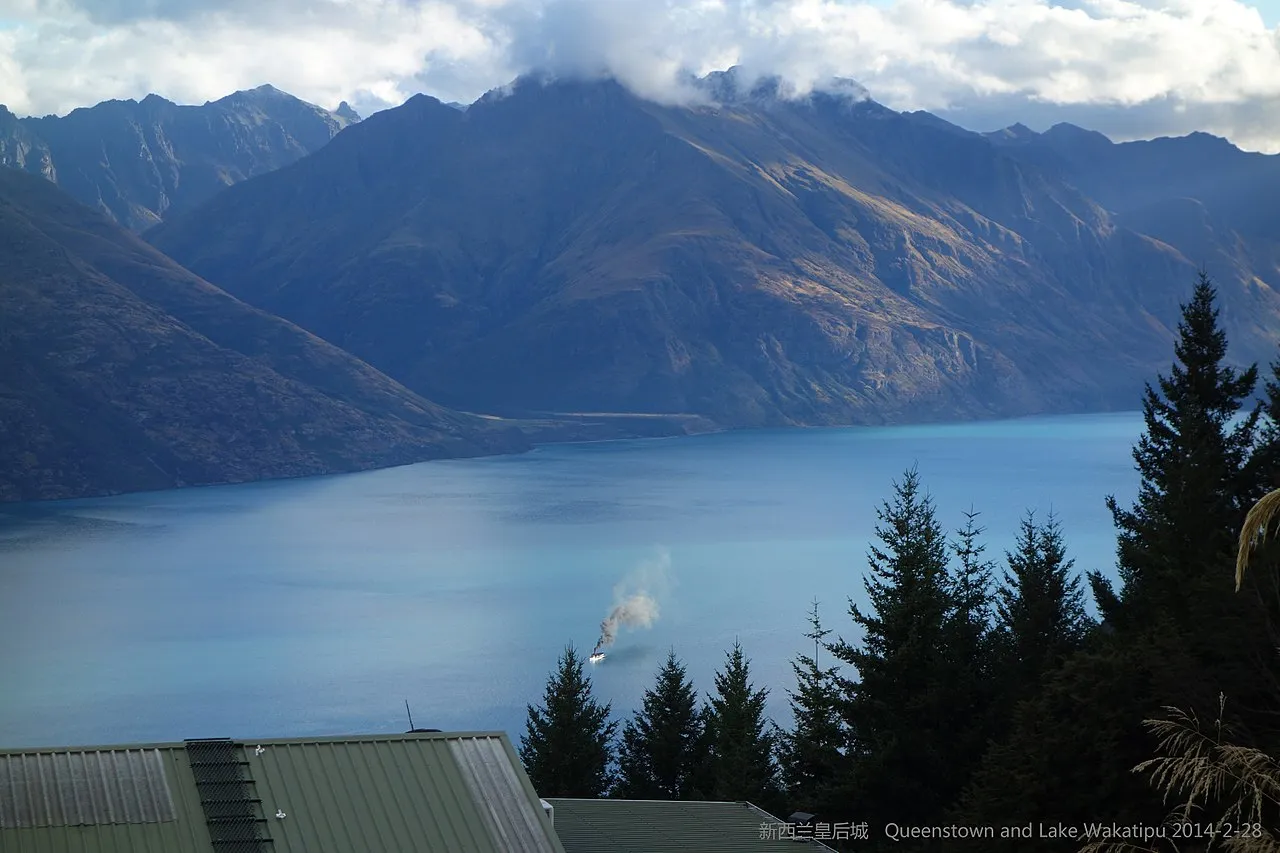
From across the water the ship is a subject in her own right: the Queenstown Hill summit looks straight down on her daily crossings, and the long day-trip road to Milford Sound begins along the same shoreline she once supplied by water.
TSS Earnslaw Steamship timeline
-
Launched at Kingston
Built in numbered sections by John McGregor & Co. of Dunedin, railed to the southern tip of Lake Wakatipu, and riveted back together on the Kingston shore to enter service in the same year the Titanic sailed.
- 1912–1960s
The lake's working lifeline
For nearly six decades the Earnslaw carried mail, cargo, sheep, and cattle to the high-country stations strung along the lake — most of which no road reached until the 1950s and 1960s.
-
Saved for tourism
When the railways moved to withdraw her, the Queenstown operator now trading as RealNZ took the ship over and turned the daily supply run into the scenic Walter Peak crossing visitors take today.
-
Centenary under steam
The Earnslaw marked 100 years of continuous service on Lake Wakatipu, still driven by her original coal-fired boilers and twin-screw engines.
When to Visit
Multiple daily sailings run year-round. The standard Walter Peak Farm Return typically departs Queenstown's Steamer Wharf at 10 AM, 12 PM, and 2 PM, each returning roughly 3.5 hours later after the farm visit, with a dinner cruise leaving around 6 PM (later in the long midsummer daylight). A shorter 1.5-hour scenic lake cruise with no farm stop runs on selected departures. Boarding opens about 20 minutes before departure, and because the gangway angle shifts with the lake level and wind it can be steep, so allow time; the main saloon deck is broadly accessible, but the open upper deck and the engine-room gallery are reached by stairs. Booking ahead is strongly recommended, particularly over summer (December–February) and the ski season (June–August), when popular sailings sell out days in advance — confirm current schedules and accessibility with the operator, RealNZ.
Admission and Costs
Fares are set by the operator and shift with the season; the figures below are typical.
- Walter Peak Farm Return (cruise + farm tour): about NZ$75–89 (US$46–54) per adult, roughly NZ$32–40 (US$20–25) per child aged 5–14.
- Walter Peak Dinner Cruise: about NZ$125–149 (US$76–91) per adult, including a three-course dinner at the Colonel's Homestead.
- Scenic Lake Cruise (steamship only, about 1.5 hours, no farm stop): about NZ$49 (US$30) per adult.
Booking through the official RealNZ site secures your preferred sailing; a limited number of dockside tickets may be released on the day but sell at higher walk-up rates and are not guaranteed in peak season. Children under five generally travel free when not occupying a dining seat.
The Case for a Guide
- Steam engineering explained — the engine room's original machinery becomes comprehensible when a guide or the ship's crew walks you through the cycle from coal-fired boiler to twin screws, and through the daily challenge of keeping 1912 technology in commercial service
- High-country farming context — the sheep-shearing and sheepdog demonstrations are far richer when a guide explains the merino wool trade, the breeds adapted to the Wakatipu basin's hard winters, and why these isolated stations relied on the Earnslaw for decades
- Lake Wakatipu's seiche — the crossing is the ideal setting to explain one of the lake's strangest traits: its surface rises and falls by roughly 10 centimetres about every 52 minutes, a standing-wave oscillation (a seiche) driven by pressure differences across the lake's 77-kilometre length — a pulse invisible to anyone who does not know to watch for it
- Historical shipping routes — a guide maps the original supply runs to stations no road reached until the 1950s and 1960s, tying the ship's story to the isolation of high-country life and to the Queenstown that grew up around the lake trade
Tips for Visitors
Secure a seat on the open upper deck early — the Remarkables from the water rank among the finest views in Queenstown, and dramatically better than from behind the saloon glass. Visit the engine-room gallery mid-crossing, while the stokers are actively feeding the firebox and the machinery is at full song. If the schedule allows, book the dinner cruise: the return at dusk, with the Remarkables turning pink and the town lights reflecting on the lake, justifies the premium. At the farm, the sheepdog demonstration is the sleeper hit — visitors with no prior interest in dogs or sheep routinely name it the highlight. Two practical notes: the crossing can be choppy in a strong nor'wester, so anyone prone to motion sickness should take something before boarding rather than mid-lake; and because the same sailings sell out in peak season, reserve online through RealNZ a few days ahead rather than gambling on dockside tickets. Pair the sail with the Skyline Gondola or the free Queenstown Hill summit walk to round out a Wakatipu day.
Frequently Asked Questions
What does the TSS Earnslaw cruise to Walter Peak include?
The standard Walter Peak Farm return sailing includes the 50-minute lake crossing each way on the steamship (during which you can visit the engine room and watch the stokers feeding the coal-fired boilers), a guided farm tour of Walter Peak high-country station demonstrating sheep shearing, cattle mustering, and working sheepdog demonstrations, and optional afternoon tea or dinner at the farm's Colonel's Homestead restaurant. The farm tour at Walter Peak runs for approximately 1 hour before the return sailing.
How old is the TSS Earnslaw?
The TSS Earnslaw was built in Dunedin in 1912, transported in sections by rail to Kingston at the southern end of Lake Wakatipu, and assembled beside the lake. It has been in continuous service for over 110 years, making it one of the oldest operating commercial passenger vessels in the southern hemisphere. The twin-screw steam engines are original and remain coal-fired, burning approximately two tonnes of coal per day of operation. The ship was designed to serve as the primary supply vessel for remote high-country stations accessible only by water.
Is the TSS Earnslaw suitable for children?
The Earnslaw is one of Queenstown's most family-friendly experiences — children are fascinated by the working steam engines visible through the engine room's viewing windows, the sheep-shearing demonstration at Walter Peak is engaging for all ages, and the open deck sailing across Lake Wakatipu with the Remarkables in view is a memorable experience without any physical demands. The crossing can be choppy in strong winds; those prone to motion sickness should take medication before boarding.
Is the TSS Earnslaw wheelchair accessible?
The main saloon deck is reached from Steamer Wharf by gangway and is broadly accessible on the level, and Walter Peak's farm buildings and the Colonel's Homestead have accessible pathways, but the ship's open upper deck and the engine-room viewing gallery are reached by internal stairs and are not step-free. The gangway angle shifts with the lake level and wind, so it can be steep at times. Travellers with mobility needs should contact the operator, RealNZ, before booking to confirm current arrangements and request boarding assistance; wheelchair spaces on individual sailings are limited and best reserved in advance.
How far in advance should I book the TSS Earnslaw?
Over the summer peak (December to February) and the winter ski season (June to August), the most popular midday and dinner sailings routinely sell out several days ahead, so booking online is strongly recommended. In the shoulder seasons of autumn and spring there is usually more same-week availability. A limited number of dockside tickets may be released on the day, but they sell at higher walk-up prices and are not guaranteed when cruise ships are in port.