
Walking Route
Walking Routes
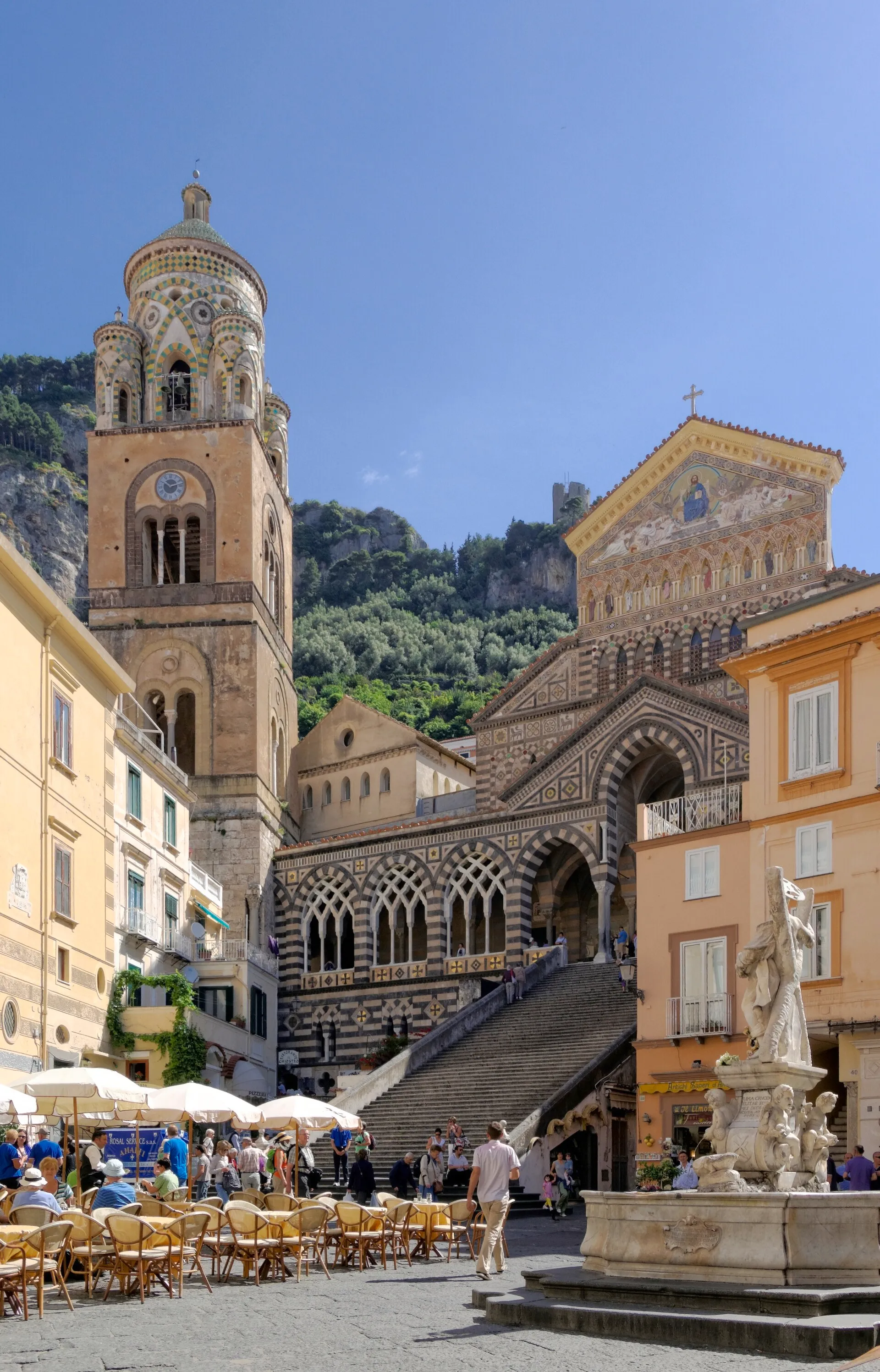
Amalfi rewards a slow wander between the sea and the hills, and the map above traces the essentials. Start in the Piazza del Duomo, where a monumental staircase of more than sixty steps climbs to the Cattedrale di Sant'Andrea.
Its Arab-Norman facade, banded in stripes of stone and crowned with geometric mosaic, is the coast's most photographed building; the bronze doors were cast in Constantinople in the 1060s, and the crypt below holds the relics of the apostle Andrew, brought here in 1208. Step off the courtyard into the Chiostro del Paradiso (Cloister of Paradise), a 1260s burial ground whose interlacing whitewashed arches and palm garden fuse Islamic and Christian design.
From the cathedral, thread down to the Marina Grande for the harbour view and the beach, then turn inland up Via delle Cartiere into the Valle dei Mulini. The working Museo della Carta occupies a medieval mill with hands-on papermaking demonstrations; keep climbing and the lane becomes a trail past the romantic ruins of abandoned paper factories.
For a short add-on, walk ten minutes east to tiny Atrani; for a half-day by boat, the Grotta dello Smeraldo (Emerald Grotto), a sea cave lit emerald-green, lies a few kilometres west toward Conca dei Marini.
Local Life
Getting to and around Amalfi is a matter of letting the boats and buses do the work:
- Ferry -- Amalfi is the coast's main harbour, with seasonal boats to Positano, Salerno, Sorrento, and Capri; the water approach skips the coast-road traffic entirely.
- Bus -- blue SITA coaches run the SS163 from Sorrento, Positano, and Salerno, and climb to Ravello in about 25 minutes.
- Private driver -- the comfortable, stress-free option from Naples or the airport.
- Parking -- limited but far easier than Positano, with a large paid lot near the harbour.
Town life still follows an old rhythm: the cathedral and shops open in the morning, the centre quiets during the afternoon riposo (2--4 PM), and the piazza fills again in the evening. Twice a year — on 27 June and 30 November — the feast of Sant'Andrea fills the square, when bearers shoulder the saint's silver statue and sprint it up the long cathedral staircase.
Amalfi timeline
-
Amalfi breaks free and becomes a duchy
Having slipped the orbit of Byzantine Naples, Amalfi sets itself up as an independent maritime duchy — among the first Italian ports to govern itself and look outward to the sea for its fortune.
- 9th–11th c.
Golden age of Mediterranean trade
Amalfitan merchants run trading colonies from Constantinople to Cairo and Tunis, dealing in gold, spices, and textiles. The town's navigational customs, the Tavole Amalfitane, become a maritime code respected across the sea.
- c. 1057–1066
Bronze doors cast in Constantinople
The great bronze doors of the cathedral are commissioned from Constantinople by a wealthy Amalfitan merchant — among the first such doors in Italy, and a measure of the town's eastern connections.
- 1135 & 1137
Pisa sacks Amalfi
Rival Pisa storms and plunders Amalfi twice in three years, breaking its naval power for good and beginning the long slide from great republic to quiet coastal town.
-
Relics of St Andrew arrive
Cardinal Pietro Capuano brings the relics of the apostle Andrew from Constantinople after the Fourth Crusade; they are enshrined in the crypt, making the cathedral a pilgrimage site to this day.
- 1266–1268
The Cloister of Paradise is built
The Chiostro del Paradiso is laid out as a burial ground for Amalfi's notables, its interlaced whitewashed arches fusing Moorish and Christian design into one of the coast's most distinctive spaces.
-
A storm devastates the lower town
A violent seaquake and storm — witnessed and described by the poet Petrarch — swallows much of Amalfi's harbour and lower quarter, confirming its retreat from Mediterranean power.
- Today
Ferry hub of a UNESCO coast
Now the most accessible and best-connected town on a UNESCO World Heritage shoreline, Amalfi is the practical base from which most visitors explore the coast by boat and bus.
When to Visit
The historic centre is open to wander year-round, and much of the pleasure is free. The Cathedral of St Andrew complex generally opens daily from 9 AM to about 7 PM, with reduced winter hours and limited visiting during services; the Paper Museum runs roughly 10 AM to 6:30 PM in season and closes on winter Mondays.
Come in the morning, before the cruise-ship and coach day-trippers arrive from about 10 AM to 3 PM, and note that shops shut for the afternoon riposo between roughly 2 and 4 PM. In high summer, an early start and a late-afternoon return by ferry are the two kindest ways to see Amalfi without the midday crush.
Admission and Costs
The town itself costs nothing to explore, and the beach has free public stretches alongside the paid lidos. Paid sights are modest: entry to the Cathedral of St Andrew complex — cathedral, Chiostro del Paradiso, crypt, and diocesan museum — is about €3 (roughly $3), and the Paper Museum about €4.50 (roughly $5).
A two-hour guided walking tour typically runs €30–50 (roughly $33–55) per person and is often bundled into wider Amalfi Coast day tours. Budget separately for ferries — a seasonal hop to Positano is about €10 (roughly $11) — and for a boat excursion to the Grotta dello Smeraldo.
The Case for a Guide
Amalfi hides far more history than its small centre lets on, which is why a knowledgeable local guide pays off here. Beyond pointing the way through the stepped lanes, a good guide turns the town back into the great republic it once was:
- The vanished empire -- how a town of a few thousand once rivalled Venice and Genoa, wrote the Mediterranean's maritime law in the Tavole Amalfitane, and lost it all to Pisa and the sea.
- Decoding the cathedral -- the Arab-Norman facade, the Constantinople bronze doors, the St Andrew relics and the "manna" tradition, and the Cloister of Paradise next door.
- The paper story -- a walk up the Valle dei Mulini with real context on carta bambagina and the craft Amalfi borrowed from the Arab world.
- The quiet corners -- neighbouring Atrani, the valley trails, and the boat launches for the Grotta dello Smeraldo.
- Honest logistics -- which ferries are actually running, where to eat away from the harbour mark-ups, and how to time a visit around the cruise-ship crowds.
Tips for Visitors
See the cathedral and Cloister of Paradise early, before the day-trip crowds land, and use Amalfi as your transport base: it has the best ferry connections on the coast, so plan routes outward from here rather than fighting the SS163 by car.
Frequent buses climb to hilltop Ravello in about 25 minutes for its gardens and long views, and the flat, compact centre makes Amalfi far friendlier than Positano for anyone with mobility concerns. Walk ten minutes east to Atrani for a quieter lunch, and for a souvenir seek out genuine handmade carta di Amalfi in the paper shops up Via delle Cartiere, away from the main square.
Frequently Asked Questions
What season is best for visiting Amalfi town?
May through September is the prime stretch, with warm Mediterranean weather for climbing the cathedral steps, swimming off the Marina Grande, and hopping ferries along the coast. June and late September strike the best balance between sunshine and manageable crowds, while July and August bring peak heat and the day-trip coaches. January and February are the quietest months, when many restaurants and hotels close and ferries run reduced winter schedules — though the mild climate still makes the historic centre pleasant for walking.
How do I get to Amalfi, and should I drive?
Do not arrive by car if you can avoid it: the SS163 coast road is narrow and slow, and parking in Amalfi is scarce and expensive. The town is instead the main ferry hub of the coast, with seasonal boats to Positano, Salerno, Sorrento, and Capri, plus blue SITA buses along the SS163 and a frequent connection up to hilltop Ravello. From Naples most visitors take a train to Salerno or Sorrento and finish the journey by ferry or bus.
How much should visitors budget for Amalfi?
The town itself is free to wander. The Cathedral of St Andrew complex — cathedral, Cloister of Paradise, crypt, and diocesan museum — costs about €3 (roughly $3). The Paper Museum in the Valle dei Mulini is about €4.50 (roughly $5), the public beach is free while private lidos charge for loungers, and a guided walking tour runs about €30–50 (roughly $33–55) per person for two hours.
Is a walking tour of Amalfi worth it?
For a town this layered, a local guide earns the fee. They unpack how this tiny port once rivalled Venice and Genoa and wrote the Mediterranean's maritime law, decode the Arab-Norman detail and the St Andrew relics inside the cathedral, and lead you up the Valle dei Mulini to the surviving paper mills with real context on the craft Amalfi borrowed from Arab traders. Most tours also sort out ferry timetables and the quieter corners of neighbouring Atrani.