
Xi'an & the Terracotta Army Tours
How to tour Xi'an and the Terracotta Army — the three excavation pits, getting to the site from the city, the ancient City Wall by bike.
Read the full guideUpdated · 9 min read
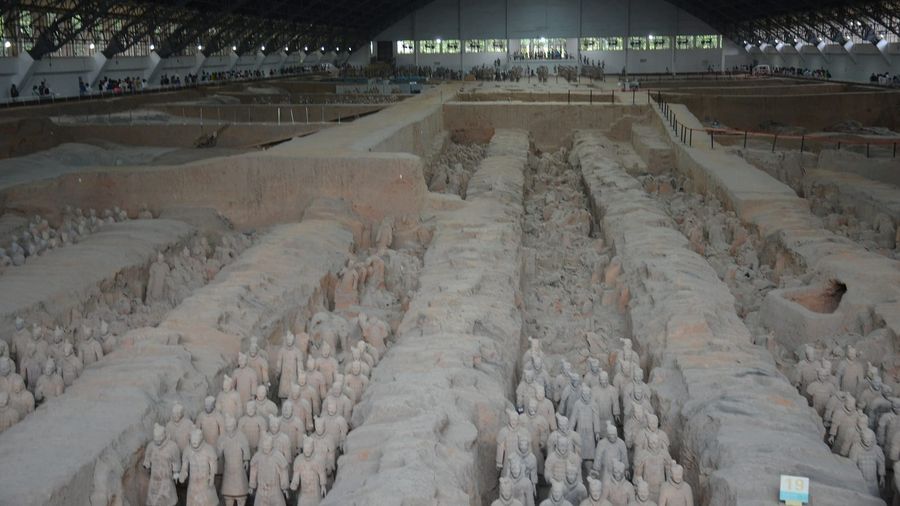
Tour the Terracotta Army as a full day: it lies about 40 kilometres east of Xi'an, holds three excavation pits, and deserves three to four hours. Reach it by public bus 游5 (306), a metro-plus-shuttle, or a guided car that folds in Huaqing Palace. Save a second day for the City Wall and Muslim Quarter.
For a thousand years Xi'an was the greatest city in the world — the eastern terminus of the Silk Road and the capital of a succession of Chinese dynasties, including the first emperor who unified the country. That emperor, Qin Shi Huang, left behind the attraction that draws millions to this corner of China today: an entire army of life-sized terracotta soldiers, buried for over two thousand years to guard him in the afterlife and rediscovered by well-diggers in 1974. A visit to Xi'an pairs that astonishing site outside the city with one of China's best-preserved historic centres inside its ancient walls. This guide covers how to tour the army, what else to see, and how to put a day together.
What Will You See at the Terracotta Army?
More than 8,000 soldiers, 130 chariots, and 670 horses, each warrior individually modelled, arranged in battle formation in three pits where they were found. Pit 1 is the showstopper, a hall the length of two football pitches; Pit 2 shows work in progress; Pit 3 is the command post. Allow three to four hours.
The Terracotta Army lies about 40 kilometres east of the city, and it is one of the great archaeological discoveries of the twentieth century. More than 8,000 soldiers, 130 chariots, and 670 horses were modelled in clay, each warrior with individual features, and arranged in battle formation to accompany the first emperor into death. They are displayed where they were found, in three excavation pits under aircraft-hangar roofs.
Pit 1 is the showstopper: a vast hall the length of two football pitches, with rank upon rank of restored infantry standing in their corridors, stretching back into the still-unexcavated earth. Pit 2 shows the work in progress — cavalry, archers, and figures half-emerged from the soil, with a few star warriors displayed in glass cases at eye level. Pit 3 is the small command post. An exhibition hall nearby holds the exquisite bronze chariots. Allow three to four hours, start at Pit 1 before the tour buses fill it, and remember that the figures were originally painted in bright colours that flaked away within minutes of exposure to air — part of why so much remains deliberately unexcavated.
Getting there is straightforward but fiddly: public bus 游5 (306) from the railway station takes about an hour, or a guided tour or hired car removes the connections and usually folds in the Huaqing Palace hot springs and the first emperor's enormous unexcavated tomb mound, both on the same road.
Is the Xi'an City Wall Worth Visiting?
Very much so. The Ming-dynasty rampart is the most complete ancient city wall in China, a 14-kilometre rectangle wide enough to drive along. The classic thing to do is rent a bike at one of the gates and cycle the full circuit in a couple of hours, best at sunset when the wall is illuminated.
Back in town, the headline sight is the Xi'an City Wall, the most complete ancient city wall in China. The Ming-dynasty rampart forms a 14-kilometre rectangle around the old city, wide enough on top to drive along, and the classic thing to do is rent a bike at one of the gates and cycle the full circuit in a couple of hours. From up there the geometry of the old imperial capital makes sense — the grid of streets, the drum and bell towers at the centre, the modern city pressing in beyond the moat. Sunset and the evening illumination are the prettiest times to ride.
Why Visit Xi'an's Muslim Quarter?
It is the warren of lanes behind the Drum Tower, home to the city's Hui Muslim community for over a thousand years and a living legacy of Xi'an's Silk Road centuries. Come hungry in the evening for biang biang noodles, roujiamo, spit-roasted lamb, and pomegranate juice, and visit the serene Great Mosque at its heart.
No visit to Xi'an is complete without the Muslim Quarter, the warren of lanes behind the Drum Tower that has been home to the city's Hui Muslim community for over a thousand years — a living legacy of Xi'an's Silk Road centuries. It is at its best in the evening, when the food streets light up: hand-pulled biang biang noodles, roujiamo (the "Chinese hamburger" of stewed meat in a flatbread), spit-roasted lamb, persimmon cakes, and pomegranate juice pressed to order. At its heart is the Great Mosque, one of the oldest and largest in China, built in a serene Chinese architectural style with courtyards and a pagoda-like minaret rather than domes. Come hungry and wander.
What Is There to See at the Giant Wild Goose Pagoda?
Built in 652 to house Buddhist scriptures brought from India by the monk Xuanzang, the seven-storey Giant Wild Goose Pagoda is a serene Tang-dynasty survivor anchoring the southern city, when Xi'an — then Chang'an — was the largest city on earth. The plaza stages one of Asia's biggest musical fountain shows each evening.
For a quieter half-day, the Giant Wild Goose Pagoda anchors the southern part of the city. Built in 652 to house Buddhist scriptures brought back from India by the monk Xuanzang — whose pilgrimage inspired the classic novel Journey to the West — the seven-storey brick pagoda is a serene survivor of the Tang dynasty, when Xi'an (then Chang'an) was the largest city on earth. The plaza in front stages one of Asia's biggest musical fountain shows in the evenings, and the surrounding Tang-themed district is pleasant for a stroll.
How Do You Put a Xi'an Itinerary Together?
The efficient plan is a full day for the Terracotta Army and its roadside companions, then a second day for the wall, the Muslim Quarter, and the pagoda, which cluster in or beside the old city. With only one day, do the army in the morning and the wall and Quarter in the late afternoon and evening.
The efficient plan is a full day for the Terracotta Army and its road-side companions, and a second day for the wall, the Muslim Quarter, and the pagoda, which all sit within or beside the old city. If you only have one day, do the army in the morning and the wall and Muslim Quarter in the late afternoon and evening. Spring and autumn are the kindest seasons; Xi'an summers are hot and the winters cold and grey, though the indoor pits are climate-controlled year-round.
Why Is a Guide Worth It at the Pits?
Because the pits have sparse signage and the figures give up little without context — how they were sculpted on a production line of standardised parts and individual faces, why they were smashed and burned soon after burial, how farmers found them in 1974. A guide also threads the army, hot springs, and tomb mound into one smooth day.
The Terracotta Army is the textbook case for a guide. The pits themselves have sparse signage, and the figures, extraordinary as they are, give up little of their story without context — how they were sculpted on a production line of standardised parts and individualised faces, why they were smashed and burned soon after burial, how farmers stumbled on them while digging a well in a drought. A licensed guide or a strong audio guide turns rows of statues into a window onto the ambition and paranoia of the man who first unified China. Guides also solve the logistics, threading the army, the hot springs, and the tomb mound into one smooth day and getting you to Pit 1 ahead of the coach crowds. In the city, a half-day walking guide unlocks the layered history of the wall and the Silk Road quarter far faster than wandering alone.
Related Guides
- Bangkok Temple Tours — temple-hopping logistics for travellers combining China with Southeast Asia
- Visiting the Taj Mahal — another monumental world wonder where timing beats the crowds
- Getting Around Tokyo: A Practical Transport Guide — transit sense for a wider East Asia itinerary
Xi'an offers a rare double: a buried army that rewrote what we knew of ancient China, and a walled city you can cycle around in an afternoon. Give the Terracotta Army its full day and a knowledgeable guide, ride the wall at dusk, eat your way through the Muslim Quarter, and the old capital of the Silk Road delivers far more than its single famous sight.
Frequently Asked Questions
How do you get to the Terracotta Army from Xi'an?
The site is about 40 kilometres east of the city near Lintong. The cheapest way is public bus 游5 (306) from Xi'an Railway Station, taking around an hour; a metro-plus-shuttle combination also works. Many visitors join a guided day tour or hire a car-and-driver, which removes the connections and usually bundles the nearby Huaqing Palace hot springs.
How long do you need at the Terracotta Army?
Allow three to four hours on site. There are three excavation pits plus an exhibition hall, and Pit 1 — the vast main hall of massed warriors — alone deserves an unhurried visit. With travel time from the city, the whole outing is comfortably a full day, especially if you add Huaqing Palace or the tomb mound on the way.
Is the Xi'an City Wall worth visiting?
Very much so. Xi'an has the most complete ancient city wall in China, a 14-kilometre rectangle you can walk or, better, cycle the full circuit of in about two hours. Renting a bike on top of the wall is one of the most enjoyable things to do in the city and gives a real sense of the old imperial capital's scale.
Do I need a guide for the Terracotta Army?
The pits have limited signage and the story — how the army was made, buried, and rediscovered by farmers in 1974 — is not obvious from the figures alone. A licensed guide or a good audio guide makes the difference between rows of statues and a window into the first emperor's China. Guides also handle the transport and timing, which simplifies the day considerably.