
Terracotta Army timeline
- 246 BCE
Mausoleum begun
Work started on Qin Shi Huang's tomb complex soon after he took the Qin throne as a boy of thirteen.
- c. 210 BCE
Army sealed underground
The pits were closed at the First Emperor's burial and lay hidden for more than two thousand years.
-
Farmers strike the first figure
Well-diggers in Lintong District unearthed fragments of a warrior, exposing the buried army.
-
Pit 1 opens to visitors
The great infantry hall became the centrepiece of the new site museum.
-
UNESCO World Heritage listing
The Mausoleum of the First Qin Emperor was inscribed on the World Heritage List.
Key Artifacts
Beyond the massed ranks, a handful of individual finds repay slow attention. The pair of bronze chariots unearthed in 1980 about 20 metres west of the burial mound are the museum's centrepiece: cast at roughly half life size, the second — the covered "comfortable chariot" (anche) — was assembled from more than 3,400 separate parts, including hundreds of gold and silver fittings, a functioning umbrella canopy, and reins so finely modelled they look ready to snap taut. In Pit 2, the kneeling archer is the best-preserved warrior yet recovered — low to the ground and shielded by collapsed roofing, he survived the fires that damaged the rest and still shows traces of the pink flesh tone and patterned armour that once covered the whole army. Hunt too for the site's true anomaly, the single green-faced warrior lifted from Pit 2, whose jade-green complexion has never been convincingly explained — folk ritual, workshop whim, and faded pigment are all still argued over. Look, then, at the ranked figures and how uniform encodes hierarchy: armoured generals with tall twin-knot headdresses and curl-toed shoes, kneeling and standing crossbowmen, charioteers with arms outstretched to hold vanished reins, and light infantry in plain tunics, every rank fixed by Qin military regulation. The bronze weapons found among them — swords, halberds, and tens of thousands of arrowheads — were cast to standardised patterns, and some emerged sharp and bright; long credited to a deliberate anti-rust chromium coating, that gloss was reattributed by a 2019 study to the dry, alkaline soil rather than any Qin plating technique, a debate a good guide can bring to life at the display case.
Excavation History
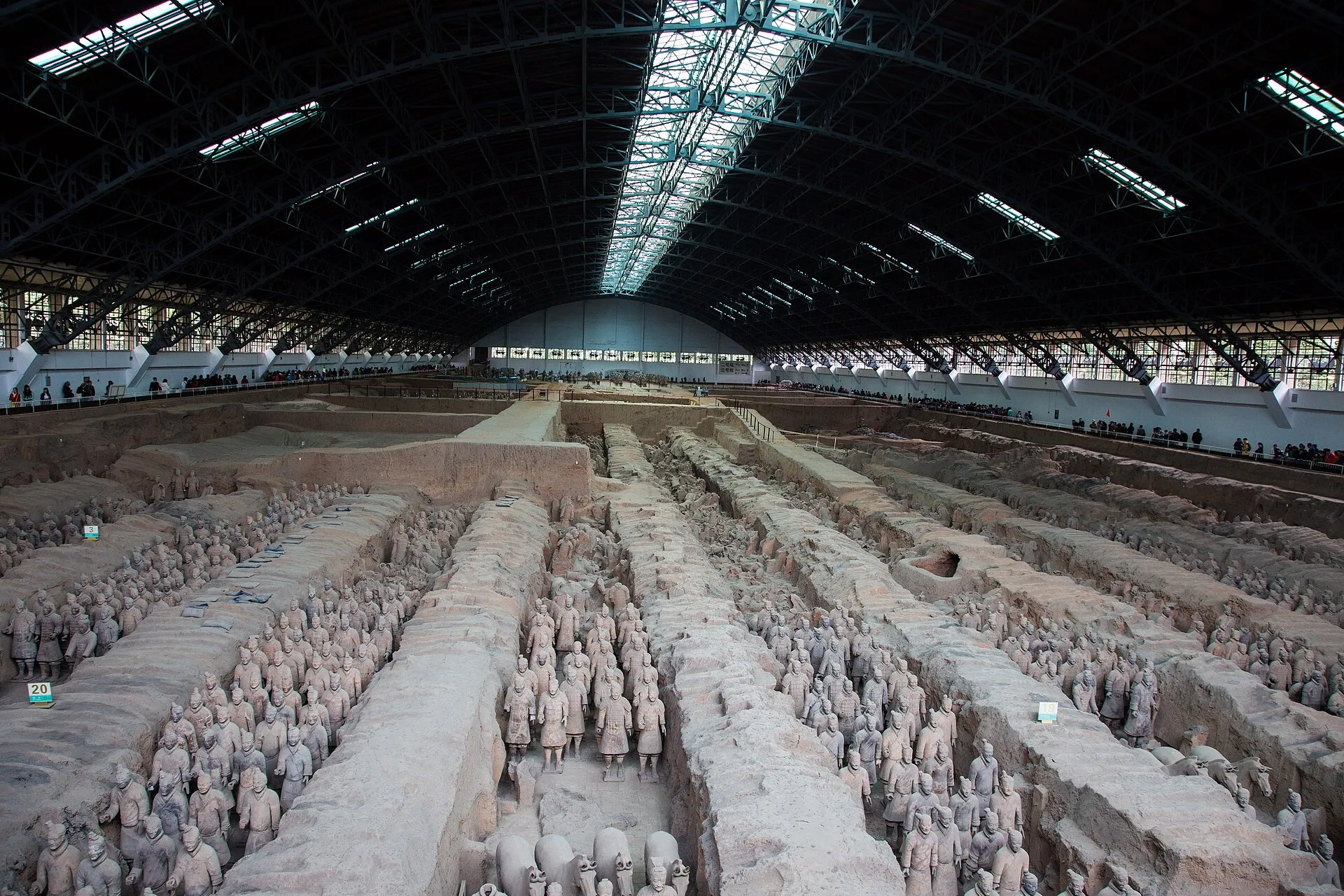
The site divides into three pits opened progressively after 1974. Pit 1, the grand infantry formation, is the largest at about 230 metres long and holds an estimated 6,000 figures in eleven parallel corridors; it opened to the public in 1979 and delivers the single most overwhelming first impression in Chinese archaeology. Pit 2, found in 1976, is more intricate — cavalry, kneeling and standing archers, and war chariots arranged in four interlocking units that show how a Qin army actually manoeuvred. Pit 3, the smallest, reads as the command post, with high-ranking officers grouped around a single chariot. A fourth pit was also dug between Pits 2 and 3 but found empty, apparently abandoned unfinished when the Qin dynasty collapsed within a few years of the First Emperor's death. Ancient sources say the wider mausoleum took some 700,000 conscripts and craftsmen decades to raise. Yet the heart of the complex remains sealed: the First Emperor's actual burial mound, half a kilometre west, has never been excavated, as Chinese archaeologists prefer to wait for methods that can protect whatever lies inside. The historian Sima Qian, writing about a century later in the Records of the Grand Historian, described rivers of mercury flowing through a scale model of the empire beneath the mound — and modern soil surveys have detected mercury far above natural levels exactly where his text predicts, one of archaeology's most striking meetings of ancient writing and hard data.
When to Visit
The complex is open daily, 8:30 AM – 5:00 PM (last entry 4:30 PM), and because the pits are sheltered indoors the weather barely touches the visit itself. The rhythm of the day matters more than the season: coach groups from Xi'an flood Pit 1 through the late morning, so aim to be at the gate for opening or to arrive after 2:00 PM, once the morning tours have moved on. Spring (April–June) and autumn (September–October) bring the most comfortable conditions for the open-air stretches between the entrance, pits, and museum, while July and August are hot and busy with domestic holiday crowds. Winter keeps the halls quiet, though the hour-long ride out from the city can be bitterly cold in January and February.
Admission and Costs
A single ¥120 (about $17) ticket covers all three pits and the exhibition hall, with no separate charge for the bronze chariots. A free shuttle bus loops between the entrance, the pits, and the mausoleum mound, saving a long walk. The official audio guide costs ¥30 (about $4) and is available in English, though it cannot match a live guide at the roped-off pits. Reaching the site from Xi'an, public bus 306 (¥7, about $1) from near the railway station is cheap and direct, while a private car runs roughly ¥200–400 ($28–56) round trip. Licensed guides typically start from about ¥300 ($42) for a small group; agree the scope and price before you set off.
The Case for a Guide
The Terracotta Army is viewed from elevated walkways with no labels explaining what you are actually looking at — everything that makes the site extraordinary comes through the guide standing beside you.
- Original polychrome paint traces: Freshly excavated warriors emerge from the earth still coated in lacquer and mineral pigments — including the synthetic "Chinese purple" the Qin manufactured centuries before Europe — that oxidise and curl away within minutes of exposure to air; guides explain the decades-long conservation partnership with German museum scientists that developed the stabilising treatment now saving those fragments, and point to the small preserved sections where colour survives.
- Individual face uniqueness theory: Each warrior's face, hairstyle, ear shape, and expression appears distinct; guides explain the archaeological debate over whether real soldiers served as models or whether artisans simply varied facial features systematically, and what the distinction means for how we understand Qin imperial organisation.
- The still-buried main tomb and why it waits: Emperor Qin Shi Huang's actual burial mound lies half a kilometre away, still unexcavated; guides explain that Chinese archaeologists have chosen to leave it sealed until preservation technology improves, describe what soil mercury readings suggest about the interior, and explain the political and cultural weight of disturbing the First Emperor's rest.
- Mercury river legend vs. modern soil analysis: The historian Sima Qian wrote of rivers of mercury inside the tomb; modern soil sampling has detected mercury concentrations hundreds of times above background levels in precisely the locations his text describes; guides explain what this extraordinary correlation between ancient text and scientific data reveals.
- Different warrior ranks identified by uniform: Generals wear elaborate armour with curled-toe shoes and tall knot hairstyles; infantry wear flat-soled shoes and shorter styles; cavalry differ again; guides point out these rank distinctions at ground level and explain the strict Qin military hierarchy they encode.
Tips for Visitors
A few habits separate a rushed stop from a memorable one. Walk into Pit 1 first, while your sense of scale is fresh, then work through Pits 2 and 3 and finish in the exhibition hall with the bronze chariots. Bring binoculars or a zoom lens — the roped viewing distance hides the facial detail that makes the army extraordinary. Budget three to four hours; an hour leaves no time for the quieter pits or the museum. Ignore the unlicensed guides who crowd the gate and book instead through your hotel or a reputable agency. And eat before you arrive: the on-site food is overpriced and forgettable, so start with a proper breakfast in Xi'an, ideally in the Muslim Quarter.
Frequently Asked Questions
When is the best season to see the Terracotta Army?
Because the warriors stand inside enormous roofed halls, the season affects your comfort more than the view. April to June and September to October bring mild weather and lighter crowds; midsummer is hot and packed with domestic tour groups, while winter stays quiet indoors even though the ride out from Xi'an can be freezing in January and February. Whatever the month, the time of day matters most: arrive at opening or in the mid-afternoon.
What is the entrance fee for the Terracotta Army?
A single ¥120 (about $17) ticket admits you to all three pits and the exhibition hall, including the bronze chariots, with no extra charge to see any part of the site. The official English audio guide adds ¥30 (about $4), and a licensed live guide for a small group typically starts around ¥300 ($42). The shuttle bus between the pits and the mausoleum mound is free.
How much time should you plan for the Terracotta Army?
Allow three to four hours on site. Pit 1 alone deserves 45 minutes to an hour, and rushing means skipping the tactical detail of Pit 2, the command post in Pit 3, and the finely cast bronze chariots in the exhibition hall. Add roughly an hour each way for the journey between central Xi'an and Lintong District.
Is a guide recommended for visiting the Terracotta Army?
Strongly, yes. The pits are roped off and viewed from raised walkways with almost no labelling, so the vanishing paint chemistry, the rank distinctions between the figures, the still-sealed imperial tomb, and the mercury findings all reach you through narration rather than signs. A licensed guide also steers you clear of the unlicensed touts who work the entrance.
What is the best order to explore the three pits?
Start with Pit 1, the vast infantry hall, while your energy and sense of awe are at their peak. Move next to the more intricate Pit 2 with its cavalry and archers, then the small command-post Pit 3, and save the exhibition hall and its two bronze chariots for last.